A hotel central reservation system, or CRS, keeps room availability, rates and bookings aligned across sales channels. For an independent or mid-sized hotel, that shared view can save staff from updating each channel by hand and reduce the risk of selling the same room twice.
On a busy Friday, a guest books through a third-party site while the front desk still sees the room as available. Someone then has to call the guest with bad news. A CRS gives your team one place to manage what is for sale, at what price and on which channels, so staff time and distribution costs are easier to control. Guests notice the results from their first interaction, including whether booking and Wi-Fi access are straightforward.
Why Hotels Need a Central Reservation System
Your phone rings at 6 p.m. A guest is in a taxi, confirmation in hand, and your team can't find a room for her because the same room type sold on your website ten minutes earlier. That's not a staff effort problem. It's a synchronization problem.
Think of a central reservation system, or CRS, as the front desk whiteboard that every sales channel can read at the same time. When a room sells, the board updates. When a guest cancels, the room goes back on sale. When you change a rate for Saturday, every connected channel should show the same price and rules.
Signs your inventory is slipping out of sync
Most general managers recognize the symptoms before they name the cause.
- Overbookings on peak nights: Two channels sell the last room because neither updated quickly enough.
- Mismatched rates: The same room shows different prices on different sites on the same night, and guests screenshot the cheaper one.
- Copying between screens: Staff retype reservations from email or an extranet into the property system, and small errors creep in.
- Closed rooms that stay open: You close a room type for maintenance, but it keeps selling somewhere else.
If your team checks three screens to answer one availability question, you don't have one source of truth yet.
The pressure grows with every channel you add. One direct website is manageable by hand. Add online travel agencies, a global distribution system for travel agents, metasearch, and group enquiries, and manual updates can't keep pace with bookings and cancellations arriving around the clock.
A CRS also protects the guest experience after booking. Accurate availability means fewer relocation calls, clearer confirmation details, and fewer surprises at check-in. That's why reservation control connects directly to practical ways to improve guest satisfaction, not just to back-office efficiency.
You don't need a CRS because it's fashionable technology. You need one when the number of places you sell rooms has outgrown the number of updates your team can safely make by hand. Once that gap appears, every busy weekend tests it.
How Hotel CRS Technology Evolved from Airlines
Hotels didn't invent this idea. Airlines did, because they faced the same puzzle earlier. A seat on a flight is perishable inventory, just like a room night. If it isn't sold by departure, the revenue is gone, and if it's sold twice, someone has a bad day at the gate.
From airline seats to hotel rooms
The concept emerged in the 1950s through collaboration between American Airlines and IBM, and early computerized reservation systems appeared in the 1960s, as traced in the history of how hotel CRS platforms evolved from airline systems. Hotels began adopting comparable technology during the 1970s. At first, that mostly meant computerizing what reservation offices already did by phone and paper.
The bigger change came in the 1990s. Systems started connecting rates and room inventory across multiple sales channels, rather than holding reservations in one isolated office. A rate change could travel. Inventory could be shared instead of split into separate piles for each outlet.
Then the 2000s added hotel brand websites and online travel agencies as major digital routes to guests. Properties could sell directly to consumers and reach international markets without relying only on phone reservations or travel agents. Each new route made central coordination more valuable, because each new storefront needed the same accurate stock count.
The milestone that still explains the product
The key milestone wasn't putting reservations on a computer. It was moving from isolated, property-level reservation handling to interconnected, multi-channel inventory management. That shift laid the foundation for links among the CRS, the property management system (PMS), global distribution systems, hotel websites, and online travel agencies.
A useful way to judge any modern system: Ask whether it's a booking diary with connections added later, or a coordination layer built to keep many channels in agreement.
That history helps you read vendor claims clearly. A modern CRS for hotels is more than a database of names and dates. It's the layer that coordinates availability, pricing, reservations, and distribution across direct and third-party channels, so a change in one place doesn't leave stale offers selling somewhere else.
Airlines taught hospitality a simple lesson. Centralize the inventory count, distribute it widely, and keep every seller reading from the same page. Hotels adapted that lesson to room types, rate plans, packages, and stay restrictions, which is where the daily complexity now lives.
Core Features Every Hotel CRS Should Include
Think of the CRS as a master control room for selling rooms. The PMS runs the stay once the guest is in-house. The CRS decides what's offered to the world before that point, and it keeps those offers consistent.
The working parts, one by one
Reservation handling is the inbox and filing cabinet combined. Bookings arrive from your website, agencies, and other channels, and the CRS records dates, room type, rate plan, and source in one format. Without it, your team becomes the integration, retyping details and hoping nothing gets missed during a busy check-in.
Real-time availability is the live stock count. Sell a room and the count drops everywhere. Cancel a booking and it rises again. Without that immediacy, you're selling from yesterday's count, which is how overbookings happen on your busiest nights.
- Rate and restriction management: You set prices, minimum stays, closed-to-arrival rules, and cancellation terms centrally. Without central control, the same room can carry different prices in different places, and guests lose trust quickly.
- Inventory control: You decide how many rooms each channel can sell and when to stop. That lets you protect direct availability on high-demand dates instead of giving every channel unlimited access.
- Distribution management: The CRS pushes offers to direct channels, online travel agencies, and global distribution systems, and pulls reservations back in.
Sound revenue decisions depend on those controls working together, which is why CRS selection sits close to your wider hotel revenue management strategies rather than in IT alone.
Why group bookings get special treatment
A wedding block isn't twenty separate reservations that happen to share a surname. Groups need room holds, release dates, and pricing rules that single bookings don't. You hold rooms until a cut-off date, then release unsold rooms back to general sale automatically. If your CRS handles groups poorly, staff track blocks in spreadsheets, and held rooms either vanish from sale too long or get sold twice.
Ask vendors to demonstrate a group block with a release date during your evaluation, not just a simple single-room booking. The awkward cases reveal the real system.
Facilities with mixed operations face similar coordination questions, and managers who run accommodation alongside leisure facilities often compare software for golf clubs using the same logic of matching features to how their venue sells time and space.
Prioritize by property size. A small independent may lean hardest on availability and distribution. A group with events business needs strong group tools. Every property, though, needs the basics to agree with each other, because one weak feature usually breaks the others.
Integration Points with PMS, OTAs and Payment Gateways
A CRS rarely works alone, and many projects get harder than the sales demo suggested. Your CRS sits between the PMS, online travel agencies, your website, revenue tools, and payment gateways. Each connection needs a clear owner for each type of data, or two systems will overwrite each other.
The CRS should function as the portfolio-level source of truth for reservations, availability, rates, inventory, group bookings, and distribution, while synchronizing with each PMS, a model described in Oracle's CRS integration business context for hospitality systems. That guidance separates reservation, rate, price-availability, inventory, profile, and distribution interfaces, which tells you something important. A well-designed architecture uses domain-specific APIs, not one generic booking endpoint.
Who owns each piece of data
| Data object | Typical owner | Why ownership matters |
|---|---|---|
| Operational stay record | PMS | Front desk needs one record for check-in, room moves, and billing |
| Portfolio distribution rules | CRS | Channels need consistent offers across properties |
| Pricing and restrictions | Revenue management system | One pricing source prevents conflicting rate updates |
| Room and rate master data | Agreed before go-live | Mismatched codes break reservations and availability checks |
Many hotels connect through Opera Micros and similar property systems, and the practical details of enhanced integration with Opera Micros and Cisco Meraki show why the reservation record and the guest-facing systems need to share accurate stay data.
Payment gateways depend on that accuracy too. A gateway can't take the right deposit or process a cancellation refund correctly if the reservation amount, taxes, or cancellation rule arriving from the CRS is wrong. If you're reviewing how payment connections are structured, integrating card and crypto with Suby is a useful reference for how gateway APIs expect clean, consistent transaction data.
Map first, then test like a skeptic
Before enabling reservations, map room types, rate plans, market codes, source codes, taxes, packages, and cancellation rules between systems. This unglamorous work is where accuracy is won or lost.
Then run one acceptance test. Change a rate, a restriction, and room inventory in the designated source system. Verify every connected channel receives the same effective date, occupancy rule, and sell limit, with no duplicate or stale offers. If a vendor can't pass that test in front of you, don't go live on a promise.
Choosing a CRS by Property Type and Sector
Scale changes what "good" looks like. In a 2022 global hospitality distribution study, 89% of large hotel chains had adopted a CRS-centric distribution strategy, while 33% of medium-sized chains and 58% of small chains still used the PMS as their primary distribution system, according to research on the CRS becoming the central hub of hotel distribution. Channel counts explain much of that gap. Large chains averaged 26 third-party channels, medium-sized chains 23, and small chains 12.
What differs by property type
Large chains need portfolio control. Head office sets distribution rules, properties adjust to local demand, and the CRS keeps both layers from colliding. With that many channels, PMS-led distribution usually can't coordinate everything.
Mid-sized groups sit in the awkward middle. You've outgrown manual updates, but you don't have a large central team. Your priority is integration depth with your existing PMS and honest estimates of staff time for mapping and testing.
Independent hotels often need reach without headcount. Centralized connectivity can give you distribution comparable to larger brands, but only if the system is simple enough for a small team to run daily. A phased approach, starting with your highest-volume channels, often beats connecting everything at once.
Questions that work for every shortlist
- Channel fit: Does it connect to the channels you sell through now, plus the ones in your two-year plan?
- Integration depth: Is the PMS link real time and two-way, and who owns each data object?
- Staff capacity: How many hours of mapping, testing, and training should you budget?
- Total cost: What do integration charges, transaction fees, and support add to the licence?
- Group support: Can it handle blocks, holds, and release dates if events matter to you?
Keep guest-facing tools in their proper lane while you decide. Splash Access, for example, handles guest Wi-Fi access, captive portals, and visitor data capture on Cisco Meraki networks. It complements a CRS rather than replacing one, since it doesn't manage room inventory or distribution.
That distinction matters when you scan current hospitality technology trends and vendors blur categories. Buy the CRS for reservation control. Buy guest network tools for connectivity. Then make sure they share data cleanly where the guest journey needs it, such as recognizing an in-house guest at Wi-Fi login.
Captive Portal and Authentication Options for Guest Wi-Fi
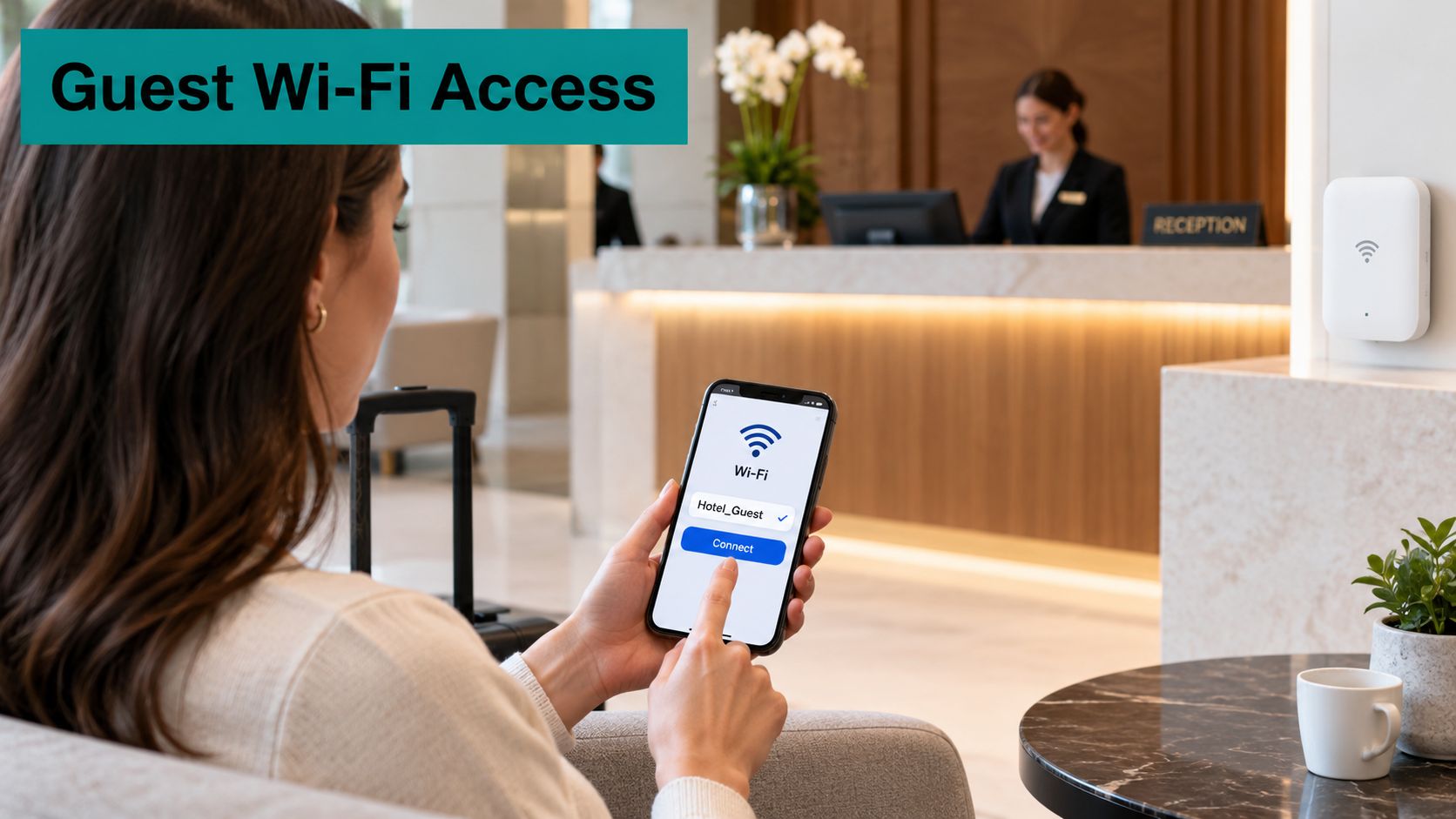
Your CRS handles the booking, but the first technology a guest encounters is usually your Wi-Fi. A captive portal is the login page a device sees before it gets online. On a Cisco Meraki network, that page can carry your branding, your acceptable-use terms, and your chosen login method, while guest traffic stays separate from operational systems.
Comparing the main authentication choices
A shared passphrase is the familiar option. One password, printed at reception, shared by everyone. It's convenient, but the Canadian Centre for Cyber Security warns that shared PSK Wi-Fi is unsuitable for business use because a common passphrase doesn't identify individual users and provides limited audit capability, as summarized in guidance on when organizations should prioritize authenticated Wi-Fi. When something goes wrong, you can't tell who was connected.
IPSK, or individual pre-shared key, gives each guest, room, or device its own key. EasyPSK approaches aim to make issuing those individual keys simple for front desk staff. You keep the familiar password experience, but you gain device-level accountability and can revoke one key without changing the password for the whole property.
- Voucher access: Staff issue time-limited codes, which suits conferences, day visitors, and retail spaces that want controlled, short sessions.
- Social login and social WiFi: Guests sign in with a social account, and you capture visitor details with consent for marketing. That fits hotels and retail locations that value repeat-visit data.
- Directory-backed access: Schools and corporate BYOD networks often authenticate against existing staff or student directories, so personal devices get online under a known identity.
Sector needs differ in predictable ways. Education campuses juggle students, staff, and visitors on separate segments. Retail operators often want fast social WiFi onboarding and footfall insight. Corporate BYOD environments prioritize identity and segmentation so a personal phone never reaches internal systems. Hotels usually blend approaches, in-room IPSK for guests, vouchers for events, and a branded portal throughout.
If you're assessing the underlying network at the same time, reviewing managed wireless networking options helps you separate the wireless infrastructure decision from the authentication layer that sits on top of it. The portal design itself deserves equal care, and a clear hotel Wi-Fi login page reduces front desk password questions from the first night.
Segmentation rule: Guests, staff, IT equipment, and IoT devices belong on separate SSIDs or network segments, whatever login method you choose.
The guest network complements your CRS for hotels rather than duplicating it. The CRS proves who booked and what they paid. The captive portal proves who connected, when, and under what terms. Together, they give you a joined-up record from reservation to in-room connection.
Next Steps for Connecting Your Hotel Systems
A guest books through an online channel, but the rate or room availability does not update everywhere. For an independent or mid-sized hotel, even one mismatch can mean extra front-desk work and a lost booking. Start with an audit before choosing a system: list your sales channels and record where inventory or rates fell out of sync during the last quarter. Those examples show which connections need attention first.

A practical sequence to follow
- Map your data owners: Decide which system controls stay records, distribution rules, and pricing before a vendor changes the setup.
- Align master data: Match room types, rate plans, taxes, and cancellation rules between the CRS and PMS.
- Define event handling: Agree who will monitor updates, retries, and mismatches, by property and channel.
- Test before launch: Run bookings, cancellations, and rate changes through the full process. Rehearse what staff should do if a connection fails.
- Plan the Wi-Fi layer: Choose a captive portal login method, such as IPSK, EasyPSK, vouchers, or social login. Confirm that guest traffic stays separate from hotel operations.
The guest's first digital interaction may be the Wi-Fi login, so plan it alongside the reservation connections. A portal should make access straightforward while keeping a useful record of authentication. NIST's guidance discusses access controls and logging for wireless networks in the wireless network security standard for guest access. Set an acceptable-use policy for guest Wi-Fi and ask guests to acknowledge it at login.
Budget staff time as well as software costs. Training, front-desk exception handling, and a named person to resolve reconciliation questions all affect the workload after launch. For a smaller team, clear ownership can prevent routine mismatches from becoming recurring interruptions. A steady go-live depends on preparation, including data mapping and test bookings.
If choosing a CRS also raises questions about guest Wi-Fi, Splash Access provides Cisco Meraki captive portals with IPSK and EasyPSK authentication, social Wi-Fi login, and Opera Micros integration for hotels, education, retail, and corporate BYOD environments. Visit Splash Access to learn how its branded guest login can work alongside existing reservation systems.