If you're managing a hotel, resort, retail venue, campus, or a corporate BYOD environment, you've probably seen the same pattern. Guests don't judge your network by the AP model in the ceiling. They judge it by the moment they try to connect and your hotel wifi login page either works smoothly or becomes an instant support ticket.
That first interaction matters more than many anticipate. A clunky captive portal slows check-in, frustrates business travelers juggling multiple devices, and creates a bad impression before the guest even reaches the room, lobby, or meeting space. A polished login flow does the opposite. It makes access feel easy, secure, and intentional.
The good news is that modern Cisco and Meraki deployments give you far more control than the old "enter one shared password and hope for the best" model. With the right captive portal design, the right authentication method, and a stronger security posture using IPSK or EasyPSK, your guest WiFi can support marketing, loyalty, operations, and compliance at the same time.
Your Guest WiFi Is More Than Just an Amenity
A guest arrives after a long flight, opens a laptop in the lobby, joins your network, and lands on the hotel wifi login page. In that moment, the page is doing more than granting internet access. It is shaping the first digital impression of the property, collecting consent, and setting the tone for how organized and trustworthy your operation feels.
Hotels that still treat guest WiFi like a utility miss the bigger opportunity. The captive portal sits at the intersection of guest experience, marketing, analytics, and security. If the page is slow, generic, or confusing, the network feels like a problem. If it is branded, quick to load, and tied to the right backend systems, it starts pulling its weight across multiple teams.
Guests already tell you WiFi matters
Guest expectations are clear. Blueprint RF's guest WiFi analytics research reports that over 90% of hotel guests rate WiFi quality as a top factor in overall satisfaction, 84% say free WiFi influences booking decisions, and venues using captive portal logins collect an average of 847 new verified email addresses per location per month. That puts the login experience in the same conversation as front desk speed, room readiness, and brand consistency.
One practical rule applies here. If your portal only gets people online, it is underperforming.
A well-built portal should handle two jobs at once. It should make access easy for the guest and give the property useful first-party data it can use. That can mean verified email capture, loyalty enrollment, room-based access, event-specific messaging, or return-guest recognition. Cisco Meraki makes this easier to manage because the splash page, policy controls, and analytics all live in one dashboard instead of being spread across disconnected systems.
The login page can support revenue, not just access
For many properties, the hotel wifi login page is the only digital touchpoint every guest is likely to see on-site. That makes it useful for more than terms acceptance. A good page can promote late checkout, highlight spa or dining offers, push conference-specific information, or direct guests into a loyalty program without making the sign-in flow feel heavy.
That balance matters. Ask for too much up front and completion rates drop. Ask for too little and the portal becomes a missed business tool.
This is also where network design choices start affecting business outcomes. Open guest WiFi with a basic splash page is simple, but it gives you limited control and little accountability per device. A Meraki deployment paired with IPSK or EasyPSK gives operators a better middle ground in environments that need stronger segmentation, repeat-guest recognition, or differentiated access for event staff, VIPs, and standard visitors. The guest sees a cleaner experience. The network team gets clearer policy enforcement.
For properties comparing service models, free hotel WiFi login approaches show how the access page can support both convenience and marketing without turning sign-in into a bottleneck.
The same model works beyond hospitality
Retail managers use captive portals to tie store visits to campaigns and repeat traffic. Schools use them to separate guest users from academic systems. Corporate offices use them to give visitors internet access without exposing internal resources. The use case changes, but the operating principle stays the same. The login page is a control point, not just a pass-through screen.
I usually tell operators to judge the portal by what it does after the connection is made. Can marketing segment visitors cleanly. Can IT enforce policy by user type. Can the property capture consent and keep audit trails. Can the page support brand standards across multiple locations. Those are the questions that turn guest WiFi from a cost center into part of the operating model.
If you are upgrading the physical network at the same time, Klimka's access point services can support the infrastructure side while the captive portal and policy stack are being cleaned up.
Building a Solid Foundation for Your Captive Portal
A guest arrives after a long trip, joins the hotel WiFi, and taps the login page. If coverage is weak, the redirect stalls, or the wrong traffic shares the same network, that guest does not blame the RF plan. They blame the hotel.
That is why the foundation matters. The hotel wifi login page sits on top of AP placement, SSID design, policy enforcement, DHCP health, DNS behavior, and gateway rules. If those layers are unstable, the portal becomes a support problem instead of a marketing and data tool.
For hospitality deployments, Cisco Meraki is a strong reference point because it keeps wireless management, splash page controls, traffic shaping, and client visibility in one dashboard. Add IPSK where staff, event teams, or long-stay users need segmented access without sharing a single password, and the whole design becomes easier to operate across one property or a multi-site portfolio.

Start with a dedicated guest SSID
Guest traffic should never sit on the same network as POS, back office systems, cameras, or building controls. Separation reduces risk, keeps guest usage from interfering with hotel operations, and gives IT a clean place to apply portal rules and bandwidth policies.
A solid baseline usually includes:
- A dedicated guest SSID with a clear, property-branded name.
- Client isolation so one guest device cannot talk directly to another.
- Modern wireless security based on the device mix and user experience you want to support.
- Gateway or controller-based redirection so unauthenticated users land on the login page reliably.
- Policy segmentation that keeps internet access, staff access, and operational systems in their own lanes.
As noted in Omada's hotel WiFi deployment guidance, the practical work is in the setup details. Security mode, redirect method, and authentication design all have to match the property environment. Meraki handles that especially well because you can standardize settings, monitor failures, and adjust policy without rebuilding the network every time marketing wants a new campaign.
Keep the portal flow short and reliable
Hotels often focus on how the page looks before they test how the page behaves on real guest devices. That order should be reversed.
A captive portal has to load quickly on phones, render properly in captive portal mini-browsers, survive weak signal areas near elevators and far-end rooms, and complete the redirect cleanly after login. Long forms, heavy branding assets, and too many decision points cause abandonment. They also cut into the value of the login page as a source of consent records, guest data, and campaign attribution.
The best-performing portals usually ask for the minimum information needed for the access model, then pass richer marketing actions to the post-login journey. That keeps connection rates high while still giving the property room to promote loyalty programs, upgrades, dining offers, or local partnerships after the guest is online.
Build for scale, policy control, and clean analytics
Consumer gear can get a small site online. It rarely holds up when occupancy is high, conference traffic spikes, or front desk staff need answers about why a guest in room 814 cannot reach the portal.
Business-grade wireless gives you better visibility into association failures, DHCP issues, splash authentication errors, and overloaded APs. That matters because a login failure is not just an IT ticket. It is a lost chance to capture first-party data, present a branded offer, or enforce the right level of access for a guest, vendor, or event attendee.
If you're reviewing the physical side of the deployment, Klimka's access point services are a useful example of the kind of structured AP planning and installation support that helps avoid dead zones and weak guest experiences before the captive portal even comes into play.
Choose a portal platform that connects operations, marketing, and security
Once the wireless layer is stable, the platform running the login experience determines how much business value you get from it. A basic splash page only gates access. A better platform ties guest onboarding to branding, consent capture, analytics, and policy enforcement.
For Meraki environments, captive portal management for WiFi on Meraki networks gives operators a way to manage branded login flows, guest access policies, and data capture without turning every update into a custom development project.
That is the shift hotel teams should aim for. The login page should connect guests quickly, feed useful analytics back to the business, and support security policy in the background. When the foundation is built correctly, the portal stops being a thin gate and starts acting like part of the property's operating system.
Choosing the Right Guest Authentication Method
A guest lands in the room, scans the WiFi card, and expects to be online in seconds. If the login flow is clumsy, the front desk gets the call. If the method is too loose, credentials spread far beyond that room. Authentication sets the tone for the guest experience, but it also drives how well the property can segment users, collect consented data, and contain risk.
Hotels get better results by choosing an access method that fits operations. A resort with room-based stays has different needs than a retail center pushing email capture, and both are different from a corporate BYOD network where device accountability matters more than marketing.

The common methods and where they fit
Each authentication option trades convenience for control in a different way. The right choice depends on what the property is trying to achieve at login.
| Method | Best For | Pros | Cons |
|---|---|---|---|
| Social media login | Retail, cafes, some hotel marketing campaigns | Fast sign-in, supports social campaigns, can add demographic and engagement signals | Many guests do not want to use personal accounts, and privacy concerns can hurt completion |
| Email or form login | Hotels, retail, education events | Captures first-party data, supports newsletter opt-ins and follow-up offers | Extra fields increase drop-off quickly |
| Room number or guest ID login | Hotels and resorts | Feels natural for hotel guests, can tie access to a live reservation, supports PMS-linked validation | Depends on reliable PMS integration and clear error messages |
| Vouchers or access codes | Conferences, co-working, VIP areas, education | Controlled access, easy to time-limit, simple for temporary users | Codes get shared, lost, and reissued |
| One-click access | Public guest areas and very low-friction environments | Fastest path online | Weak identity, limited analytics, little policy control |
| SMS or OTP login | Hotels, events, higher-accountability guest access | Verifies a working contact method, improves record quality | Depends on message delivery and guest patience |
| IPSK or EasyPSK | Hotels, corporate BYOD, education, healthcare | Unique credentials per room, guest, or device. Better isolation and accountability | Needs planning around onboarding, expiry, and support workflow |
Why IPSK changes the decision
Shared guest passwords create avoidable problems. Once the code is posted, texted, or reused, the property loses visibility into who is on the network and which device belongs to which guest.
IPSK fixes that by assigning a unique pre-shared key to each room, guest, or device. In Cisco Meraki deployments, that gives hotels much tighter control without forcing guests through a complicated enterprise login flow. It also improves segmentation. A family in room 512 does not need to sit on the same trust model as a conference attendee in a ballroom or a back-office tablet used by staff.
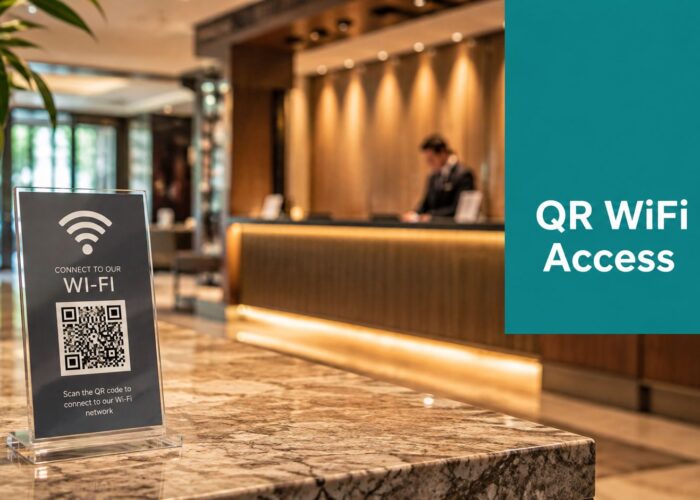
In practice, this matters most at scale. QR-based onboarding reduces typing mistakes. Expiring keys at checkout reduce stale access. Device-specific credentials make abuse easier to trace and easier to shut off without affecting everyone else on the SSID.
That is why I usually treat IPSK and EasyPSK as the gold standard for hospitality environments that want both convenience and control.
Matching method to environment
A good guest authentication design starts with the actual use case, not with whichever login option is easiest to switch on in the dashboard.
- Hotels and resorts: Room number plus last name can work well if PMS integration is stable. IPSK or EasyPSK is usually the stronger long-term choice when the property wants cleaner segmentation, less password sharing, and better post-checkout control.
- Retail and shopping centers: Email capture and social login often make more sense because the business goal is engagement, campaign attribution, and repeat visits.
- Education: Voucher-based access, identity-linked credentials, and stronger policy controls fit lecture halls, dorms, and guest events better than a shared password.
- Corporate BYOD: IPSK or identity-based policy assignment is usually safer and easier to manage than a single visitor code passed around the office.
If you are comparing options in detail, guest WiFi user authentication techniques for Meraki-based deployments gives a useful breakdown of how these models differ in setup and user experience.
If you're evaluating the broader identity side beyond guest WiFi, Finchum Fixes IT's MFA guide is a helpful reference for thinking about stronger authentication practices across business systems.
What usually works best in hotels
Most properties do best with a layered approach instead of a single login path.
- Primary path: Room-linked authentication or QR-based IPSK/EasyPSK
- Fallback path: SMS or voucher access for edge cases, such as early arrivals, event guests, or PMS sync issues
- Data capture layer: Optional email entry, loyalty opt-in, or consent collection after the guest is identified
- Operations layer: Automatic expiry at checkout, role-based policy assignment, and separate treatment for guest, event, and staff-owned devices
This model keeps the first connection easy while turning the hotel wifi login page into more than a gate. It becomes part of marketing, analytics, and security operations at the same time.
What stops working fast
A few patterns still create support tickets and security headaches:
- One shared password printed everywhere: Easy to distribute, hard to retire, impossible to tie to a person or room
- Long forms before access: Guests abandon them, especially on mobile
- Mandatory social login for every user: Fine for some campaign-driven venues, but a poor fit for many hotel guests who want quick access
- Portal-only security thinking: A polished login page does not fix weak wireless segmentation or broad shared access behind it
The best authentication method feels simple to the guest and disciplined to the operator. In hotels, that usually means pairing a branded captive portal with Cisco Meraki policy control and IPSK-based identity at the network edge.
Designing a Login Page That Boosts Your Brand and Revenue
Once the network is stable and authentication is sorted, the login page becomes a real business surface. On this surface, many hotels either waste a valuable touchpoint or use it well.
A generic captive portal says, "You are connecting to WiFi." A branded portal can also say, "Book spa time, join loyalty, get a dining offer, or download the guest app." That difference matters because attention is highest at the moment of connection.

The best portal pages stay focused
I've seen properties overload the page with restaurant promos, local attractions, event banners, newsletters, and legal text all at once. The result is usually confusion. A better page gives the guest one clear action, then one strong secondary option if needed.
That approach lines up with the available data. WiFi marketing research compiled by Amra & Elma reports 68.4% unaided brand recall from splash screens, and single-call-to-action splash screens achieve 23.7% loyalty opt-in rates and 14.2% discount redemption rates across multiple venue types.
What a strong hotel wifi login page includes
A practical branded flow usually has these parts:
- Recognizable branding: Logo, colors, typography, and a welcome message that match the property.
- One primary action: Connect, continue, or verify.
- One business objective: Loyalty sign-up, offer claim, app download, or email opt-in.
- Fast mobile layout: Most guests are joining from phones, not laptops.
- Clear consent language: Especially if you're collecting marketing permissions.
A splash page should feel like a front desk greeting, not a billboard covered in sticky notes.
Use the page like a landing page
The teams that do this well borrow ideas from conversion-focused web design. Keep the message short. Make buttons obvious. Remove anything that doesn't help the guest complete the next step.
If you want a useful framework for cleaner conversion thinking, tips for high-converting websites from Baslon Digital apply surprisingly well to captive portal design too.
Good examples by venue type
Different sectors should emphasize different outcomes.
Hotels and resorts
A hotel portal can promote loyalty enrollment, breakfast offers, late checkout requests, spa booking, or messaging support. The trick is to choose one priority per page state. If the first screen is already asking for an email, don't add five other competing offers.
For properties that want to connect guest access with broader marketing activity, hotel internet marketing through guest WiFi shows how branded login pages can support offers, campaigns, and guest follow-up within a connected hospitality workflow.
Retail
Retail venues often get more value from social WiFi, coupon delivery, and repeat-visit campaigns. Here the portal acts more like a lightweight acquisition tool.
Education and corporate BYOD
These sectors usually benefit from a cleaner, more restrained design. The priority is trust, clarity, and access control. Branding still matters, but over-marketing the login experience can feel out of place.
What to avoid
A few design mistakes come up repeatedly:
- Tiny legal text and tiny buttons on mobile
- Multiple equal-priority calls to action
- Stock artwork unrelated to the venue
- Login fields that ask for more than the venue will use
- Slow-loading pages with oversized media
Good captive portals don't need to be flashy. They need to be clear, branded, and aligned with one operational goal and one marketing goal. That's what turns a basic login page into a useful revenue touchpoint.
Mastering Security Privacy and Network Compliance
A guest checks in after a long flight, joins your WiFi, sees a polished hotel wifi login page, and assumes the network is safe. That assumption becomes your responsibility the moment they connect.
The login page handles access, consent, and branding. It does not secure the wireless network by itself. Real protection comes from the network design behind the portal: encrypted SSIDs, client isolation, traffic segmentation, credential control, logging, and clear data handling rules. If those pieces are weak, the portal is only decorating risk.

Open guest WiFi has real risk
Open guest WiFi still shows up in hotels because it feels easy to deploy and easy to explain to staff. It also creates avoidable exposure. Security firms and public cybersecurity reports continue to document abuse on poorly protected public WiFi, especially on networks that rely on open SSIDs, shared passwords, or weak segmentation.
For hotels, the bigger problem is operational. A flat guest network makes it harder to contain abuse, harder to trace activity back to a room or device, and harder to prove that your team applied reasonable controls if an incident ever has to be investigated. A modern hotel wifi login page should support a safer access model, not sit on top of an outdated one.
Why IPSK and WPA3 matter
Cisco Meraki with IPSK, often deployed as Identity PSK or EasyPSK depending on the design, gives hotels a much better balance of security and day-to-day manageability. Instead of one password printed on every key sleeve or desk card, each guest or room gets a unique key tied to a policy.
That changes the security model in practical ways:
- Containment: One leaked key affects one guest, room, or device group instead of the whole property.
- Accountability: Access records can be tied back to a stay, room number, or onboarding workflow.
- Expiration: Credentials can expire automatically at checkout.
- Segmentation: Different users can land on different VLANs or group policies without extra friction at the front desk.
I recommend this approach for properties that want the login page to do more than collect clicks. Once access is tied to a real identity token, the portal becomes part of a larger system for analytics, policy enforcement, and guest lifecycle tracking. Marketing gets cleaner attribution. IT gets tighter control. Operations gets fewer headaches from shared-password sprawl.
Privacy and compliance have to be built into the workflow
Hotels often want the portal to collect email addresses, loyalty signups, stay preferences, or consent for future offers. That can be useful. It also creates obligations.
If your login page gathers personal data, the form, consent language, retention policy, and admin permissions all need to line up with the rules that apply to your property and your guests. For many operators, that means accounting for GDPR, CCPA, and local data retention requirements even if the hotel is not based in Europe or California.
A few practices make this easier to manage:
- Ask for less data. If the field does not support a real operational or marketing use, remove it.
- Separate internet access from marketing consent. Guests should be able to see the difference clearly.
- Set retention periods in advance. Access logs, opt-in records, and contact data should not sit indefinitely without a policy reason.
- Restrict admin visibility. Front desk staff, marketers, and network admins usually need different levels of access to guest data.
For teams reviewing policies, audit trails, and consent handling, guest WiFi regulatory compliance service guidance provides a useful reference for managed environments.
Security should reduce future support, not create more of it
The mistake I see most often is a hotel choosing between convenience and control as if they cannot have both. They can. The right design uses stronger security in the background and keeps onboarding simple on the front end.
With Meraki, that usually means pairing protected wireless access with practical delivery methods such as room-based credentials, PMS-linked onboarding, QR code handoff, or short-lived keys sent by SMS or email. Guests still get online quickly. The difference is that the access method now supports segmentation, better auditability, and cleaner reporting.
That matters beyond security. A better-controlled login flow produces better data. Better data supports sharper remarketing, cleaner consent records, and more reliable guest analytics. In a well-run deployment, the hotel wifi login page stops being just a gate and starts working as a controlled handoff between guest experience, revenue activity, and network policy.
Troubleshooting Common Captive Portal and Login Issues
A guest arrives after a long trip, joins the hotel WiFi, and waits for the login page that never loads. Front desk gets the complaint. IT gets the escalation. Marketing loses the chance to capture consent or present an offer. Security loses visibility into who got on the network.
That is why captive portal troubleshooting should be treated as an operational workflow, not a one-off help desk task. In a well-run Meraki deployment, the hotel wifi login page is part of the guest journey, the data pipeline, and the access control model. If it breaks, the issue is bigger than inconvenience.
When the login page doesn't appear
This is still the most common portal complaint. The device associates to the SSID, but the splash page never opens.
Start with the checks that isolate scope fast:
- Confirm the guest joined the correct SSID. Staff, conference, and guest networks often have similar names.
- Clear stale session state. Cached portal sessions and remembered DNS responses can prevent the redirect from firing.
- Check device captive network behavior. iPhones, Android devices, Windows laptops, and some privacy-focused browsers do not all trigger portal detection the same way.
- Test on another device in the same location. That tells you whether the problem follows the user, the access point, or the VLAN path.
If several guests in one area report the same issue, check AP status in Meraki Dashboard, upstream DHCP and DNS behavior, firewall rules, and the redirect settings tied to that SSID. In practice, failed redirection is often a path issue, not a page design issue.
When authentication fails even though the guest details are correct
This usually points to a sync problem between systems. The guest may be entering valid information, but the backend source is out of date or the policy attached to that identity no longer matches.
Check the common failure points:
- PMS sync status. Room assignment, check-in state, or folio updates may not have reached the portal system yet.
- Voucher validity. Reused, expired, or partially consumed codes create predictable login failures.
- SMS or email delay. A code that arrives late often leads to repeated retries and locked sessions.
- Identity provider handoff. SAML and directory-based authentication can fail at the redirect or token stage, even when credentials are correct.
Set up a fallback before the outage happens. A QR code path, a short-lived voucher, or an IPSK-based backup method gives front desk staff a controlled way to get the guest online without bypassing policy.
When one device works and the others don't
This shows up constantly with families, business travelers, and extended-stay guests. A phone connects. The laptop loops back to the portal. The tablet lands on a blank page.
The first place to look is device association policy. Multi-device limits, MAC randomization, and shared credentials can all create inconsistent behavior. This is one reason I prefer clearer identity models in hospitality environments. With IPSK or room-linked onboarding, each connection is easier to trace, support, and segment than with a single shared password handed to every device.
That matters for more than support. Cleaner per-device onboarding produces better analytics, more accurate consent records, and tighter security controls.
When the guest connects but says the WiFi is slow
At that point, the portal may be working exactly as designed. The issue has usually shifted to capacity, shaping, or upstream performance.
Check these areas:
- Bandwidth policies. Guest rate limits may be too low for video calls, streaming, or app updates.
- High-density coverage zones. Conference rooms, breakfast areas, and lobbies often behave very differently from guest floors.
- WAN congestion. Access points can look healthy while the internet circuit is saturated.
- Application policies. If streaming, VPN, or calling services are restricted, guests often report that as poor WiFi rather than blocked traffic.
Meraki makes this easier to verify because you can separate RF issues from client authentication issues and traffic shaping problems in a few clicks. That saves time. It also prevents the front desk from treating every complaint like a portal failure.
Build a support flow your team can actually use
Front desk staff need a short, repeatable script. IT needs a fast decision tree. Management needs reporting that shows whether failures are tied to coverage, portal rendering, PMS sync, or guest behavior.
A practical flow works like this: confirm SSID, test portal trigger, verify the guest identity source, check Meraki client status, then move to fallback access if a dependency is down. That keeps the guest experience moving while preserving security and auditability.
The best long-term fix is usually a better onboarding model. QR access, room-linked credentials, and IPSK workflows reduce guesswork, lower support volume, and turn the hotel wifi login page into something more useful than a gate. It becomes part of how the property captures consent, supports remarketing, and keeps guest access controlled.
If your current hotel wifi login page still feels like a generic gate instead of a managed guest experience, Splash Access is one platform built around Cisco Meraki environments for branded captive portals, social WiFi, QR onboarding, voucher access, IPSK workflows, and policy-driven guest authentication across hospitality, retail, education, and corporate BYOD use cases.