Sourcing is the supplier-selection stage, ending when an organization awards a supplier agreement; procurement is the full buying lifecycle, including sourcing and everything that follows. In short, sourcing chooses who to buy from, while procurement makes sure the purchase is approved, controlled, delivered, paid for and managed over time.
You may be sorting out Wi-Fi for a school, hotel or retail site right now. Perhaps your team is comparing Cisco Meraki-compatible captive portal options, checking how visitors will authenticate, and trying to work out who'll own the contract once a vendor is chosen. Knowing where sourcing ends and procurement continues helps everyone make the right decision, without leaving service quality, security or costs without an owner.
Sourcing and Procurement Side by Side
Sourcing finds and assesses suppliers, then recommends or selects the best fit based on requirements such as quality, quantity and delivery speed. Procurement covers the wider lifecycle, from defining the need and approving the specification to managing the agreement, transactions and supplier relationship. The Chartered Institute of Procurement & Supply's description of sourcing supports this distinction: sourcing is a focused part of supply management, while procurement manages the broader commercial lifecycle.
| Dimension | Sourcing | Procurement |
|---|---|---|
| Core question | Which supplier offers the best value and terms? | Is the need bought, controlled and delivering value over its life? |
| Scope | Upstream: requirement analysis, market engagement and award | End to end: need identification through contract exit |
| Stops at | Supplier agreement awarded | Contract ends, asset retired or contract renewed |
| Typical activities | RFP, supplier comparison, negotiation | Requisitioning, purchase orders, invoice matching, supplier reviews |
| Typical owner | Category or sourcing specialist | Procurement operations and contract managers |
| Wi-Fi example | Choosing a Cisco Meraki-compatible captive portal vendor | Checking SLA reports, invoices and renewal dates for that vendor |
An RFP, or request for proposal, asks potential suppliers to describe how they'd meet the organization's needs, along with their proposed terms. If a hotel group compares captive portal suppliers and negotiates the agreement, that's sourcing. The work doesn't end for the organization when the agreement is signed. Procurement needs to confirm that the specification was approved, the contract covers the required SSIDs, purchase orders match the agreement, invoices are accurate and service performance is reviewed.
That distinction matters because a low initial price doesn't guarantee good value over the contract's life. The team must also account for ongoing service, support, risks, renewals and how well the supplier meets the organization's needs.
Sourcing is one stage inside procurement, not a rival department.
How the Work Splits Across the Buying Lifecycle
A Wi-Fi purchase makes the handoff easier to see. Sourcing focuses on choosing the right supplier and agreeing on terms; procurement-led work takes over after the award to put those terms into everyday operation. The boundary isn't just administrative. It changes which team is expected to control supplier selection and negotiated value, and which team handles orders, invoices and ongoing performance.
The broader source-to-pay model also distinguishes supplier selection and contracting from operational work such as ordering and payment. Here's how a campus buying a Wi-Fi platform might follow the lifecycle:
- Need definition. The campus works out what service it needs, including its requirements for access points and guest connectivity. The business owner helps define the intended experience; sourcing uses those needs to shape the requirement.
- Market analysis. The sourcing team looks at Wi-Fi platforms and captive portal suppliers that fit the campus's requirements. It considers service, support, integrations and the supplier's ability to meet the need.
- Supplier selection. The team requests proposals and scores supplier responses against the agreed criteria. It compares the options and recommends a supplier.
- Negotiation and award. Sourcing negotiates commercial terms and helps establish the supplier agreement. The sourcing boundary generally ends when the agreement is awarded.
- Onboarding and purchase orders. Procurement turns the agreement into operational purchasing, including the purchase order and the approved device or service quantities. The campus coordinates the deployment and confirms that the order reflects the intended scope.
- Invoice matching and performance review. Procurement checks invoices against the order and tracks contract requirements, such as service levels. The campus reviews whether the Wi-Fi service is working for students, staff and visitors.
- Renewal, change or exit. Procurement manages the contract decision and its timing. The business owner determines whether the service still meets operational needs or whether the campus should plan a change.
The performance measures differ at that handoff. Sourcing looks at supplier-selection quality, competition and total cost of ownership, which means the cost over the service's useful life, not just its initial price. After signature, procurement focuses on compliant transaction execution, cycle time, exceptions and payment accuracy.
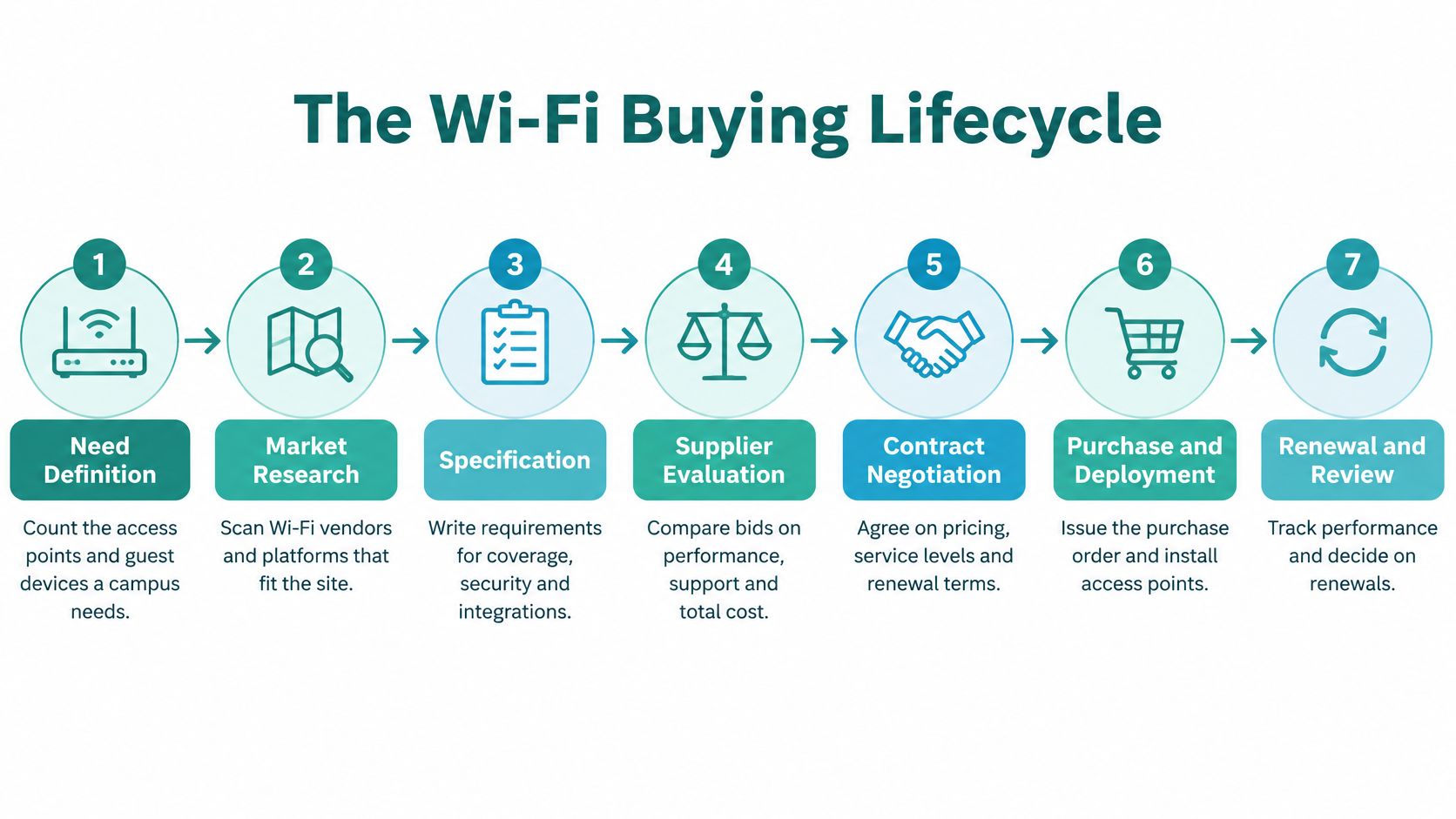
For a campus, sourcing may select the Wi-Fi platform, while procurement raises the purchase order, maintains the device count and coordinates the service review. If deployment timing is part of the purchase, teams can also use a Wi-Fi implementation timeline to plan the work and clarify handoffs.
Try mapping your last technology purchase onto these seven stages. Note who handled each one, and where ownership changed hands.
Who Owns Each Decision When Teams Share the Work
“Sourcing is strategic, procurement is operational” can be a useful shorthand, but it doesn't settle the practical questions: who owns supplier risk, data quality, contract performance and business outcomes when sourcing, procurement, finance, IT and operations share responsibility? Those duties cross team boundaries, so the distinction works best as a governance model, not as a rigid organizational chart.
The roles below offer a starting point. Responsible means doing the work. Accountable means answerable for the outcome. Consulted and informed describe how other roles contribute or stay updated.
| Activity | Sourcing | Procurement | Business owner (IT, facilities or operations) |
|---|---|---|---|
| Requirement definition | Consulted | Consulted | Accountable for the outcome |
| Market analysis and shortlist | Responsible | Consulted | Informed |
| Negotiation and contract award | Responsible | Accountable | Consulted on service levels |
| Onboarding and purchase orders | Informed | Responsible | Accountable for go-live |
| Performance and SLA tracking | Informed | Responsible | Accountable for uptime and security |
| Renewal or exit | Consulted | Accountable | Accountable for the replacement plan |
SLA means service-level agreement, the contract's terms for expected service and support. In a Cisco Meraki deployment, procurement might maintain the service contract and confirm that the organization follows its commercial terms. IT, however, may own guest network availability and the security of BYOD segmentation, while operations looks after the visitor experience. The contract manager can track a service commitment, but that doesn't make them the owner of every operational outcome.
This same map can work for hospitality, retail, education, healthcare and corporate offices. The specific approval thresholds and job titles will differ, so adjust the assignments to match who has authority and expertise in your organization. A Cisco Commerce Workspace purchase process can also be a prompt to clarify which role handles the commercial steps and which owns service delivery.
If two roles both claim accountability for the same outcome, clarify who makes the final decision before a problem lands between teams.
Draw this table for your organization, then mark any row where two roles claim the same outcome. That's the spot to discuss first.
Metrics and Costs Each Side Should Track
When a school district reviews Wi-Fi proposals, the lowest equipment price may not mean the best value. Sourcing compares suppliers and contract options before award; procurement tracks whether the chosen deal is ordered, delivered, invoiced, and paid as agreed. The measures should reflect those different responsibilities, even when one team shares the work.
A global source-to-pay benchmark from SAP reports an average sourcing-event cycle time of 46.4 days. It also reports that top-quartile organizations achieve more than 9% annual sourcing savings through competitive sourcing events. These figures appear in the SAP source-to-pay benchmarking report. They describe sourcing performance, not invoice processing after a supplier is selected.
Sourcing savings compare historical spend with awarded spend, then divide the difference by historical spend. For example, if a district's annual Wi-Fi spend falls from 200,000 to 182,000 after a competitive event, the 18,000 difference equals 9% of the original spend. This is an illustration of the calculation, not a research result.
Procurement needs measures for execution after award. The available reference values below relate to sourcing; no benchmark value is supplied for the other measures.
| Metric | Belongs to | Reference value |
|---|---|---|
| Sourcing-event cycle time | Sourcing | 46.4 days average |
| Sourcing savings | Sourcing | Top quartile above 9% a year |
| Total cost of ownership | Sourcing | No benchmark value supplied |
| Procure-to-pay cycle time | Procurement | No reference value provided |
| Cost per transaction | Procurement | No benchmark value supplied |
| Touchless processing rate | Procurement | No reference value provided |
| First-pass invoice match rate | Procurement | No reference value provided |
| Maverick spend share | Procurement | No reference value provided |
| On-time delivery | Procurement | No reference value provided |
“Maverick spend” means purchases made outside approved suppliers or contract terms. Procurement can also track purchase-order and invoice-processing costs, the time from purchase to payment, and how often invoices match correctly on the first pass. Sourcing can compare total cost of ownership, which includes more than equipment price. A total-cost-of-ownership approach helps teams account for the wider cost of delivering and supporting Wi-Fi.
Keep ownership visible in the dashboard. A low transaction cost cannot show whether the supplier was the right choice, while negotiated savings alone do not ensure accurate orders or reliable delivery. Give each measure a named owner, and let teams share accountability where the work overlaps. For instance, sourcing may assess supplier risk while procurement monitors delivery against contract terms. Separate views make those responsibilities easier to discuss.
Wi-Fi Buying Scenarios in Education, Retail and BYOD Corporate
Consider a campus common room. Students need convenient Wi-Fi for personal devices, while staff systems and visitor access need different controls. The buying decision isn't just about which platform offers a splash page. The team must also decide how users authenticate and what each connected device can reach.

| Sector | Sourcing question | Procurement control | Access method |
|---|---|---|---|
| Education campus | Which Cisco Meraki-compatible platform supports student and visitor onboarding? | Approved vendor list, data-processing terms and term-based renewal dates | Click-through captive portal for visitors, IPSK or EasyPSK for student devices |
| Retail and shopping center | Which captive portal offers social login and social Wi-Fi that feeds marketing tools? | Consent wording review, approved marketing integrations and voucher purchase orders | Social login or social Wi-Fi splash page with voucher codes for shoppers |
| BYOD corporate office | Which authentication solution separates personal devices from corporate resources? | Security review, SSO integration with Azure AD or SAML and helpdesk SLA | IPSK per device or EasyPSK for role-based access, isolated guest network for visitors |
A captive portal is a web page a user sees before getting Wi-Fi access. With click-through, the visitor accepts terms or taps a button to connect; sign-on asks the user to provide credentials or use an identity workflow. A retail team might compare social login and social Wi-Fi options, then procurement checks consent wording, approved marketing integrations and how voucher codes are ordered. In education, teams may consider IPSK, an individual pre-shared key for a device or user, or EasyPSK for role-based access, alongside a simple visitor portal.
For corporate BYOD, the question is how to identify personal devices without treating them like managed corporate endpoints. The National Institute of Standards and Technology's BYOD guidance recommends separating BYOD traffic from enterprise resources and limiting access to what's needed. Its zero-trust implementation example further describes separating enterprise and guest network segments, with guest access limited to the public internet (NIST zero-trust guidance).
That means a Cisco Meraki SSID can place visitors on a restricted guest network while authenticated corporate users receive policy-based access. Stronger authentication, preferably multi-factor authentication, can be used for enterprise access. Teams planning connectivity for a school can also review education Wi-Fi budgeting considerations. Across all three settings, guest access should never reach sensitive systems.
Should AI Take Over More of Sourcing?
For a Wi-Fi purchase, AI might compare suppliers or flag unusual bid scores, but a person still needs to judge whether the result is fair and fits the organization's needs. Supplier discovery and bid evaluation usually sit with sourcing, which owns supplier selection. Procurement should review AI-assisted contract analysis for purchasing terms, renewals, and obligations.
One industry report found that 74% of procurement leaders consider their data not AI-ready, and 75% say data quality reduces their confidence in AI (supplier.io's report on AI in procurement). These figures point to a practical starting point: clean supplier records and consistent spend categories before relying on AI comparisons.
Begin with a narrow pilot, such as finding contract clauses or flagging renewal dates. A named reviewer should check each result before it affects a supplier award or purchase. That keeps responsibility clear even when sourcing and procurement share the work.
Structuring the Team and Signing Off on Wi-Fi Vendors
The right team setup depends on the organization's size and risk. A single-site café or clinic might have one person handle both sourcing and procurement, but someone still needs to own renewal decisions. A multi-site retailer or campus will usually need clear ownership for supplier selection, purchase-order operations and IT service delivery; hospitals should keep sourcing and procurement ownership distinct and use a shared metrics dashboard. In BYOD-heavy offices, bring security into the sourcing process before the shortlist is set.
After selecting a supplier, put the operational controls in writing:
- Calendar renewals: Record notice dates and set a reminder 90 days ahead.
- Review service: Hold a quarterly business review against the agreed KPIs.
- Define service expectations: Set SLA targets for uptime, captive portal login success and support response time.
- Reconcile inventory: Maintain one shared device and SSID register so counts match invoices.
- Protect data: Use data-processing agreements that cover guest and student information.
- Plan for exit: Include data-return terms and exit clauses to limit lock-in.
- Recheck ownership: Review who holds each role annually.
A composite example shows why the register matters. A retail group found two vendors billing for one site, then corrected the discrepancy by reconciling its device register against its purchase orders. The lesson is practical: shared records help procurement check charges against what the business ordered and deployed.

A clear sign-off path
Before an RFP goes out, write the requirement on one page, including the required SSIDs, device counts and authentication needs. Then name the sourcing owner who'll run the RFP, the procurement owner who'll manage the purchase order and contract, and the business owner accountable for uptime and guest experience.
Agree on the KPIs and review dates before deployment, then put the renewal notice date on the contract calendar. When your team reviews access point needs, a Wi-Fi access point review can help frame the technical discussion alongside the commercial one.
Finally, check each Cisco Meraki shortlist option for captive portals, IPSK, EasyPSK, social login, social Wi-Fi, Azure AD or SAML integration, and clear support. Then book the owner meeting this week. A short conversation now can prevent confusion later about who approves the purchase, manages the agreement or answers for the service.
Splash Access offers Cisco Meraki-compatible guest Wi-Fi with customizable captive portals, WPA2 and IPSK authentication, EasyPSK options, and integrations including Azure AD and SAML. If you're clarifying the sourcing and procurement roles for your Wi-Fi project, visit Splash Access to explore how its platform can support guest access and onboarding.