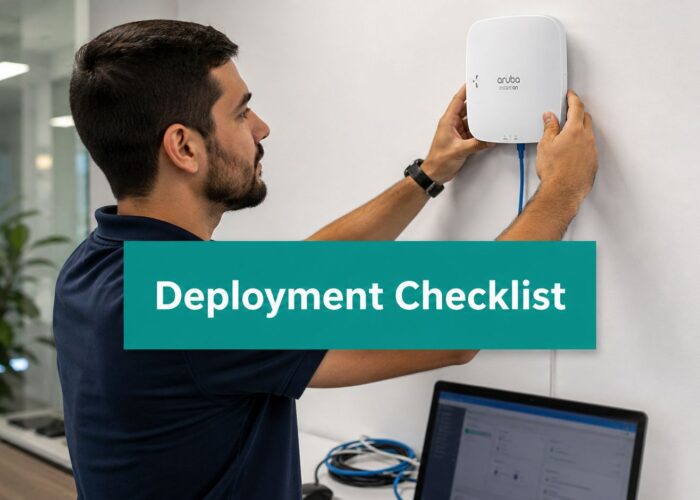
Hey there! It’s a classic mistake I’ve seen countless times in the field: a brand-new Cisco router, switch, or Meraki access point gets unboxed and plugged in, but the factory-set login is forgotten. Leaving a Cisco default password like cisco/cisco in place seems like a small detail to fix later, but it’s the digital equivalent of leaving the front door wide open.
This isn't just a theoretical problem. That simple oversight is a welcome mat for attackers, turning your new hardware into an immediate liability.
The Hidden Risk of Your Cisco Default Password
Every piece of network hardware, straight from the factory, comes with a default login that is publicly documented and easily found online. It’s designed to make initial setup quick, but it's a gaping security hole if you don’t change it immediately. This risk is universal, affecting everyone from a small coffee shop with guest Wi-Fi to a large corporation managing a complex Bring Your Own Device (BYOD) policy.
Forgetting to change just one Cisco default password can be the single point of failure that exposes your entire network.
From Device Access to Network Compromise
Once an attacker finds a device with default credentials, they have the keys to the kingdom. They can monitor unencrypted traffic, steal sensitive user data, or even use your network to launch other attacks. I’ve seen this cause major headaches, especially in environments like Retail or Education where guest networks are essential.
A compromised device could quickly lead to:
- Data Breaches: Unauthorized access to customer information, especially if you're capturing data through social login or payment portals.
- Network Downtime: A malicious actor can easily reconfigure a router or switch, bringing business operations to a grinding halt.
- Reputation Damage: A security incident erodes trust, whether it’s with students on a university campus or shoppers in a mall.
The initial point of entry for many network breaches isn't some sophisticated zero-day exploit; it's an unchanged, easy-to-guess default credential. Securing this entry point is the most fundamental step in network defense.
To give you a clearer picture, here’s a quick-reference table of common default credentials and why they are so risky. These are the logins attackers try first.
Common Cisco Default Credentials and Their Risks
| Device Type | Default Username | Default Password | Primary Risk |
|---|---|---|---|
| IOS Routers/Switches | cisco | cisco | Grants full administrative access to the network backbone. |
| ASA Firewalls | (none) or cisco | cisco or (blank) | Allows attackers to reconfigure firewall rules and disable security. |
| Meraki Devices | (device serial #) | (blank) | Cloud-managed access can be hijacked, compromising all connected APs. |
| Small Business Series | cisco | cisco | Exposes the entire local network, often used in smaller, less-monitored environments. |
Changing these credentials on day one is non-negotiable. It’s the first and most critical step in securing any new piece of hardware.
Securing the Digital Front Door
That initial password is the first link in a long chain of security that protects your users and data. Modern networks often depend on advanced Authentication Solutions to manage who gets on the network and what they can do. For a guest wifi network, this might mean a Captive Portal that prompts users for a social wifi login. If you want to dive deeper into how these systems are architected, you can learn more about what Cisco ISE is and the role it plays.
In BYOD Corporate environments, technologies like IPSK (Individual Pre-Shared Key) or EasyPSK assign a unique password to every user or device—a far more secure approach than a single shared password. But here’s the bottom line: none of these sophisticated defenses matter if the underlying network hardware is exposed. Securing that default password is the first and most important step toward building a network you can actually trust.
How to Find and Change Passwords on Your Cisco Devices
Alright, so you know the risks of that out-of-the-box Cisco default password. It's time to take control of your hardware. Whether you're setting up a new router or taking over an existing network, this is where the rubber meets the road. I'll walk you through the practical steps to access your devices and lock them down properly.
It's a surprisingly simple vulnerability. A new device comes out of the box with a known password, and before you know it, an attacker has an open door into your network.

As you can see, the path from unboxing to a potential breach is frighteningly direct. This is the first security gap you need to close.
Accessing and Securing Your Device
First things first, you need to get into the device's management interface. For most Cisco gear, that means physically connecting your computer to the device’s console or management port using an Ethernet or console cable. Once you're plugged in, you'll use a web browser or a terminal client to reach the login screen.
After you've logged in, your immediate priority is to navigate to the administration or user account settings. This is where you'll change the password. While you're there, it's also smart to delete any pre-configured default accounts you won't be using. It’s a five-minute task that dramatically improves your security.
Expert Tip: I've seen it happen too many times—a single compromised password granting access to an entire network. Always give each piece of hardware its own unique, strong password. Never reuse credentials across devices.
Changing the password is just one piece of the puzzle. For a truly secure setup, it's worth brushing up on password management best practices to protect all of your accounts and systems.
What to Do When You're Locked Out
What happens if you've inherited a switch with an unknown password or you've simply been locked out? Don't panic. The factory reset is your go-to solution. This action completely wipes the running configuration, returning the device to its original state.
- Find the reset button: Most Cisco and Meraki devices have a tiny, recessed button you'll need a paperclip to press.
- Perform the reset: With the device powered on, press and hold that button for about 10-30 seconds. The exact timing can vary by model, so it never hurts to double-check the manual for your specific hardware.
- Log back in: Once the reset is complete, the device will reboot with its original default credentials. You can now log in and immediately set a new, secure password.
For those of us who live in the command line, securing a device is just the beginning. Once you have access, you can fine-tune everything from firewalls to routing protocols. If you're looking to dive deeper, our guide on essential Cisco CLI commands is a great resource. A secure password is the foundation for all other security layers, especially for features like Captive Portals and IPSK used in guest wifi deployments.
Managing Security with the Cisco Meraki Cloud
If you’ve spent any time in the trenches with traditional Cisco hardware, the Meraki experience is a breath of fresh air. It's a completely different way of thinking about network management, especially for guest wifi in places like Retail stores, Education campuses, or offices with Bring-Your-Own-Device (BYOD) policies. Everything happens in the cloud, which fundamentally changes how you approach security.

Because of this cloud-centric model, the whole idea of a simple cisco/cisco login on a Meraki device is pretty much nonexistent. Security is baked right into the onboarding process from the very start.
The Meraki Cloud Dashboard Difference
From the moment you unbox a Meraki device, you realize the process is unique. You don't plug in a console cable and log in locally. Instead, you claim the device by adding its serial number to your organization's Meraki cloud dashboard. This action immediately ties that piece of hardware to your secure account.
This means there’s no traditional Cisco default password to worry about, change, or have exploited. Your access is controlled by your personal cloud login, which forces you to use a strong, unique password from day one. You're not logging into individual access points or switches; you're managing your entire network from a single, secure web portal.
With Meraki, security isn't an afterthought—it's the starting point. The entire platform is designed to move you away from device-level passwords and toward a centralized, cloud-based security model.
This shift has massive implications for everything from deploying a few access points in a small office to managing Wi-Fi across hundreds of Retail locations. All your configurations, security updates, and monitoring are handled remotely and securely. You can see how this centralized philosophy applies to network protection by reading our overview of the Cisco Meraki firewall.
Foundation for Advanced Authentication
The Meraki dashboard is far more than a simple configuration tool; it's the control center for setting up some powerful Authentication Solutions. This is where you can build and manage sophisticated guest wifi experiences with surprising ease.
- Captive Portals: Quickly create branded login pages to greet users and manage access. This is ideal for offering social wifi logins (like with a social media account) or collecting user information.
- WPA2-Enterprise: For BYOD Corporate settings, you can easily integrate with RADIUS servers to enable robust, certificate-based authentication.
- Meraki Cloud Authentication: Use the built-in system to create user accounts directly from the dashboard, which is great for smaller-scale, controlled deployments.
Having this simplified management console makes it incredibly easy to deploy advanced security methods that used to be a headache, like IPSK (Individual Pre-Shared Key) and EasyPSK. Instead of wrestling with complex command-line interfaces, you can enable these features with just a few clicks. This allows you to give every user or device its own unique Wi-Fi key, dramatically reducing the risks that come with shared passwords and building a much safer network for BYOD.
Building a Secure Guest Wi-Fi Experience
So you've locked down your Cisco gear by changing the default password. That’s a fantastic start, but if you’re managing a network for a busy Retail space, a hotel, or even a BYOD Corporate office, that’s just table stakes. Real security and a great user experience mean going beyond a simple password.
It’s time to build on that secure foundation with modern authentication methods that benefit both you and your users.

This is where a Captive Portal comes in. It acts as a branded, secure gateway to your network. Instead of just a sterile password field, users are greeted with a professional landing page that guides them through the connection process.
The Power of the Captive Portal
Think of a Captive Portal as your network’s friendly concierge. Before anyone gets full access, they’re authenticated and identified. From a security standpoint, this is a massive win, but it also opens up some powerful opportunities for your business.
- Social Wi-Fi Login: Give users the option to connect using their social media accounts. It's incredibly convenient for them and gives you access to valuable, anonymized demographic insights.
- Email and Form Capture: You can ask for an email address or have users fill out a quick form. This is a simple, effective way to build marketing lists and learn more about who is visiting your location.
- Tiered Access: Why not offer different levels of service? Provide a free, basic connection for casual users and a faster, paid option for those who need more bandwidth.
This kind of controlled access is light-years ahead of just changing a router password. A secure Captive Portal is the key to unlocking these features on your Cisco and Meraki networks.
Beyond the Shared Password with IPSK and EasyPSK
In any environment with lots of personal devices (BYOD), a single, shared Wi-Fi password is a huge liability. All it takes is one employee sharing the password or losing a device, and your entire network is exposed. To solve this, we can turn to advanced Authentication Solutions like IPSK (Individual Pre-Shared Key) and EasyPSK.
These systems generate a unique, secure password for every single user or device. It's like giving each person their own personal keycard instead of handing out copies of a master key. If a device is lost or an employee leaves, you just revoke their specific key without disrupting anyone else. It's an elegant and powerful way to dramatically improve security on both Cisco and Meraki networks.
The reality is, automated attacks are relentless. Unchanged default passwords are the low-hanging fruit that attackers program their bots to look for, day in and day out.
This isn't some far-off, theoretical threat. Bots are constantly scanning for vulnerabilities, and default passwords are their primary target. Enterprise networks often log dozens of SSH and Telnet login attempts from bad actors within just a few hours—all trying to guess default credentials. Cisco's own advisories have shown how these automated scans can target millions of exposed devices daily. Shifting to stronger authentication methods like IPSK is one of the most effective ways to shut the door on these brute-force attempts.
Lessons From Real-World Security Breaches
Thinking a default password exploit is something that only happens to other people is a dangerous gamble. Let's be blunt for a moment and talk about what happens when credential management goes wrong, because these aren't just scare stories—they're crucial lessons I've seen play out in the real world.
That forgotten Cisco default password isn't just a minor oversight. It’s a ticking time bomb, and we've all seen it detonate, causing absolute chaos for businesses you'd assume were untouchable.
When Theory Becomes a Harsh Reality
Back in August 2022, Cisco itself gave us a textbook example of what's at stake. A ransomware gang breached its corporate network, and the whole mess started with a single, compromised employee account. The attackers, known as Yanluowang, bragged about swiping 2.75GB of data. The entry point was tied directly to weak credentials—a massive wake-up call for any business using Cisco tech.
Just when you’d hope the industry had learned its lesson, another major incident hit. Fast-forward to April 2024, and security researchers found a campaign exploiting vulnerabilities in Cisco ASA and IOS XE software, compromising tens of thousands of devices. These attacks are often successful for one simple reason: unpatched devices are left sitting on the network with default admin credentials, making them low-hanging fruit for automated attacks.
Connecting Breaches to Your Business
These events aren't just abstract headlines; they have direct, tangible consequences for how you operate every day.
- For a Retail Business: A compromised network can mean stolen customer data, especially if you're capturing it via social wifi or a Captive Portal. A breach like that doesn't just cost you in fines; it completely shatters customer trust.
- For an Education Institution: Think about a single exploited switch causing a campus-wide network outage during final exams. Or worse, granting attackers access to sensitive student and faculty records.
- For a BYOD Corporate Office: A breach could expose proprietary data, grind business to a halt, and undermine all the security policies you've put in place for BYOD users. A secure network is a productive network.
The biggest takeaway from these real-world breaches is that defense-in-depth is not just a buzzword. It's an essential strategy that starts with changing the Cisco default password and extends to implementing modern Authentication Solutions.
These incidents all hammer home the same critical point: you can't skip the fundamentals. Securing your devices is the first and most important step, but layering on stronger controls like IPSK or EasyPSK is what gives your network the resilience to stand up to modern threats. By giving each user a unique key, you get rid of the single point of failure that a shared password creates, making your network dramatically more secure.
Answering Your Top Cisco and Guest Wi-Fi Security Questions
We've walked through everything from basic device passwords to more advanced strategies for securing your guest network. It's a lot to take in, so let's wrap up by tackling some of the most common questions I hear from network admins and business owners.
I Can’t Find the Default Password for My Cisco Model. What Do I Do?
This happens all the time, especially when you inherit older hardware or misplace the original documentation. Before you panic, take a moment to physically inspect the device. You'd be surprised how often manufacturers print the default login credentials on a sticker on the back or bottom of the router or switch.
If there's no sticker, your best and safest move is to perform a factory reset. This wipes the custom configuration and brings the device back to its out-of-the-box state, which includes a known Cisco default password. You can find that password in the official support documentation for your specific model. Once you're in, your very first step should be to change it to something strong and unique.
How Do IPSK and EasyPSK Improve Security Over One Wi-Fi Password?
Using a single, shared password for your entire Wi-Fi network is a massive security risk. I see this a lot in Retail, Education, and even BYOD Corporate environments. Think about it: if just one person shares that password or their device gets compromised, your whole network is suddenly vulnerable.
This is where IPSK (Individual Pre-Shared Key) and EasyPSK come in. Instead of one password for everyone, these systems allow you to generate a unique key for every single user or device on the same network.
For instance, in a corporate BYOD setting, each employee's phone can get its own password. If that phone is lost or the employee leaves the company, you simply revoke that one key. Nobody else is affected, and you don't have to go through the headache of changing the password for the entire office.
It's like giving everyone a personal keycard instead of making copies of a master key. This simple shift in approach dramatically boosts security and accountability across your network.
Ultimately, these advanced Authentication Solutions get rid of the single point of failure that a shared password creates, giving you much tighter control over who gets on your network.
How Can I Improve My Meraki Guest Wi-Fi Beyond Basic Security?
Meraki provides a fantastic, secure foundation right out of the box, but you can take your guest wifi to a whole new level. By integrating a specialized Captive Portal solution, you can turn a simple internet connection into a powerful business asset with branded, user-friendly login pages.
This is where you can really start to see a return on your investment. Some of the most valuable features to look for include:
- Social Wi-Fi Login: Allowing guests to connect with their social media profiles is a win-win. It’s a seamless, one-click process for them and gives you valuable demographic insights.
- Email Capture: A simple email entry form is a classic, effective way to build marketing lists and keep in touch with your visitors after they've left.
- Automated Authentication: These platforms can also completely automate the heavy lifting of complex methods like IPSK, making it surprisingly easy to manage secure access for hundreds or even thousands of users.
When you add these layers on top of Meraki, you move beyond just providing internet access. You're creating an integrated part of your marketing and security strategy.
Ready to transform your guest Wi-Fi from a basic utility into a powerful tool for security, marketing, and user engagement? Splash Access provides a complete suite of tools built for Cisco and Meraki networks, offering everything from customizable captive portals with social login to automated IPSK management.
Learn how to secure and monetize your network with Splash Access.