Procurement in construction is the structured route from defining requirements and choosing contracts to managing suppliers for value for money, not merely buying materials or picking a builder.
If procurement starts when you invite builders to bid, who has already decided who designs the project, carries delay risk and orders specialist equipment? Those decisions often shape the result before anyone submits a price.
What Procurement Means Beyond Buying Materials
In construction, procurement is the structured process through which a client defines project requirements, obtains design and construction services, selects contractual arrangements and manages suppliers to achieve value for money. A useful procurement definition in construction must cover that whole journey, not just the purchase order.
Think of it as planning a journey. Appointing the builder is like buying the ticket, but you still need to decide the route, connections, luggage arrangements and what happens if a connection fails.
The New South Wales Government construction procurement guide describes three connected elements: the management structure for delivering the project, the contracts covering design, construction, maintenance or operations, and the subcontracting arrangements used to deliver the work.
Follow the responsibility, not just the order
Say a school commissions a new teaching building. Buying access points is purchasing; deciding who designs the wireless network, coordinates cabling, approves substitutions and proves the system works is procurement.
The school needs more than equipment delivered to reception. It needs classrooms ready for teaching, safe installation and a network that staff can operate after the contractors leave.
That creates distinct responsibilities:
- Requirements: The school explains what students, staff and visitors must be able to do.
- Delivery: Designers and contractors turn those needs into coordinated work.
- Contract management: The client checks performance, approves payments and resolves changes.
UK government guidance takes a similar approach: define requirements, procure goods, works and services, then manage the resulting contracts and suppliers. The tender is an important event within that process, not the whole process.
Start with the building in use
Hotels, schools, healthcare facilities and commercial buildings can't judge success by the initial tender price alone. Opening dates, safety, operational continuity and lifecycle costs matter because the owner must live with the finished result.
A cheap installation that requires disruptive replacement isn't necessarily good value. Nor is a finished building whose specialist systems haven't been commissioned.
Practical rule: Describe what the building must do before deciding what to buy.
For a school, retail fit-out or corporate office, the brief can include guest Wi-Fi, a captive portal, Cisco or Meraki access points, and authentication solutions such as IPSK or EasyPSK. When these form part of the works, they need scope boundaries and acceptance requirements just like lighting or ventilation.
The strategy then turns that brief into choices about funding, selection, pricing, design, management and supplier involvement.
Stakeholders and Key Terms
Before issuing a tender, identify who can make decisions and who must approve the result. A project organisation chart helps, but names beside specific responsibilities are more useful than job titles alone.
Who makes which decision
- Client or owner: Sets requirements, funds the work and approves the procurement strategy.
- Architects, engineers and designers: Develop the design where the client retains that responsibility.
- Main contractor and trade contractors: Deliver their awarded packages and coordinate the obligations assigned to them.
- Construction manager: Coordinates packages and interfaces under the chosen management arrangement.
- Suppliers and specialists: Confirm equipment availability, develop technical submissions and test their packages. A Wi-Fi integrator might coordinate Cisco Meraki access points with cabling and authentication.
- End users: Staff, students, guests and BYOD device owners help define whether the completed installation is usable.
If you're assembling that team, HireArchitects' guide to when to hire each preconstruction specialist provides useful context for bringing expertise into the project before decisions become expensive to reverse.
Keep supplier discovery separate from the broader delivery decision. Understanding the difference between sourcing and procurement helps prevent a shortlist of available suppliers from becoming an accidental project strategy.
Tender language in plain English
| Term | Plain-language meaning |
|---|---|
| Lump sum | An agreed total price for a defined scope, subject to the contract's adjustment rules. |
| Unit price | An agreed rate multiplied by the measured quantity of work. |
| Reimbursable cost | Payment of allowable actual costs, usually with an agreed fee. |
| EPC | Engineering, procurement and construction delivered through an integrated contractor arrangement. |
| Request for bids | An invitation to price detailed requirements. |
| Variation | A contract change handled through the agreed instruction, valuation and approval process. |
| Provisional sum | An allowance for work that isn't sufficiently defined when the contract is priced. |
| Responsive bid | A bid that meets the stated submission and substantive tender requirements. |
These terms don't replace the contract wording. They help you spot the questions worth asking before signing, especially whether an allowance is included, who may instruct changes and what evidence supports payment.
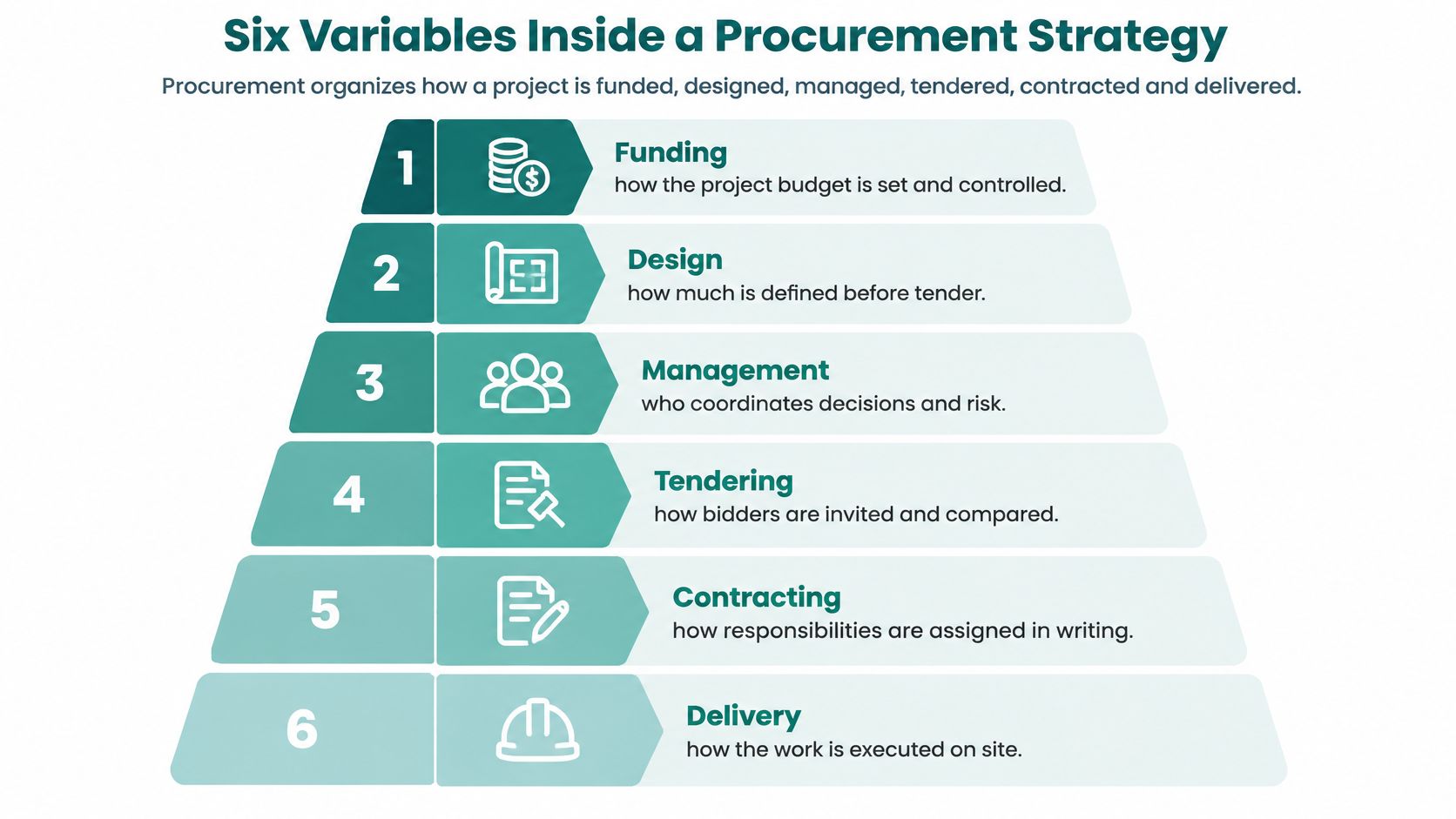
Six Variables Inside a Procurement Strategy
Six variables in a construction procurement strategy
| Variable | What it decides | Typical question |
|---|---|---|
| Funding source | Who pays and which approval rules apply | Public client, developer or occupier? |
| Supplier selection | How the market is invited | Open bid, selective list or two-stage? |
| Pricing basis | How money is calculated | Lump sum, unit price, reimbursable or mixed? |
| Design responsibility | Who owns the design | Client team or contractor? |
| Management responsibility | Who coordinates the work | Client, construction manager or main contractor? |
| Supply-chain integration | When specialists join | After full design or during early packages? |
The Wits University paper on innovative construction procurement identifies these six variables as part of a procurement strategy. Together, they establish the commercial and organisational framework, rather than a shopping list of materials.
What each choice changes on site
Funding source determines the approval path. A public client may have prescribed procurement procedures, while an occupier may need landlord consent before committing to alterations.
Supplier selection determines how you test capability and value. Open competition invites the wider market; a selective list screens bidders beforehand; a staged approach lets the client develop the package with supplier input before fixing the final commercial commitment.
The pricing basis determines what the accounts team needs to verify. A measured-work package requires reliable quantity records, while a reimbursable package needs access to allowable-cost evidence.
Design responsibility needs a clear boundary. If the contractor develops a wireless design, state which client requirements remain mandatory and who reviews proposed departures.
Management responsibility determines who resolves clashes. Someone must coordinate access-point positions with ceilings, lighting, power, containment and access for maintenance.
Finally, supply-chain integration determines when specialist knowledge enters the job. Early involvement can expose equipment constraints or missing interfaces while the design is still adjustable.
Turn the framework into a technology package
For education, retail and BYOD corporate projects, avoid a scope that says only “provide Wi-Fi.” State the intended coverage areas, guest journey, captive portals, social login or social Wi-Fi requirements, and the authentication outcomes expected from IPSK or EasyPSK.
Where Cisco Meraki is the network standard, identify compatibility requirements and assign responsibility for checking the proposed configuration. Don't assume that naming a platform defines how users will connect, receive credentials or lose access when their authorisation ends.
- Define interfaces: Identify who provides cabling, switching, internet connectivity and portal configuration.
- Control commitments: Connect package approvals to purchase order systems so orders match authorised scope.
- Preserve options: Where design is developing, request transparent option prices rather than accepting an unexplained contingency.
Choose a row for your own project and write down the answer. An unresolved management or design responsibility is more useful to identify now than after delivery routes have been shortlisted.
Delivery Routes from Traditional to Design and Build
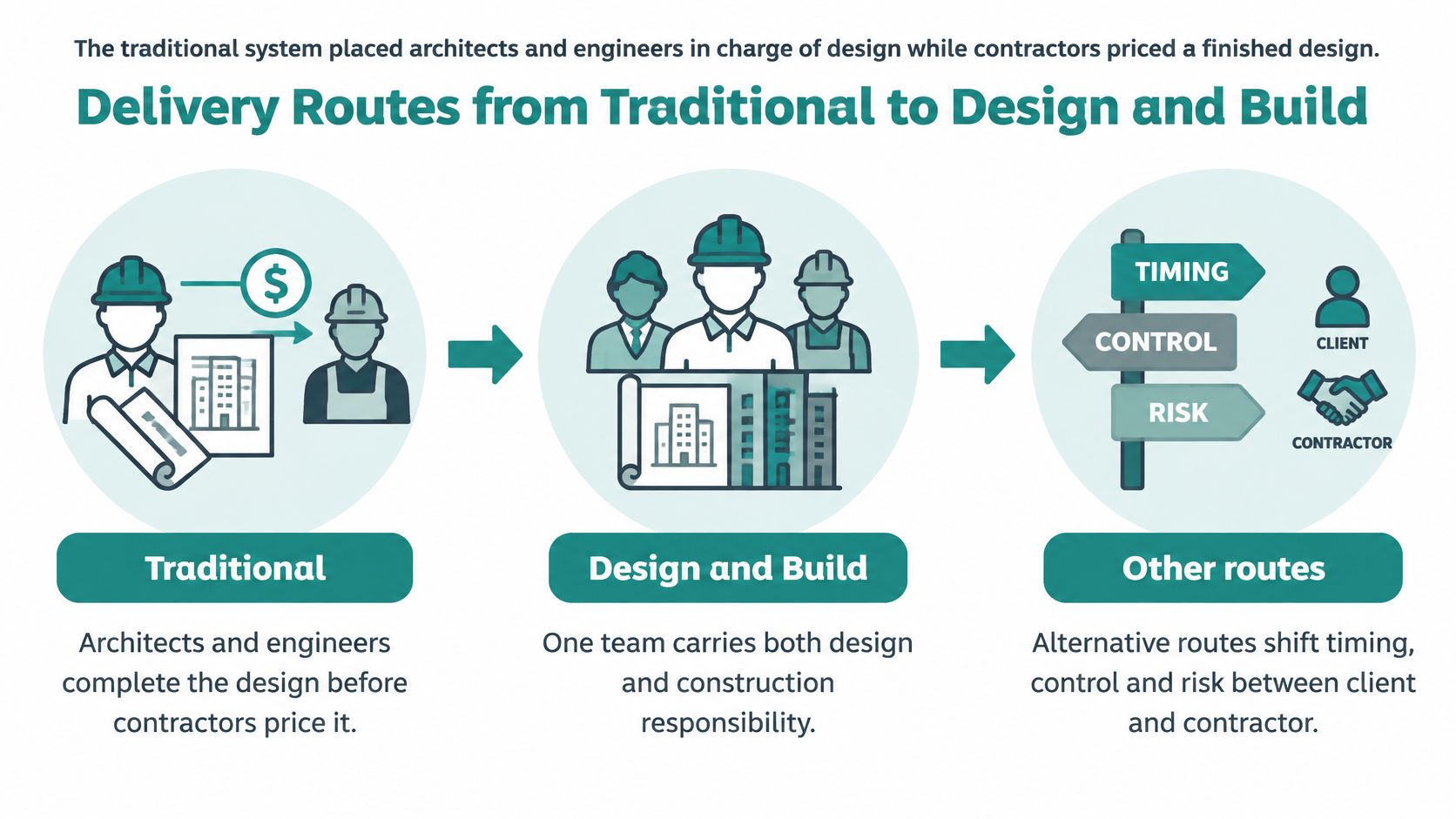
The traditional system placed architects and engineers in charge of design while contractors priced a finished design, and later routes such as design and build and construction management shift that split.
The Collaborative Procurement Guide explains how different arrangements change responsibility, contractor involvement and collaboration. The practical question isn't which label sounds most modern, but which arrangement fits the information and management capacity you have.
Construction delivery routes compared
| Route | Design sits with | Construction sits with | Best when | Main trade-off |
|---|---|---|---|---|
| Traditional design-bid-build | Client consultants | Contractor after bids | Design is complete and price certainty matters | Slower start; changes become variations |
| Design and build | Contractor | Same contractor | One point of responsibility is wanted | Client has less direct design control |
| Management | Client consultants | Trade contractors under a manager | Early start and package flexibility matter | Client holds interface risk |
| Integrated or collaborative | Shared early | Shared delivery team | Complexity needs early supplier input | Needs a capable client team |
| Revenue financed | Allocated by the agreement | Delivery partner | The asset is paid from future income | Long commercial commitment |
Read the trade-off behind the label
Traditional procurement separates design from construction appointment. Tennessee's Office of the State Architect delivery-method policy treats design-bid-build as its standard method unless another receives approval, with award to the responsive and responsible bidder offering the lowest cost.
That isn't permission to accept any cheap submission. Responsiveness concerns meeting the tender requirements; responsibility concerns the bidder's suitability to perform.
Design and build places coordination with the contracting side, but the owner still needs clear requirements and a disciplined review process. A single contract won't resolve an ambiguous brief.
Under a management route, the client can release developed packages while other designs continue. Check the actual contractual structure: management contracting and construction management don't necessarily place trade contracts with the same party.
Keep outcomes measurable
Integrated or collaborative arrangements bring suppliers into shared delivery planning. They require clear decision rights and commercial rules, beyond a mere promise that everyone will cooperate.
Choose a route your team can administer, not just one that appears to offer an earlier start.
A detailed traditional tender can still specify Wi-Fi coverage, captive-portal behaviour, authentication integration and guest-network security. The delivery route determines who develops that solution and coordinates its testing, not whether those outcomes matter.
Contract Prices and Who Pays When Things Change
Who pays if the quantities increase, equipment costs move or the client changes the brief? The answer comes from the contract's pricing and risk provisions, not the headline tender total.
The World Bank procurement guidelines identify lump-sum, unit-price, reimbursable-cost and combined arrangements, with reimbursable costs reserved for exceptional circumstances involving high risk or costs that can't be estimated accurately in advance.
Pricing mechanisms and where the risk sits
| Pricing type | Use when | Owner gets | Watch-out |
|---|---|---|---|
| Lump sum | Design and quantities are defined | Stronger budget predictability | Contingencies and variations if information is thin |
| Unit price | Quantities are uncertain but measurable | Payment on verified quantities | Arguments over measurement |
| Reimbursable cost | Risk is exceptional or costs cannot be estimated | Flexibility to proceed | Weak price control |
| Combined or target cost | Some work is firm and some is not | Shared pain and gain where expressly agreed | Heavier administration |
| EPC | One party should engineer, procure and build | Single point of responsibility | Needs precise tests and change rules |
Match payment to what you know
Lump sum works best when bidders can understand and price the whole obligation. Thin information doesn't remove uncertainty; bidders may price contingencies, exclude work or seek variations later.
Unit prices suit measurable uncertainty, such as excavation quantities. Agree the measurement method and supporting records before work begins.
Reimbursable work needs cost controls, audit rights and clear allowable-cost rules. A combined arrangement can price settled packages firmly while treating uncertain work differently; target-cost pain/gain sharing must be expressly defined rather than assumed.
EPC is a responsibility arrangement rather than a pricing formula. It can simplify owner coordination, but performance requirements, interfaces, commissioning tests and change rules must be precise.
Put the commercial rules in writing
Use a request for bids when requirements are detailed. Where bidders must develop different solutions or methods, use a proposal approach that lets you evaluate those differences fairly.
Procurement documents should state:
- Commercial basis: Contract type, pricing basis and scope boundaries.
- Selection rules: Published evaluation criteria and required evidence.
- Decision authority: What the engineer or construction manager may approve or instruct.
- Completion duties: Testing, commissioning, training and handover obligations.
Scope changes commonly drive overruns. Where energy, materials or programme dates may move, define escalation clauses, allowances, provisional sums and early-warning duties rather than negotiating from scratch after the event.
Also assess total cost of ownership, including operation and maintenance. A low installation price won't help if the client inherits avoidable support work.
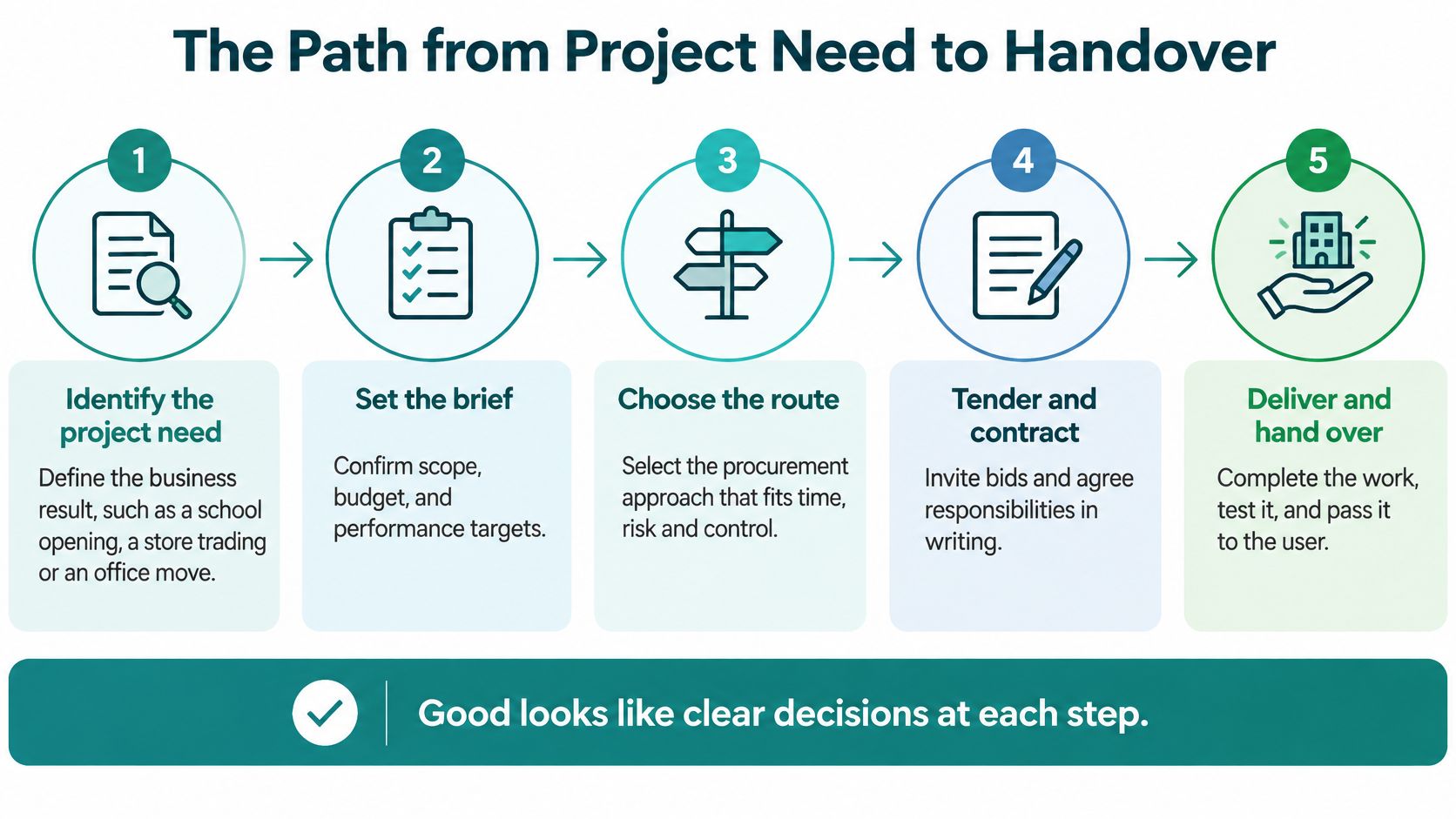
The Path from Project Need to Handover
A procurement process needs an owner at every stage, including after award. The World Bank procurement framework treats procurement as an end-to-end process and includes related construction activities such as installation, insurance, commissioning and training.
Make each decision checkable
Identify the project need. Define the business result, such as a school opening, store trading date or corporate floor supporting BYOD. Acceptance check: the sponsor approves a clear statement of operational need.
Plan procurement. Map work packages, interfaces, approvals, long-lead equipment and the people who'll administer contracts. Acceptance check: every package has a decision owner and required delivery milestone.
Write the specification. Separate employer requirements from contractor design duties. For technology, describe guest Wi-Fi behaviour, captive-portal pages, social login or social Wi-Fi, and IPSK or EasyPSK credential management so users or devices needn't rely on a single shared password. Acceptance check: the proposed Cisco Meraki configuration, where specified, can be tested against written outcomes.
Set the budget. Test assumptions against supplier capacity and realistic scope, not the lowest imaginable equipment price. Acceptance check: the estimate identifies exclusions, allowances and unresolved risks.
Solicit the market. Invite bids or proposals suited to how much solution development remains open. Acceptance check: all bidders receive the same requirements and clarification information.
Evaluate submissions. Apply published criteria, including technical compliance, delivery capability and commercial qualifications. Acceptance check: the recommendation records why the selected submission meets those criteria.
Award the contract. Settle scope boundaries, pricing, authority and change procedures before authorising work. Acceptance check: the executed documents agree with the approved award recommendation.
Manage delivery and handover. Review submittals, inspect work, witness testing and collect commissioning records, training information, warranties and defects obligations. Acceptance check: unresolved items have named owners in the punch list, with a documented close-out process.
Keep the evidence usable
Retain approved specifications, tender clarifications, instructions, test results and payment records in a shared project record. That makes bids comparable at the start and gives the contract administrator a traceable basis for variations and payment later.
Schools, Shops and Offices with Guest Wi-Fi
A wireless package makes procurement responsibilities tangible. Someone must design the network, price access points with extended lead times and sign off the finished user experience.
The Scottish Construction Procurement Handbook identifies five generic strategies: integrated, traditional, design and build, management, and revenue financed. Those organisational choices affect specialist systems just as they affect the physical building.

Education and the missing network brief
Say a campus client completes the shell design for a traditional tender. Its technology consultant also defines student and guest networks, captive portals, social login for visitors and IPSK for dorm and BYOD devices.
The tender assigns network design to the consultant, equipment availability and access-point pricing to the specialist bidder, and test approval to the campus IT representative. Bidders must price those requirements rather than assume the school will configure everything later.
The lesson: A builder appointment alone wouldn't establish who owns the wireless design or accepts the completed network.
Retail and the opening-day test
A shopping-centre fit-out uses design and build because the opening date is fixed. The contractor's specialist develops coverage, a social Wi-Fi splash page and EasyPSK access for staff devices.
The contractor carries the coordinated network design and obtains confirmed access-point pricing and delivery information. Before handover, the retailer's nominated representative witnesses coverage, onboarding and staff-access tests.
An installed access point isn't evidence that a shopper can complete the guest login journey.
The lesson: Give a named contracting party responsibility from design through testing, with client acceptance criteria agreed before installation.
BYOD corporate and the unfinished IT brief
An office client uses a management route so base-build packages can start while the IT team settles its requirements. The tender still specifies Cisco Meraki compatibility, authentication, guest separation from the corporate LAN and responsibility for commissioning the captive portal.
The client appoints the network designer, the specialist package contractor prices and tracks access points, and the corporate IT owner signs off commissioning. The construction manager coordinates their dependencies with the cabling and ceiling teams.
Planning IT support for construction alongside installation helps clarify who handles technical issues during fit-out and who takes responsibility after occupation.
The lesson: Name the commissioning owner before award, even if some design details remain open.
These are scope examples, not a product shortlist. Which constraint dominates your job: a fixed design, a fixed opening date or a brief that's still moving?
Choose the Route Before You Issue the Tender
Write a short decision sheet before inviting bidders. Lock the strategy choices, the delivery route, the price mechanism and the specialist outcomes that must be testable at handover.
Record the decision and its reason
- Complete design and capable bidders: The lowest responsive price can be a fair selection basis where the applicable rules permit it.
- Unified design responsibility: Choose design and build when a single contracting party must coordinate design and construction.
- Early package starts: Consider management or an integrated route when sequencing requires specialist involvement before everything is settled.
- Moving quantities: Don't force an unsupported lump sum onto work that needs measurement.
Use estimating tools to make assumptions visible. Exayard construction estimating software can be considered within that estimating workflow, but the team must still define scope, allowances and responsibility.
Include the operational finish line
For education, retail and BYOD corporate projects, the decision sheet should identify captive portals, social login or social Wi-Fi, and IPSK or EasyPSK on Cisco Meraki where that's the agreed standard. Specify coverage and authentication acceptance tests, including who witnesses them and approves the results.
Where a custom splash experience must match an existing network, customers fill in our custom request form with their specifications and system details, and we then build a custom splash account for them.
Procurement continues through contract administration, so nominate the person who'll manage changes and close-out rather than treating award as the finish line.
Before the first bidder is invited, write the route, the price type and the acceptance tests on a single page.
Splash Access offers guest Wi-Fi captive portals and authentication options for Cisco Meraki environments, helping you define the user experience within a construction technology package. Visit Splash Access to explore guest access options for your education, retail or corporate project and identify the requirements your tender needs to capture.