Hey there! In today's crowded market, a great menu just isn't enough. The secret ingredient to a packed house is a powerful online presence. This guide serves up a full course on digital marketing for restaurant owners, designed to transform your online efforts into real-world results. We'll move beyond generic advice and dive straight into actionable strategies that attract new diners and turn them into loyal regulars.
This isn't just another list of obvious tips. We're breaking down the specific tactics you can implement today, from dominating local search with Google Business Profile to crafting an irresistible social media presence. We'll explore how to build a community through email and SMS marketing and how to harness the power of influencer collaborations and user-generated content. Ultimately, the goal of digital marketing is to boost your bottom line. Discover comprehensive approaches for strategies to increase restaurant sales that align perfectly with the digital tactics covered here.
Furthermore, we'll cover how to leverage in-venue technology to create a seamless customer journey. This includes integrating powerful guest Wi-Fi solutions, like those from Cisco and Cisco Meraki, which use captive portals and advanced authentication solutions like IPSK to engage customers the moment they connect. Whether you're in the hospitality, retail, or managing a corporate BYOD environment, these principles of secure, engaging connectivity are universally applicable. Get ready to cook up a storm and watch your reservations soar.
1. Master Local SEO with an Irresistible Google Business Profile
Think of your Google Business Profile (GBP) as your restaurant's digital front door. For most potential diners, it's their very first interaction with your brand, especially when they perform "near me" searches on Google or look for directions on Google Maps. A fully optimized profile is the cornerstone of any effective digital marketing for restaurant strategy, telling both Google and hungry customers that you are a top choice in the area.
This isn't just about listing your hours. A powerful GBP acts as a dynamic, interactive hub. For example, a local pizzeria can dominate "pizza near me" searches by accumulating over 100 positive reviews, while a fine-dining establishment can entice reservations with high-resolution photos of its signature dishes. A cafe can use the Posts feature to announce a new seasonal latte, driving same-day foot traffic from people scrolling in the neighborhood. This constant activity signals relevance to Google's algorithm, boosting your visibility.
Quick Implementation Tips
- Complete Every Field: Fill out every section of your GBP, including attributes like "outdoor seating," "Wi-Fi," and "accessibility." The more data you provide, the better Google can match you to relevant searches.
- Active Photo Management: Upload new, high-quality photos at least weekly. Showcase your food, your ambiance, and your happy customers.
- Review Engagement: Make it a policy to respond to every single review, positive or negative, within 24 hours. This shows you value customer feedback.
- Utilize Google Posts: Use the Posts feature weekly to highlight specials, promote events, or introduce new menu items.
- Master NAP Consistency: Ensure your Name, Address, and Phone number (NAP) are identical across all online directories. To truly master local search, delve deeper into the importance of this by understanding NAP consistency for local SEO. This consistency builds trust with search engines.
- Leverage On-Premise Tech: Connect your physical and digital worlds. By using a guest Wi-Fi captive portal, you can prompt satisfied diners to leave a review right after their meal, boosting your profile's authority. This approach aligns well with modern location-based marketing strategies.
2. Leverage Social Media as a Visual Menu and Community Hub
Let's talk social! Think of your social media profiles, particularly Instagram and Facebook, as your restaurant's living, breathing menu and community gathering space. For today's diners, scrolling through a visually appealing feed is often the first step in deciding where to eat. A well-curated social media presence is a critical component of any modern digital marketing for restaurant plan, allowing you to tell your brand's story, showcase your culinary creations, and build a loyal following.
This isn't just about posting pictures of food. A powerful social media strategy creates an immersive experience. For example, a trendy taco spot can use Instagram Reels to show the behind-the-scenes process of making their signature birria, creating a mouth-watering spectacle that drives immediate cravings. A family-owned Italian restaurant can use Facebook to host a live Q&A with the chef, fostering a personal connection with regulars. A coffee shop can run a user-generated content (UGC) contest, encouraging customers to post photos with a unique hashtag for a chance to win a gift card, turning patrons into brand ambassadors.
Quick Implementation Tips
- Focus on High-Quality Visuals: Invest in good lighting and learn basic food photography principles. Your photos and videos are your digital storefront, so make every dish look irresistible.
- Embrace Video Content: Use short-form video like Instagram Reels and TikToks to showcase your atmosphere, staff personalities, and the art of your food preparation. These formats have massive organic reach.
- Engage Actively: Don't just post and ghost. Respond to comments, answer direct messages promptly, and engage with content from your followers and other local businesses.
- Run Targeted Ads: Use Facebook and Instagram's powerful ad platforms to run promotions targeted at users within a specific radius of your restaurant who have shown interest in food and dining.
- Promote User-Generated Content (UGC): Actively encourage guests to tag your restaurant in their posts. Share the best customer photos on your own profile (with credit) to build social proof and community.
- Integrate with On-Premise Tech: Connect your social media efforts to your in-house experience. When guests log into your Wi-Fi via a social login captive portal, you can present them with a follow prompt for your social channels. This kind of social Wi-Fi seamlessly converts diners into digital followers, creating a powerful marketing loop. This approach is a cornerstone of modern location-based marketing strategies.
3. Email Marketing & Loyalty Programs
Unlike social media, where algorithms control who sees your content, email marketing gives you a direct, owned line of communication with your most valuable customers. It’s the engine for building long-term relationships, turning one-time visitors into regulars. An effective digital marketing for restaurant strategy uses email to nurture these connections, driving repeat business and building a loyal community around your brand.
This channel is perfect for targeted, personal communication that a social media post can't replicate. For example, a coffee shop chain sends personalized offers based on a customer's purchase history, encouraging them to try a new drink they're likely to enjoy. A local bistro can use email to announce a last-minute dinner special exclusively for subscribers, filling tables on a slow Tuesday night. These campaigns make customers feel like insiders, rewarding their loyalty and keeping your restaurant top-of-mind.
Quick Implementation Tips
- Build Your List Strategically: Collect email addresses at every touchpoint. The most effective method is through your guest Wi-Fi. By setting up a captive portal on your Meraki or Cisco network, you can offer free internet access in exchange for an email address, automating list growth.
- Segment for Relevance: Don't send the same message to everyone. Group your subscribers by their visit frequency, average spend, or menu preferences to send highly relevant promotions that convert.
- Craft Compelling Subject Lines: Your subject line determines if your email gets opened. Use action-oriented language, create urgency, and personalize where possible (e.g., "An Exclusive Offer Just for You, [Name]!").
- Optimize Send Times: While Tuesday to Thursday mornings are generally considered optimal, test different days and times to see what works best for your specific audience.
- Offer Exclusive Value: Make your email list the best place to get deals. Provide subscribers with exclusive discounts, early access to new menu items, or special event invitations.
- Integrate with On-Premise Tech: Connect your email efforts directly to your in-venue experience. A captive portal can automatically add new diners to a "Welcome" email sequence. You can also explore powerful digital marketing automation tools to streamline this entire process from sign-up to loyalty reward.
4. Influencer & User-Generated Content Partnerships
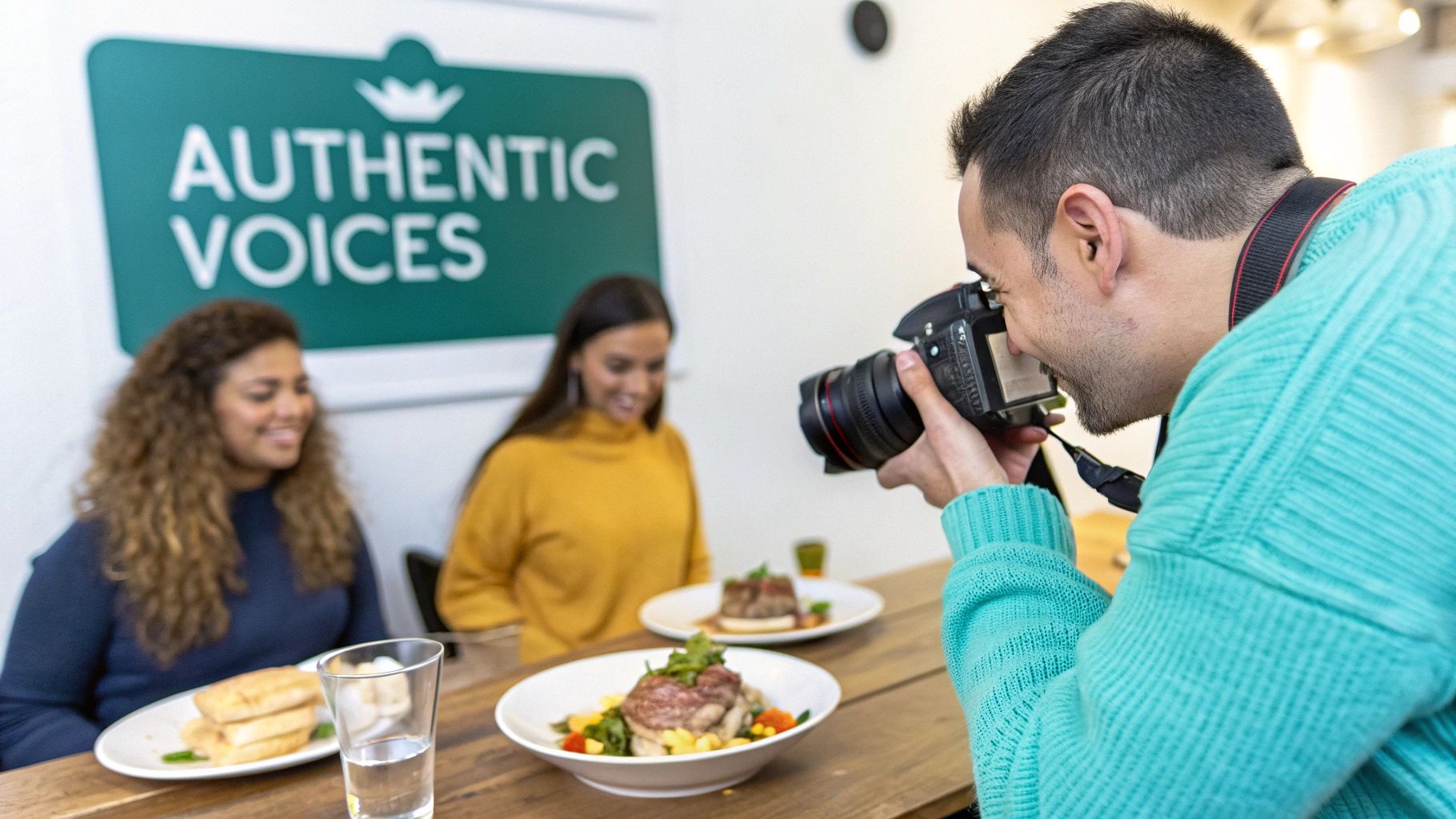
Modern word-of-mouth marketing has gone digital, and its most powerful ambassadors are influencers and your own customers. Partnering with food bloggers, local creators, and even enthusiastic patrons transforms your dining experience into authentic, shareable content. This strategy moves beyond traditional advertising by leveraging trusted voices to build credibility and social proof, making it a vital component of any comprehensive digital marketing for restaurant plan.
This is about creating a groundswell of genuine excitement. Imagine a local food influencer with 15,000 highly engaged followers posting a story about your weekend brunch special, leading to a noticeable spike in reservations. Or, picture a customer’s stunning photo of your signature cocktail being reshared on your official profile, encouraging dozens of others to post their own experiences. This constant flow of user-generated content (UGC) provides a steady stream of authentic marketing material that resonates far more than polished corporate ads.
Quick Implementation Tips
- Target Micro-Influencers: Focus on creators with 10k-100k followers. Their audiences are often more localized and engaged, providing better ROI and a more authentic connection than mega-influencers.
- Align Audiences: Before partnering, ensure an influencer's follower demographic matches your ideal customer profile. A trendy vegan blogger is a perfect fit for a plant-based cafe but not a traditional steakhouse.
- Create Branded Hashtags: Develop a simple, memorable hashtag (e.g., #EatAtJoesPizza) and promote it on menus, receipts, and social media to easily track and discover UGC.
- Feature Customer Content: Regularly repost the best customer photos and stories on your official channels (with credit). This rewards loyal customers and encourages more people to share.
- Build Real Relationships: Identify and connect with regular customers who have active, engaged social media presences. A small gesture, like a complimentary dessert, can turn a happy customer into a powerful brand advocate.
- Connect On-Site with Guest Wi-Fi: Turn your dining room into a content creation hub. Use your guest Wi-Fi captive portal, powered by systems like Cisco Meraki, to promote your branded hashtag or a photo contest upon login. This ensures guests using the BYOD network are immediately prompted to engage online.
5. Harness the Power of Video Marketing and YouTube Content
In the visual-first world of social media, video isn't just an option; it's a necessity. Video content offers a sensory experience that static images cannot match, allowing you to showcase the sounds, sights, and energy of your restaurant. This form of digital marketing for restaurant humanizes your brand, tells your story, and creates a powerful emotional connection with potential diners before they ever step inside.
This strategy moves beyond simple commercials. It’s about creating engaging narratives. Imagine a short, vibrant TikTok video showing the artful construction of your signature burger, which earns thousands of shares and drives weekend traffic. Or consider a YouTube series where your head chef shares cooking tips, establishing your restaurant as a local culinary authority. Food-centric video content commands massive audiences, and local restaurants can tap into this same energy on a smaller, more targeted scale.
Quick Implementation Tips
- Optimize for Short-Form: Create videos between 15 and 60 seconds for platforms like Instagram Reels and TikTok. Focus on one key message, whether it’s a behind-the-scenes look at food prep or a customer's happy reaction.
- Showcase the Process: Don't just show the final dish. Film the sizzle of the steak, the stretching of the pizza dough, or the meticulous plating of a dessert. This behind-the-scenes content builds authenticity and anticipation.
- Prioritize Quality: You don't need a Hollywood budget, but good lighting and clear audio are non-negotiable. Modern smartphones are incredibly capable, so invest in a simple tripod and microphone for professional results.
- Add Captions: A significant portion of social media videos are watched with the sound off. Add captions to ensure your message is understood by everyone, everywhere.
- Optimize for Search: When uploading to YouTube, treat your titles and descriptions like a blog post. Use keywords like "[Your City] best Italian food" or "[Dish Name] recipe" to capture search traffic.
- Integrate with On-Premise Tech: Use your guest Wi-Fi to promote your video channels. A captive portal, especially on robust systems like those from Cisco or Meraki, can feature a link to your latest YouTube video or TikTok profile. This turns diners into subscribers and brand advocates on the spot.
6. Search Engine Marketing (SEM) & Google Ads
While SEO builds your organic presence over time, Search Engine Marketing (SEM) allows you to pay for a guaranteed top spot in search results. This is a crucial component of digital marketing for a restaurant that wants immediate visibility. Through platforms like Google Ads, you can place your restaurant directly in front of potential customers at the exact moment they are searching for a place to eat, effectively buying your way to the top of the search page.
This instant visibility is a game-changer. Imagine a potential customer searching for "best sushi near me" and seeing your restaurant's ad first, complete with a "click-to-call" button and directions. A cloud kitchen focused on delivery could run ads targeting users searching for "pizza delivery," sending them to a seamless online ordering page. Similarly, a fine-dining establishment can target affluent travelers searching for "luxury dining" in your city, showcasing a special tasting menu to entice reservations. This direct-response capability drives immediate, measurable results.
Quick Implementation Tips
- Hyper-Local Keyword Targeting: Focus on keywords with local intent, like "Mexican food downtown [Your City]" or "[Your Neighborhood] brunch spots." This ensures you're reaching people who can actually visit.
- Use Ad Extensions: Enhance your ads with extensions. The Location Extension shows your address, the Call Extension adds a clickable phone number, and Sitelink Extensions can direct users to your menu or reservations page.
- Create Negative Keyword Lists: Prevent wasting your budget by excluding irrelevant search terms. For example, if you're an upscale Italian restaurant, you might add "cheap," "pizza," and "recipe" as negative keywords.
- Build Dedicated Landing Pages: Don't just send ad clicks to your homepage. Create specific landing pages for each campaign (e.g., a page for your happy hour special) to provide a clear call to action and improve conversion rates.
- Leverage Remarketing: Target users who have previously visited your website. You can show them ads reminding them of your special offers as they browse other sites, keeping your restaurant top of mind.
- Track Everything: Set up conversion tracking to measure what matters: reservations made, phone calls from ads, or online orders. This data is essential for understanding your return on investment and optimizing your campaigns.
7. Build Authority with a Content-Rich Blog Strategy
A blog is far more than an online diary; it's a powerful engine for attracting new customers and establishing your restaurant as a culinary authority. By creating valuable, search-optimized content, you answer the questions potential diners are asking online. This strategic approach to digital marketing for restaurants draws in organic traffic from people who aren't just looking for a meal, but for an experience, a recipe, or expertise they can trust.
This isn't just about posting your weekly specials. A well-executed blog becomes a primary asset. For instance, a farm-to-table bistro can write a detailed post about their relationship with a local organic farm, complete with photos and interviews. This content could rank for "local organic food [Your City]," attracting diners passionate about ingredient sourcing. A high-end steakhouse could publish a guide on "how to pair wine with different cuts of steak," positioning themselves as experts and driving reservations from wine enthusiasts. This content works for you 24/7, building brand equity and a loyal following.
Quick Implementation Tips
- Target Long-Tail Keywords: Focus on specific, less competitive search terms like "best gluten-free pasta in [neighborhood]" or "family-friendly brunch spots with outdoor seating" to attract highly qualified traffic.
- Publish In-Depth Content: Aim for comprehensive articles (1,500+ words) that thoroughly cover a topic. Think "The Ultimate Guide to Neapolitan Pizza" or "A Chef's Secrets to Perfect Risotto." This depth signals expertise to Google.
- Optimize for Snippets: Structure your content with clear headings, lists, and Q&A sections to increase your chances of being featured in Google's answer boxes, which can significantly boost click-through rates.
- Use High-Quality Visuals: Every post should include professional photos and videos with descriptive alt text. Showcasing your process, ingredients, and final dishes makes your content more engaging and shareable.
- Promote Across Channels: Share every new blog post across your social media profiles and in your email newsletter to maximize its reach and drive traffic back to your website.
- Focus on Internal Linking: Link from your blog posts to relevant pages on your site, such as your menu, reservations page, or online ordering portal, to guide readers toward a conversion.
8. Streamline Operations with Online Reservation & Booking Systems
In today's fast-paced world, convenience is king. An online reservation system is the digital maître d' for your restaurant, allowing diners to book a table from anywhere, at any time. Integrating a booking system directly into your digital marketing for restaurant strategy removes friction from the customer journey, transforming website visitors and social media followers into confirmed guests with just a few clicks. This is no longer a luxury for fine dining; it's a core operational tool.
The impact extends far beyond just filling seats. A modern steakhouse can use reservation data to anticipate busy nights and staff accordingly, while a popular brunch spot can reduce no-shows with automated SMS reminders. These systems also capture valuable customer data, like dining preferences and special occasions, which can be used to personalize future marketing efforts. By automating the booking process, you free up your staff to focus on delivering an exceptional in-house experience, improving both efficiency and guest satisfaction.
Quick Implementation Tips
- Prominent Website Integration: Place your reservation widget or button "above the fold" on your homepage so it's impossible to miss.
- Reduce No-Shows: Implement automated email or SMS reminders sent 24 hours before the reservation. Consider a clear and fair cancellation policy to further discourage no-shows.
- Maximize Seating Capacity: Use the system's table management features to optimize your floor plan and turn tables more efficiently during peak hours.
- Capture Guest Data: Use the booking process to collect email addresses and birthdates (with permission) to grow your email marketing list for future promotions.
- Offer Off-Peak Incentives: Drive traffic during slower periods by offering special promotions or a complimentary drink for guests who book a table between 5-6 PM on a weekday.
- Seamless Guest Experience: For an even more connected experience, integrate your guest Wi-Fi captive portal, powered by solutions like Cisco Meraki, with your booking system. Once a guest with a reservation connects to your Wi-Fi, you can greet them with a personalized welcome message, enhancing their visit from the moment they arrive. While the principles are similar, you can explore how other hospitality sectors use these powerful tools by learning more about reservation systems for hotels.
9. Mobile App Development & Push Notifications
In today's mobile-first world, a branded app gives your restaurant a permanent home on your customers' most-used device. It’s a powerful digital marketing for restaurant tool that transitions you from simply being an option on a third-party app to becoming a direct channel for engagement. A custom app consolidates ordering, reservations, loyalty programs, and payments into a single, seamless user experience.
This direct line of communication is a game-changer. For example, a local cafe can use push notifications to send a "Happy Hour starts now!" alert to app users within a one-mile radius, driving immediate foot traffic. A family restaurant can offer a mobile-exclusive coupon for a free dessert, encouraging downloads and repeat business.
Quick Implementation Tips
- Integrate Loyalty Seamlessly: Ensure your app is the central hub for your loyalty program, allowing customers to easily track points, redeem rewards, and view their progress.
- Prioritize User Experience (UX): Design a clean, intuitive interface that makes ordering effortless. Features like one-click reordering of favorite meals can significantly boost repeat purchases.
- Use Personalized Push Notifications: Go beyond generic blasts. Send targeted offers based on a customer's order history, such as a special on their favorite pizza or a reminder to book a table for an upcoming anniversary.
- Offer App-Exclusive Incentives: Drive downloads by providing deals and menu items that are only available through your mobile app. This creates a sense of exclusivity and value.
- Connect with On-Premise Tech: Enhance the in-restaurant experience by linking your app to your guest Wi-Fi. Systems powered by Cisco Meraki can trigger a push notification with a special offer as soon as a loyal app user connects to the network, creating a personalized welcome. This approach is highly effective for gathering user data and boosting engagement.
- Master Notification Strategy: Use a balanced approach to avoid notification fatigue. Combine timely alerts for order status with occasional, high-value promotions. You can explore how to integrate push notifications with Wi-Fi authentication solutions to create powerful, context-aware marketing moments.
10. Review Management & Reputation Monitoring
Your online reviews are the modern-day word-of-mouth, shaping your restaurant's reputation with every star and comment. Active review management is no longer optional; it's a critical component of digital marketing for restaurant success. It involves monitoring feedback across platforms, responding thoughtfully, and using the insights to improve your operations. This process directly influences potential customers, as a high volume of recent, positive reviews builds immense social proof and trust.
Think of it this way: a consistent stream of five-star reviews for a local bistro, each met with a personalized thank you from the owner, signals exceptional service and care. Conversely, when a customer leaves a three-star review about slow service, a prompt, professional response that offers a solution can turn a negative experience into a display of excellent customer recovery. This proactive engagement shows both the reviewer and future diners that you value feedback and are committed to quality, directly impacting your bottom line.
Quick Implementation Tips
- Respond Within 24 Hours: Aim to reply to every review, good or bad, within 24 hours. Speed shows you are attentive and value customer opinions.
- Acknowledge and Personalize: Thank positive reviewers by name and reference a specific point they made. For negative reviews, apologize for their experience and offer a solution offline.
- Incorporate Keywords Naturally: When appropriate, include your restaurant name and keywords like "best Italian food in [City]" in your responses to enhance local SEO.
- Turn Feedback into Action: Use reviews as a direct line to customer sentiment. If multiple reviews mention a specific dish being cold, address it with your kitchen staff immediately.
- Automate the Ask: The best time to ask for a review is right after a great experience. Use your guest Wi-Fi captive portal to automatically trigger a review request email or a redirect to a review page after a diner logs in. This strategy is highly effective and integrates seamlessly with network hardware from providers like Cisco Meraki.
Restaurant Digital Marketing — 10-Channel Comparison
| Strategy | 🔄 Implementation Complexity | ⚡ Resources & Cost | 📊 Expected Outcomes | 💡 Ideal Use Cases | ⭐ Key Advantages |
|---|---|---|---|---|---|
| Social Media Marketing & Content Strategy | Medium — ongoing content cadence and community management | Low–Medium — creative assets, time, possible ad spend | High engagement and brand awareness; moderate direct conversions | Visual menus, new launches, community building | 4⭐ — High organic ROI and direct customer engagement |
| Google My Business Optimization | Low — one-time setup + regular updates | Low — time to maintain and photo uploads | Strong local visibility and increased foot traffic | Local businesses seeking map/search prominence | 4⭐ — Free, high local intent visibility |
| Email Marketing & Loyalty Programs | Medium — segmentation and automation setup | Low–Medium — platform fees and list maintenance | High repeat visits and revenue uplift (strong ROI) | Retention, promotions, loyalty-driven sales | 5⭐ — Direct, measurable channel for repeat business |
| Influencer & UGC Partnerships | Medium — vetting partners and coordinating campaigns | Low–Medium — trade or paid partnerships | Variable reach; high authenticity and potential engagement | New openings, viral campaigns, visual dishes | 4⭐ — Authentic endorsements and repurposable content |
| Video Marketing & YouTube Content | High — production, editing, consistent publishing | Medium–High — equipment, crew, time | High engagement, shareability and long-term SEO benefits | Storytelling, chef profiles, signature dish showcases | 5⭐ — Strong emotional connection and multi-platform reuse |
| Search Engine Marketing (SEM) & Google Ads | Medium — campaign setup and continuous optimization | Medium–High — pay-per-click budgets and management | Immediate high-intent traffic and measurable conversions | Time-sensitive promotions, high-competition keywords | 4⭐ — Fast visibility and precise targeting |
| Content Marketing & Blog Strategy | Medium — research, writing, SEO optimization | Low–Medium — content creation and SEO resources | Gradual organic traffic growth (long-term) | Authority-building, SEO, and in-depth topics | 4⭐ — Sustainable organic traffic and expertise positioning |
| Online Reservation & Booking Systems | Low–Medium — integration and staff training | Medium — platform fees and setup | Reduced no-shows, better capacity utilization, modest revenue lift | Fine dining and reservation-driven restaurants | 4⭐ — Operational efficiency and customer convenience |
| Mobile App Development & Push Notifications | High — development, integration, ongoing maintenance | High — development + monthly maintenance costs | Strong retention and direct ordering if adoption succeeds | Large chains or high-frequency customers | 4⭐ — Direct channel with higher margins (requires promotion) |
| Review Management & Reputation Monitoring | Medium — continuous monitoring and responses | Low–Medium — tools or staff time | Improved trust, higher conversion lift and local SEO | All restaurants focused on reputation and reviews | 5⭐ — Directly improves trust and visit likelihood |
Your Recipe for Digital Marketing Success
Navigating the landscape of digital marketing for restaurant success can feel like perfecting a complex new dish. You’ve just explored a full menu of strategies, from optimizing your Google Business Profile to launching targeted paid ad campaigns and fostering a community through social media. The key takeaway isn't that you must execute all ten strategies at once. Instead, the goal is to become a master chef of your own marketing, strategically selecting and combining the right ingredients to create a recipe that perfectly suits your brand, your audience, and your unique business goals.
The journey starts with a solid foundation, or mise en place. Your Google Business Profile and a vibrant social media presence are the non-negotiables; they are the salt and pepper of your strategy, essential for visibility and basic engagement. From there, you begin to layer in more complex flavors. Email marketing fueled by a robust loyalty program creates a direct line to your most valuable customers, turning one-time visitors into lifelong fans. Similarly, harnessing the power of influencer collaborations and user-generated content adds authenticity and social proof that no advertisement can buy.
From Individual Tactics to an Integrated System
The true power of a modern digital marketing for restaurant strategy emerges when these individual channels stop operating in silos and start working together as an integrated system. Think about how a seamless online reservation system reduces friction for potential diners browsing your blog, or how positive reviews showcased on your website can boost the conversion rate of your Google Ads. Each element supports and amplifies the others.
This is where innovative on-premise technology can become your secret ingredient, connecting the physical dining experience with your digital efforts. Consider the untapped potential of your guest Wi-Fi. It's more than just a free amenity; it's a powerful data-gathering tool.
By implementing a captive portal on your guest network, you transform a simple login process into a strategic marketing touchpoint. Instead of a generic password, guests can connect via a social login, providing you with valuable, permission-based marketing data while simultaneously growing your social media following with this powerful social Wi-Fi feature.
Turning On-Site Engagement into Off-Site Revenue
Imagine a customer connects to your Wi-Fi. Instantly, they are added to a specific email list for a follow-up "thank you" note and a special offer for their next visit. This is the power of integrating systems like Cisco Meraki with advanced captive portal and authentication solutions. You can segment audiences automatically, rewarding repeat visitors and re-engaging those who haven't stopped by in a while. This is especially crucial for venues that cater to diverse audiences, such as corporate campuses with BYOD policies, retail centers, and education institutions, where secure and segmented access is paramount.
This approach allows you to:
- Automate Marketing: Trigger email or SMS campaigns based on a guest’s visit frequency or a special event.
- Enhance Security: Utilize advanced authentication like IPSK (Individual Pre-Shared Key) or EasyPSK to provide secure, personalized network access for staff or VIP guests without compromising the public network.
- Gather Actionable Analytics: Understand foot traffic patterns, dwell times, and new vs. repeat visitor rates to make smarter business decisions.
Ultimately, mastering digital marketing for restaurant growth is an ongoing process of testing, learning, and refining. Start with the foundational elements we’ve covered, build your confidence, and then begin integrating more advanced tools to create a seamless feedback loop between your physical location and your online presence. By doing so, you're not just marketing your restaurant; you're building a resilient, data-driven brand that can thrive in any environment and keep diners coming back for more.
Ready to turn your guest Wi-Fi into your most powerful marketing tool? Splash Access integrates seamlessly with leading hardware like Cisco Meraki to create intelligent, secure, and brandable captive portal experiences. Visit Splash Access to see how you can start collecting valuable customer data and supercharging your restaurant's marketing efforts today.