
Ever wonder how your favorite hotels seem to know exactly what you want before you even ask? It's not magic—it's a smart Customer Relationship Management (CRM) system working behind the scenes. In today's hospitality world, a CRM is the central nervous system for the entire guest experience, going far beyond a simple contact list to help you and your team create truly unforgettable stays.
What Is a Hospitality CRM?
Think of a hospitality CRM as your hotel's memory. It’s a specialized system built to collect and organize every piece of guest information into a single, unified profile. It's all about knowing who your guests are, what they love, and what keeps them coming back for more.
This isn't just about a name and booking history. A guest interacts with your property in countless ways, from the moment they book a room to the feedback they leave after checking out. A CRM connects all those dots, giving you the full picture.
The Modern Guest Wi-Fi Connection
Let's chat about one of the most valuable, yet often overlooked, sources of guest data: your Wi-Fi network. When a guest connects through a Captive Portal, especially one that allows for an easy social login, you gain incredible, permission-based insights. This is where high-performance networking solutions from friends like Cisco and Meraki really shine.
A well-integrated CRM doesn't just store data; it breathes life into it. It turns a simple Wi-Fi login into a personalized greeting, a past preference into a future delight, and a one-time visitor into a lifelong advocate.
Capturing this data seamlessly is a game-changer not just for hotels but also for related sectors like Education, Retail, and BYOD Corporate environments that manage guest access. By using secure Authentication Solutions like IPSK and EasyPSK, you can provide reliable connectivity while simultaneously feeding your CRM the data needed for genuine customer experience personalization.
Key CRM Functions in Hospitality at a Glance
To put it simply, a CRM helps you understand and serve your guests better. Here’s a quick, friendly breakdown of what these systems do and why it matters to you.
| CRM Function | Primary Goal | Key Benefit |
|---|---|---|
| Guest Data Consolidation | Create a single, 360-degree view of each guest. | Eliminates data silos and provides a consistent understanding of guest history. |
| Personalization Engine | Deliver tailored offers, services, and communications. | Increases guest satisfaction, encourages upgrades, and boosts ancillary revenue. |
| Loyalty Program Management | Track points, tiers, and rewards for repeat guests. | Fosters guest loyalty and encourages direct bookings over third-party sites. |
| Marketing Automation | Send targeted pre-stay, in-stay, and post-stay emails. | Drives engagement, solicits reviews, and promotes return visits automatically. |
| Operational Integration | Connect guest data with hotel operations (PMS, POS). | Empowers staff to provide proactive, informed service at every touchpoint. |
Ultimately, each of these functions works together to build stronger, more profitable relationships with the people who matter most—your guests.
Fueling Growth and Loyalty
The industry is clearly catching on. The market for CRM software in hospitality was recently valued at around USD 4.1 billion, and analysts expect that number to climb as more properties embrace technology to drive direct bookings and build loyalty. You can find more details in the hospitality CRM software market report from Dataintelo.
For any hospitality business, investing in the right CRM is no longer optional. It's also critical to see how specialized tools like loyalty applications specifically designed for hotels fit into the picture. By centralizing all your guest data, you empower your team to shift from reactive service to proactive hospitality, creating the kind of memorable experiences that build lasting relationships and grow your bottom line.
Building a 360-Degree Guest Profile with Wi-Fi Data
To create those memorable, "wow" moments for your guests, you have to know who they are. The whole point of a modern CRM in the hospitality sector is to build a detailed, 360-degree profile for every person who walks through your doors. It's about turning fragmented bits of data into a crystal-clear picture of their individual wants and needs.
This goes far beyond just remembering their name and booking history. A truly powerful guest profile tracks everything from their preferred room type and favorite table at the restaurant to the special pillow request they made last year. And one of the most valuable, yet often overlooked, sources for this intel is your guest Wi-Fi.
This simple flow shows how you can turn basic guest data into an experience they won't forget.
As you can see, it all starts with capturing guest information. Your CRM then works its magic, turning that data into the insights your team needs to deliver a personalized experience that truly connects.
Tapping into Your Wi-Fi Network
Think about it: what's one of the first things nearly every guest does upon arrival? They connect to your guest Wi-Fi. That single action is a golden opportunity. By using a Captive Portal—that branded login screen—you create a digital handshake that can ethically and securely gather valuable insights for your CRM, all with the guest's permission.
One of the slickest ways to do this is by offering social login options. Often called social Wi-Fi, this method lets guests log in with their existing social media profiles. With their consent, your CRM can instantly pull in helpful demographic data and interests, enriching their profile without making them fill out a tedious form.
The Technology Behind the Connection
Of course, this data-gathering magic doesn't happen without a rock-solid and secure Wi-Fi infrastructure. This is where industry-leading hardware from providers like Cisco and Meraki comes into play. Their networking gear provides the reliable backbone needed to manage hundreds or thousands of guest connections at once, ensuring everyone has a seamless online experience.
Just as important, these systems are built for secure data handling. Advanced Authentication Solutions such as IPSK (Identity Pre-Shared Key) and EasyPSK ensure every connection is properly secured and managed.
A powerful CRM is only as good as the data it receives. By integrating secure, high-performance Wi-Fi from Cisco Meraki with a smart Captive Portal, you turn a utility into your most valuable guest intelligence tool.
This kind of secure guest access isn't just for hotels. It's vital in any environment where you're managing visitor networks:
- Education: University campuses managing network access for students and guests.
- Retail: Shopping centers offering Wi-Fi to improve the customer journey.
- BYOD Corporate: Offices giving visitors secure guest access without risking network integrity.
By channeling this permission-based data directly into your CRM, you can start anticipating guest needs with stunning accuracy. You'll know their preferences before they even check in for their next visit. Understanding how people move around your property adds yet another layer of insight. For a closer look, you can explore how location analytics can enrich these guest profiles even further. This is how your team stops providing just good service and starts delivering truly personal hospitality.
Turn Your Guest Wi-Fi Into a Powerful Engagement Tool
Think about the first thing most guests do when they arrive: they ask for the Wi-Fi password. This simple act is more than just a request for internet; it's your first real chance to make a digital connection. When you link your guest Wi-Fi network to your CRM, you're no longer just providing a utility. You're opening a direct line of communication.
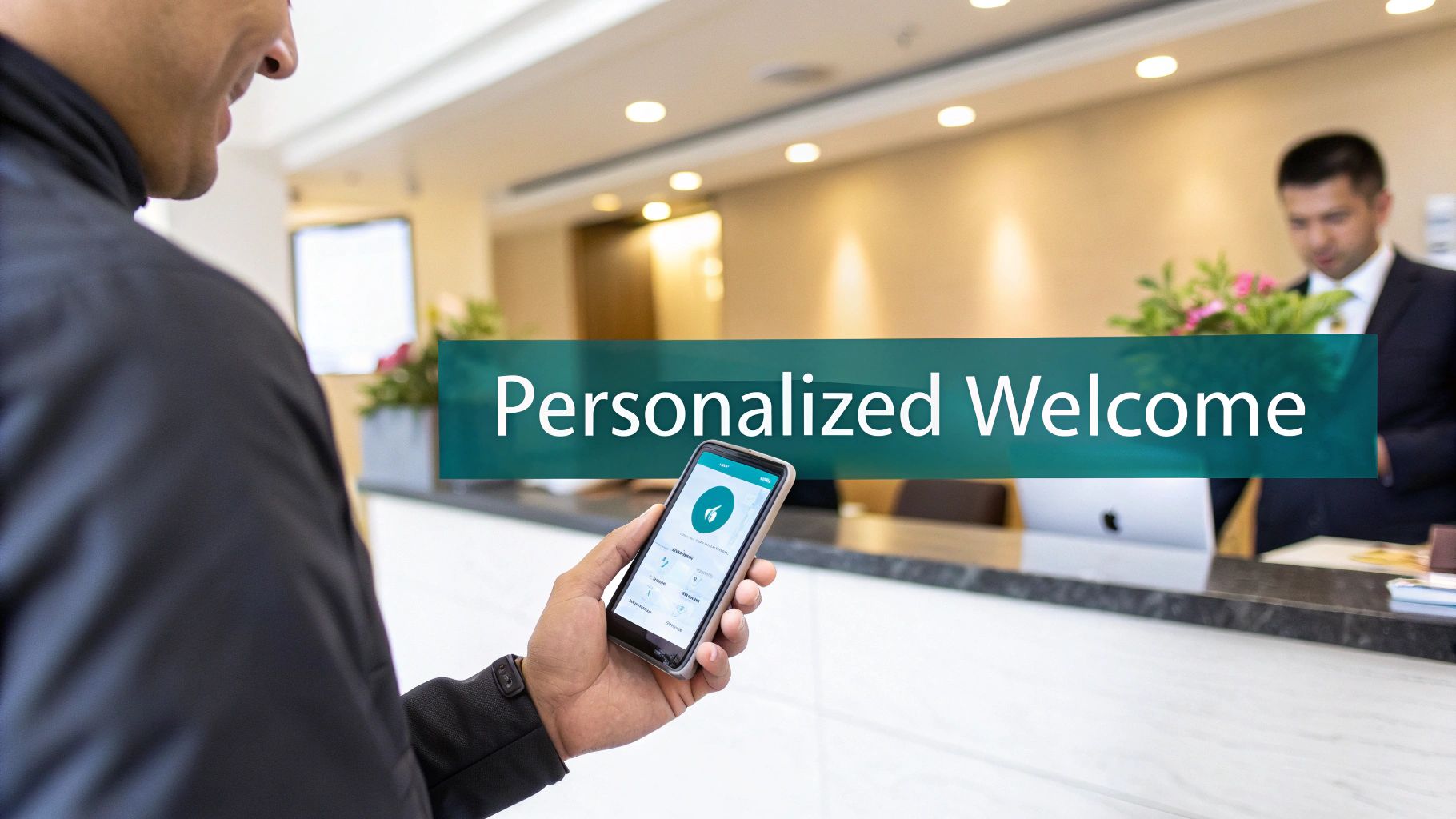
This all starts with your branded Captive Portal. When a guest logs on, they're greeted by a page you control. Instead of a generic login screen, imagine a returning guest seeing, "Welcome back, Sarah! Enjoy a complimentary coffee on us." That’s your CRM and Wi-Fi working together to create a memorable moment.
Creating Secure and Seamless Connections
Of course, a smooth and secure connection is table stakes. Modern Authentication Solutions are essential for protecting your network and making the guest experience hassle-free. This is where robust hardware and software from providers like Cisco and Meraki come in, giving you the reliable backbone guests expect.
Two methods that really stand out for balancing security and simplicity are IPSK and EasyPSK.
- IPSK (Identity Pre-Shared Key): This is a game-changer. It gives each user or device its own unique password. It's perfect for corporate travelers in a BYOD (Bring Your Own Device) environment or for long-stay guests because it ditches the security risk of a single, shared password.
- EasyPSK: Just like the name implies, this makes it simple to generate and manage all those unique keys. Your staff can easily administer access, and guests get connected without a fuss. It's incredibly useful in bustling environments like Education campuses or Retail centers that want to offer a hospitality-level experience.
These authentication methods don't just secure the connection; they feed valuable, permission-based data right back into your CRM. For a deeper dive into these technologies, our guide on complete hotel Wi-Fi solutions has you covered.
From Connection to Conversion
Once a guest is online, the real work begins. The data flowing from your Wi-Fi into your CRM gives you a real-time pulse on guest behavior. Suddenly, your guest Wi-Fi network stops being a cost center and starts driving revenue.
By linking guest Wi-Fi data to your CRM, you stop just providing internet access and start building relationships. You gain the insight to send the right offer, to the right person, at the perfect moment.
Here’s how it works in practice. Your CRM knows a particular guest always books a spa treatment. The moment they connect to your Wi-Fi, an automated message can pop up on their phone with a special offer for a massage. A family connects four different devices? That's your cue to send them a voucher for your on-site restaurant.
This kind of personalized engagement delivers real results. CRM systems are known to improve customer retention, with many businesses reporting increases of 30%–50%. In hospitality specifically, CRM-driven campaigns for pre-arrival offers and in-stay upsells frequently drive revenue growth of 10%–25%, boosting both direct bookings and on-site spending. This data-backed approach, all powered by a smart guest Wi-Fi strategy, is what turns good service into an unforgettable experience.
Using AI to Deliver Personalization at Scale
Trying to create a unique, personal experience for hundreds of guests at once sounds impossible, right? This is exactly where Artificial Intelligence comes in, completely changing how a CRM in the hospitality sector works. Think of AI as your smartest assistant, working around the clock to make every single guest feel understood and valued.
AI algorithms dive deep into massive amounts of guest data—from booking history to on-site purchases—to find hidden patterns and predict what a guest might want next. This lets your CRM automate communications and send out hyper-personalized offers that feel genuinely helpful, not just like another marketing blast.
The Brains Behind the Operation
So, how does this actually work? Imagine AI as the engine that powers next-level personalization. It’s the technology that allows a CRM to go beyond just storing information and start making smart, proactive decisions that surprise and delight your guests.
For instance, an AI-powered chatbot connected to your CRM can instantly answer common questions about check-in times or local attractions. This frees up your front-desk staff to focus on the more complex, high-touch interactions that really define great service. This kind of efficiency is a game-changer in any busy environment, whether it's a hotel, a university campus, or a large retail center.
The real magic, though, happens when AI taps into data from your guest Wi-Fi. Secure networks built on Cisco and Meraki hardware do more than just provide internet; they can feed a constant stream of valuable, permission-based data right into your CRM. With this information, the AI can trigger a perfectly timed offer the moment a guest connects through a Captive Portal.
AI Readiness A Crucial Factor
Choosing a CRM with strong AI capabilities isn't a "nice-to-have" anymore; it's a strategic must. A study cited by Forrester drove this point home, revealing that 89% of organizations see AI strategy as a critical factor when picking a CRM vendor. The same study found that over half are already using AI in their marketing and sales efforts.
An AI-powered CRM doesn't guess what your guests want—it anticipates their needs based on data. It’s the difference between sending a mass email about a spa discount and sending a personalized offer for a deep-tissue massage to a guest who you know loves the spa.
This forward-thinking approach is what separates the leaders from the pack. It’s also where the quality of your data becomes absolutely critical. Reliable Authentication Solutions like IPSK and EasyPSK ensure guests have a secure and smooth connection—especially in BYOD Corporate environments—while also making sure the data flowing into your CRM is clean and accurate. Our guide on AI in hospitality takes a closer look at this synergy.
For a deeper dive into what’s possible, explore how Artificial Intelligence Personalization can reshape your user experience. By making AI-readiness a non-negotiable part of your CRM selection process, you ensure that every guest interaction—from their first social login on your social Wi-Fi to their post-stay feedback—feels uniquely theirs. This is how you build genuine, lasting loyalty at scale, without burning out your team.
Choosing the Right Hospitality CRM for Your Business
Picking the right CRM isn't just a technical decision; it's a strategic one that will define how you connect with your guests for years to come. Think of it less like buying software and more like hiring a key team member. It needs to fit your culture, understand your goals, and be able to grow with you.
Whether you're running a single boutique hotel or a multi-property resort, the right system should feel like a natural extension of your team. It’s there to make complex tasks simple and turn raw data into meaningful relationships, not to create more work.
Core Integration Capabilities
A CRM's real power is unlocked when it talks to the other systems you rely on every day. This isn't a "nice-to-have"—it's an absolute must. At the top of that list is a solid, two-way connection with your Property Management System (PMS).
This connection is what allows guest data, from booking preferences to on-site spending, to flow seamlessly between platforms without anyone lifting a finger. If your team is stuck manually transferring information, you're not just wasting time; you're inviting errors. For any hotel using a standard PMS, it’s critical to confirm your CRM can integrate flawlessly. You can see a great example of this by looking into how a CRM works with a MICROS OPERA PMS system.
The Role of Network Infrastructure
These days, your guest Wi-Fi is one of the richest sources of guest data you have. A modern CRM needs to tap into that goldmine by connecting directly with your network hardware and software. Reliable, high-performance systems from providers like Cisco and Meraki are the foundation for managing those guest connections securely and effectively.
Think about the first thing guests do when they arrive: they connect to the Wi-Fi. Your CRM should integrate with your Captive Portals to gather permission-based data through simple options like social login. This approach, often called social Wi-Fi, is a smooth, easy way to learn more about your guests. The system must also support secure Authentication Solutions like IPSK and EasyPSK, which are essential for managing network access everywhere from university campuses (Education) to BYOD Corporate environments.
Choosing a CRM is like choosing a co-pilot for your business. It must be reliable, integrate flawlessly with your existing controls, and give you the data you need to navigate toward your goals of building stronger guest loyalty and boosting revenue.
Scalability and Data Security
Your business isn't static, and your CRM shouldn't be either. Look for a system that can scale with you, whether that means adding new properties, expanding services, or handling a growing volume of guest data. A cloud-based solution is often the most flexible choice.
Just as important is security. Your CRM will hold sensitive guest information, so airtight protection and compliance with regulations like GDPR are non-negotiable. Ask any potential vendor to detail their security protocols. Protecting your guests' privacy is fundamental to earning their trust—and keeping them coming back.
Measuring Your CRM Success With Key Metrics
So, you’ve put a shiny new hospitality CRM in place. How can you tell if it’s actually moving the needle? The real proof isn’t just about counting heads or filled rooms; it’s about tracking the right Key Performance Indicators (KPIs) that show a tangible return on your investment and healthier guest relationships.
Think of your CRM's dashboard as your command center. It pulls in data from your PMS, booking engine, and even your guest Wi-Fi network to paint a clear, real-time picture of what's driving your business. This is where you see your strategies come to life.
Moving Beyond Surface-Level Numbers
To really get a feel for your CRM's impact, you have to look past the obvious numbers. We need to zero in on metrics that speak directly to profitability and genuine guest loyalty. These KPIs tell the full story, not just a single chapter.
A few crucial metrics to keep a close eye on include:
- Guest Lifetime Value (GLV): This is the big one. It's the total amount a guest is likely to spend with you over their entire time as a customer. When GLV starts climbing, you know your personalization and loyalty programs are hitting the mark.
- Direct Booking Ratio: This one is simple but powerful. It’s the percentage of bookings coming straight from your website compared to the OTAs. A higher ratio means less money paid out in commissions and more control over the guest relationship.
- Net Promoter Score (NPS): A classic for a reason. This metric gauges guest satisfaction by asking one simple question: "How likely are you to recommend us?" Your CRM can automate sending these surveys post-stay, giving you a constant pulse on guest sentiment.
To help you get started, we've broken down the most important metrics for measuring the impact of your CRM. Tracking these will give you a clear, data-backed view of your performance and help you demonstrate a solid return on investment.
Essential KPIs to Track in Your Hospitality CRM
| Metric (KPI) | What It Measures | Why It's Important |
|---|---|---|
| Guest Lifetime Value (GLV) | The total projected revenue a single guest will generate over their entire relationship with your property. | A rising GLV directly shows that your loyalty and personalization efforts are working to increase repeat business. |
| Direct Booking Ratio | The percentage of bookings made directly through your website versus third-party channels (OTAs). | This is a direct measure of profitability, as it shows you're reducing reliance on commission-based bookings. |
| Net Promoter Score (NPS) | Guest satisfaction and loyalty, measured by asking how likely they are to recommend your hotel. | NPS is a powerful indicator of brand health and a predictor of future growth through word-of-mouth. |
| Guest Acquisition Cost (GAC) | The average cost to acquire a new guest, including all marketing and sales expenses. | Your CRM should help lower this over time by improving targeting and increasing direct, lower-cost bookings. |
| Repeat Guest Rate | The percentage of guests who have stayed at your property more than once within a specific period. | This is a fundamental measure of loyalty and shows the effectiveness of your retention strategies. |
| Average Revenue Per User (ARPU) | The average revenue generated per guest, often calculated by room revenue plus ancillary spending. | Tracking ARPU helps you see if your upsell and cross-sell campaigns within the CRM are successful. |
Ultimately, the goal is to see these numbers trend in the right direction. A successful CRM strategy will not only improve the guest experience but also deliver measurable financial results that you can take straight to the bank.
Connecting Wi-Fi Data to ROI
This is where things get really interesting. Your network infrastructure, powered by providers like Cisco and Meraki, becomes more than just an internet connection—it becomes a source of intelligence.
When a guest logs into your Wi-Fi through a Captive Portal using a social login, that action creates a valuable data point. Later, if that same guest books a room after receiving a targeted email offer, your CRM connects the dots.
You can literally draw a straight line from a specific marketing campaign to a spike in direct bookings, all by analyzing the data from your guest Wi-Fi and booking engine. This isn't guesswork; it's a clear, data-driven demonstration of your CRM's ROI.
This level of insight is a game-changer. You can even see how guests using secure Authentication Solutions like IPSK or EasyPSK—often found in BYOD Corporate or Education environments—engage differently with your brand. By consistently tracking these KPIs, you give your team the power to fine-tune marketing, streamline operations, and make smarter decisions that boost both guest happiness and your bottom line.
Hospitality CRM: Your Questions Answered
Still wondering how a CRM for hospitality actually fits into the day-to-day operations of a hotel? That's a common question. Let's break down a few of the most frequent queries we hear from hoteliers considering this kind of technology.
How Does a CRM Connect to the Guest Wi-Fi?
This is a great question because it gets right to the core of modern, automated guest data collection. Your CRM links up with your guest Wi-Fi network using what’s called a Captive Portal.
When a guest logs onto your Wi-Fi, they land on a branded splash page. This page often includes a simple social login option (think "Log in with Facebook" or "Log in with Google"). This whole process is known as social Wi-Fi.
Once they give their permission, their login information is securely funneled directly into your CRM. The system then either creates a brand-new guest profile or updates an existing one with fresh details. To handle this kind of data flow smoothly and securely, you need a robust network foundation from providers like Cisco or Meraki. This connection is what allows you to automatically send a welcome email or a special offer the very moment a guest gets online.
What's the Difference Between a CRM and a PMS?
It helps to think about their distinct roles. Your Property Management System (PMS) is the operational brain of your hotel. It manages the nuts and bolts: reservations, check-ins, check-outs, room assignments, and billing.
Your CRM, on the other hand, is the relationship heart. Its entire focus is on the guest—their personal data, their history with your brand, their preferences, and their loyalty status.
A PMS runs the hotel, but a CRM builds the relationships that keep the hotel running. The two are at their best when they work together, allowing operational data from the PMS to power truly personalized experiences through the CRM.
Why Do Secure Authentication Solutions Matter So Much?
Security is non-negotiable, whether you’re running a hotel or managing a network in Education, Retail, or a BYOD Corporate setting. Advanced Authentication Solutions like IPSK and EasyPSK are designed to ensure every single connection to your network is secure and private.
Instead of using a single, shared password that can be easily passed around or compromised, these systems generate unique credentials for each user or device.
This approach does two crucial things. First, it protects your network and your guests' data from potential threats. Second, it ensures the information flowing into your CRM is coming from a real, verified guest. It's a fundamental part of building trust and creating a safe digital environment on your property.
Ready to see how a smarter guest Wi-Fi experience can transform your guest relationships? Splash Access integrates seamlessly with Cisco Meraki to turn your network into a powerful data and engagement tool.
Learn how Splash Access can elevate your hospitality business