Would you rather get a $5 voucher at the counter, or have the manager greet you by name the next time you walk in?
Many readers answer before they've finished reading the question. Cash feels obvious. Recognition feels nice but secondary. That instinct is where a lot of incentive programmes go wrong, because the reward isn't the variable that decides whether a behaviour sticks. The behaviour is.
Ask the same question about a different action. For a guest joining your Wi-Fi, a coupon often wins. For an IT team keeping a campus network compliant, a bonus rarely does. Same organisation, same budget line, opposite answers. What follows treats monetary and non monetary incentives as a design choice, one tied to the behaviour you want and to the network that carries it, whether that's a Cisco Meraki captive portal in a shopping centre, an IPSK rollout across a school, or an EasyPSK policy in a BYOD corporate office.
Monetary Versus Non-Monetary Incentives at a Glance
If you had one budget line and two ways to spend it, which would move your people further: a bonus or a genuine thank-you in front of the team? The honest answer is that they do different jobs, and confusing the two is the most common mistake in incentive design.
Monetary incentives carry direct economic value. Cash bonuses, commission, discounts, vouchers, paid credits, gift cards with a spendable balance. Non-monetary incentives work through meaning, progress and status: recognition, flexibility, learning opportunities, autonomy over how the work gets done, advancement, priority service, a better experience.
A simple way to hold the difference: money is fuel. It gets the car moving quickly and reliably. Recognition and growth are the road and the destination, and they decide whether the journey continues past the first tank. Pour fuel into a car with no road and you get noise, not distance.
That split shows up in performance data. A 40-year meta-analysis covering 183 samples and 212,468 participants found intrinsic motivation was a medium-to-strong predictor of performance, with correlations ranging from ρ = .21 to .45, as recorded in the APA PsycNet record of the study.
| Factor | Monetary incentives | Non-monetary incentives |
|---|---|---|
| What it includes | Cash bonuses, commission, discounts, vouchers | Recognition, flexibility, learning, autonomy, status, priority service |
| Main mechanism | Direct economic value | Meaning, progress, control and status |
| Best suited to | Repetitive, measurable actions | Creative work, service quality and sustained effort |
| Main risk | Crowding out intrinsic motivation and attracting low-value participation | Feeling token or unfair when not linked to real benefits |
| Guest Wi-Fi example | Time-limited coupon shown after captive portal login | Early access or a personal thank-you after social login |
Read the rows in order and the logic builds. The mechanism row explains the fit row. The fit row explains the risk row. A reward aimed at a repetitive, measurable action rarely backfires, because there's little inner motivation to crowd out. A reward aimed at creative or service work can backfire fast when it feels like a transaction rather than an acknowledgement.
Keep this table nearby for the rest of the piece. Almost every real programme combines both columns rather than picking a side, and Spark's framework for approccio Spark ai sistemi incentivanti is a useful reference if you want to map reward types against the behaviour you're targeting.
How Cash and Discounts Motivate and Where They Stall
A discount works like a shop-floor sticker: the value is obvious, so the next action happens sooner. Guests describe loyalty the same way. In 2024, 86% of more than 9,800 consumers surveyed across the United States, United Kingdom, India and Brazil rated financial rewards and simplicity or ease of use as important or very important loyalty-programme attributes, according to Deloitte's consumer loyalty survey.
The stall shows up after that first rush. A large meta-analysis covering 2,193 estimates from 88 economics experiments found that, after correcting for publication bias and p-hacking, the average performance effect of financial incentives was close to zero across most field contexts, as documented in the meta-analysis of incentive experiments. Bigger bonuses do not reliably produce better work. They produce more of whatever the bonus measures, which is not always the behaviour the network needed.
What crowding out looks like in practice
A volunteer tutor arrives early every week because she enjoys the sessions. Pay her per session and the hour starts to look like a shift. The pay becomes the reason she comes, and the early arrival stops. Crowding out is that shift. The reward reads as controlling rather than informational, so attention moves from the task to the payment.
Four design factors decide which way it goes: the task type (repetitive versus interesting), the visibility of the reward, payment timing, and how much control the person feels over how they earn it.
Guest Wi-Fi follows the same pattern. A discount after a captive portal login lifts registrations quickly, and it also pulls in people who want the coupon and nothing else. Retail portals collect coupon hunters. A campus or office network sees the same spike when a voucher is the only reason to connect. Set that offer only after you understand the revenue mechanics of Wi-Fi monetization.
Tiered perks are a different mechanism from a straight discount. A guide to VIP packages for promoters prices early access and status for nightlife events. That packaging belongs to ticketing, not to staff recognition or guest Wi-Fi, so it should not decide whether a portal leads with money or with priority.
Before you print a voucher, ask three questions.
- Is the action measurable? If you can't count it cleanly, cash will reward noise.
- Would people do it without a reward? If yes, you may be paying for something you already had, and possibly eroding it.
- What happens to quality when the reward stops? If participation collapses on day one after the promotion, you bought transactions, not habits.
Practical rule: cash for repetitive, countable behaviour. Recognition and access for anything that depends on judgement, care or creativity.
Why Recognition, Growth and Autonomy Keep People Engaged
A skilled network engineer at a mid-sized campus gets two offers: a $1,000 bonus for hitting a ticket-resolution target, or the chance to lead the rollout of a new authentication solution with per-student keys across four buildings. The bonus is spent by March. The rollout becomes the thing she talks about in interviews for the next five years, and the reason she turns down the recruiter who calls in June.
That story is the mechanism in action: status, growth and control. Cash is a consumable. Responsibility is an asset, more like a qualification than a payment, because it keeps paying out long after the work is done. Organisations have noticed. In 2024, 80% of companies included non-financial measures in their annual incentive plans, according to the Harvard Law School Forum on Corporate Governance's summary of the 2024 Corporate Governance and Incentive Design Survey.
People aren't uniformly cash-driven
Here is the confusion worth clearing up early. When researchers ask employees what they want, a large share prefer advancement and recognition over cash rewards, and the cash-first group is consistently the smaller one. Design your incentive scheme for the average employee and you end up serving the minority.
The evidence on what predicts motivation is sharper still. A study of 357 public-sector employees found career development had the strongest effect, with a standardised coefficient of β = 0.44, followed by work-life balance at β = 0.40, as reported in the Asian Management and Business Review study. On a 1 to 7 scale, recognition programmes averaged 4.6, work-life balance initiatives 4.5, job enrichment 4.25 and career development 4.1, against overall motivation of 4.7.
Two cautions. The sample is public-sector, so treat those coefficients as design guidance rather than a universal effect size. And recognition only works when it's specific. "Employee of the month" with no reason attached lands as decoration.
Recognition without specificity is just noise with a certificate.
Think of specificity as the difference between a receipt and a thank-you letter. A receipt proves a transaction happened. A letter says what the person did and why it mattered. Only one of those makes someone repeat the behaviour.
Where teams feel connected, these levers compound. Work like One Dynamics on workplace cohesion pairs naturally with visible recognition and clear development paths, because both depend on people knowing what's expected of them and who notices when they deliver.
The practical takeaway: visible recognition, learning paths and greater control over work are cheap to start and easy to tie to measurable outcomes. Name the behaviour, name the impact, and hand over ownership of something real. If you want those rewards to feel personal rather than generic, customer experience personalization shows how the same principle scales when the audience is a guest rather than an employee.
What Performance Tests Reveal About Combining Rewards
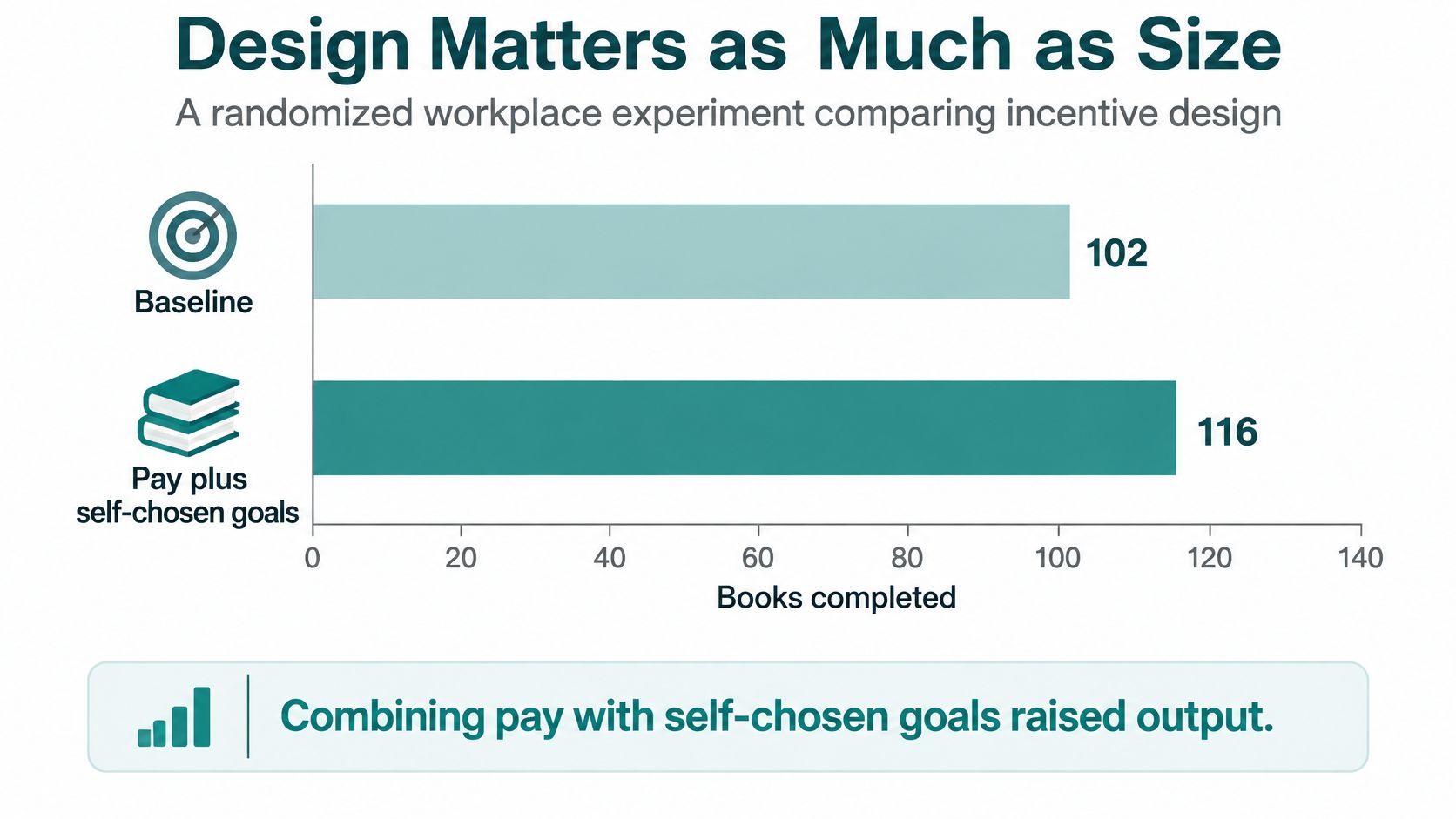
Design matters as much as size. In a randomised workplace experiment, combining monetary incentives with self-chosen goals produced output of 116 books against 102 under piece-rate pay alone, an increase of more than 14%, according to the field experiment report on incentive design. Same money, different architecture, different result. Letting people set their own target added more than raising the rate did. Cash works like fuel, but goal ownership works like steering. One gives the push, the other gives direction.
A separate field experiment compared incentive methods head to head, and the spread is instructive.
| Incentive method | Reported result | What it shows |
|---|---|---|
| Monetary incentives with self-chosen goals | 116 versus 102 books (over 14% more) | Goal ownership adds to the value of money |
| Behaviourally structured monetary incentives | 37% performance increase | Structure matters more than the reward alone |
| Social recognition | 24% performance increase | Public acknowledgement works strongly |
| Performance feedback | 20% performance increase | Clear feedback is a low-cost lever |
| Routine pay-for-performance | 11% performance increase | Standard bonuses add the least on their own |
Read the bottom row first. Routine pay-for-performance, the default most organisations reach for, delivered the smallest lift of the five. The top two rows both involve structure and ownership rather than extra cash. That pattern explains why a discount on a captive portal and a recognition scheme for IT staff should not use the same design. The discount changes the guest's immediate choice. Recognition changes how visible, repeated work feels inside a team.
The fairness problem nobody budgets for
A flexible schedule is a real reward for office staff and an impossible one for a frontline hospitality or retail worker who covers a shift. Public praise motivates some people and embarrasses others. Monetary rewards can feel controlling, while symbolic rewards generally produce weaker crowding-out effects, as discussed in the review of incentives and motivation.
The workable answer is a segmented menu: several reward types, transparent eligibility rules, and outcome measurement broken down by role, location, seniority and work arrangement. Non-monetary rewards complement competitive pay. They don't replace it, and pretending otherwise corrodes trust faster than no programme at all. A menu also prevents one-size-fits-all thinking, where the loudest group gets the reward that suits them while everyone else adapts.
Before scaling anything, run a monthly calibration and check four things: gaming of the metric, exclusion of difficult customers or cases, declining service quality, and unequal access to high-value opportunities. If any of those show up, fix the design before you widen it. Track the results the same way you'd measure marketing campaign effectiveness, with a baseline and a comparison, not a feeling.
Using Incentives on Guest Wi-Fi and Social Wi-Fi
The moment of value is right after authentication. A guest has joined the network, the captive portal has done its job, and you have three or four seconds of genuine attention. That's where an incentive earns its keep.
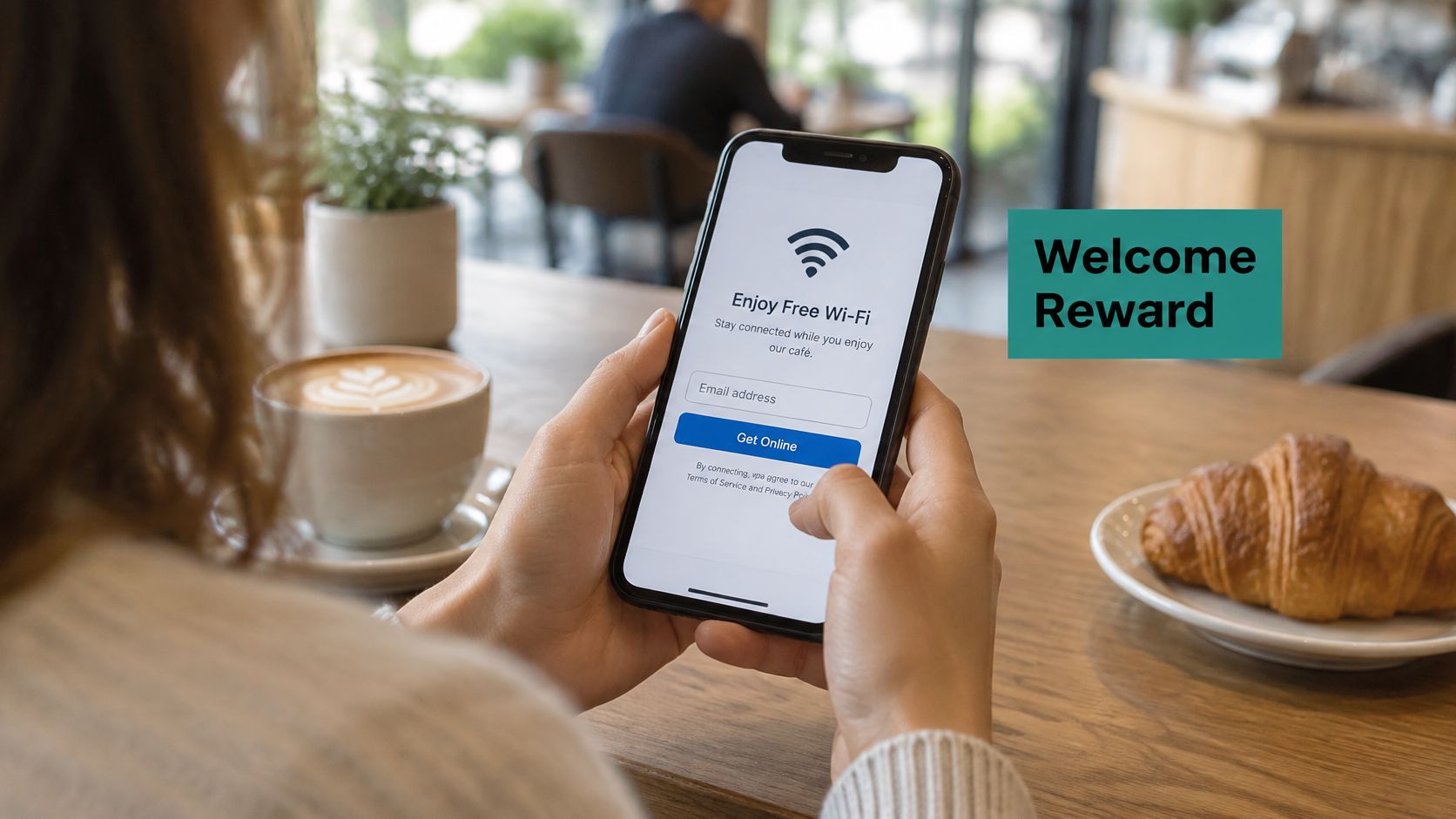
Retail data supports the approach. Survey data reports that 49% of consumers consider immediate discounts a top reason to join a loyalty programme, while savings on everyday purchases and free perks rank among the most desired incentives, according to Cordial's loyalty programme statistics. A Cisco Meraki captive portal can deliver a time-limited coupon, voucher or geo-fenced promotion immediately after login, and a social login flow can tie that reward to a permission-based profile rather than a form full of guesses.
Three patterns that work
Time-limited coupon after the portal. The guest authenticates, sees one clear offer, redeems it in store. Simple, measurable, and easy to switch off if it attracts only bargain hunters.
Social WiFi with early access. Instead of a discount, the reward is status: faster lane, early access to a sale, a members-only page. Social login gives you a verified profile in exchange, which is a fair trade when it's stated plainly.
Geo-fenced push near the venue. The offer arrives when the guest is close enough to act on it, not three days later when the moment has gone.
Whatever pattern you choose, keep the offer visually and structurally separate from the network terms. Wi-Fi access should never appear conditional on marketing consent, because it isn't, and blurring the two costs you trust you can't buy back.
A short checklist before launch.
- One benefit, stated plainly. "10% off today" beats a paragraph of terms.
- A one-tap opt-out. Consent that's hard to withdraw isn't consent.
- A follow-up measure. Redemption rate, repeat visits, or profile completion, chosen before launch.
- A quality check. Are you collecting usable data or just volume?
The strongest guest Wi-Fi incentive doesn't feel like a toll booth. It feels like the venue did something nice on the way in.
For the wider playbook on turning that moment into a relationship, customer engagement best practices covers what to do after the first login.
Matching Incentives to Retail, Education and BYOD Networks
A shopping centre, a campus and a corporate office have different people, different goals and different risk. The right mix changes with them, and so does the way you let those people onto the network.
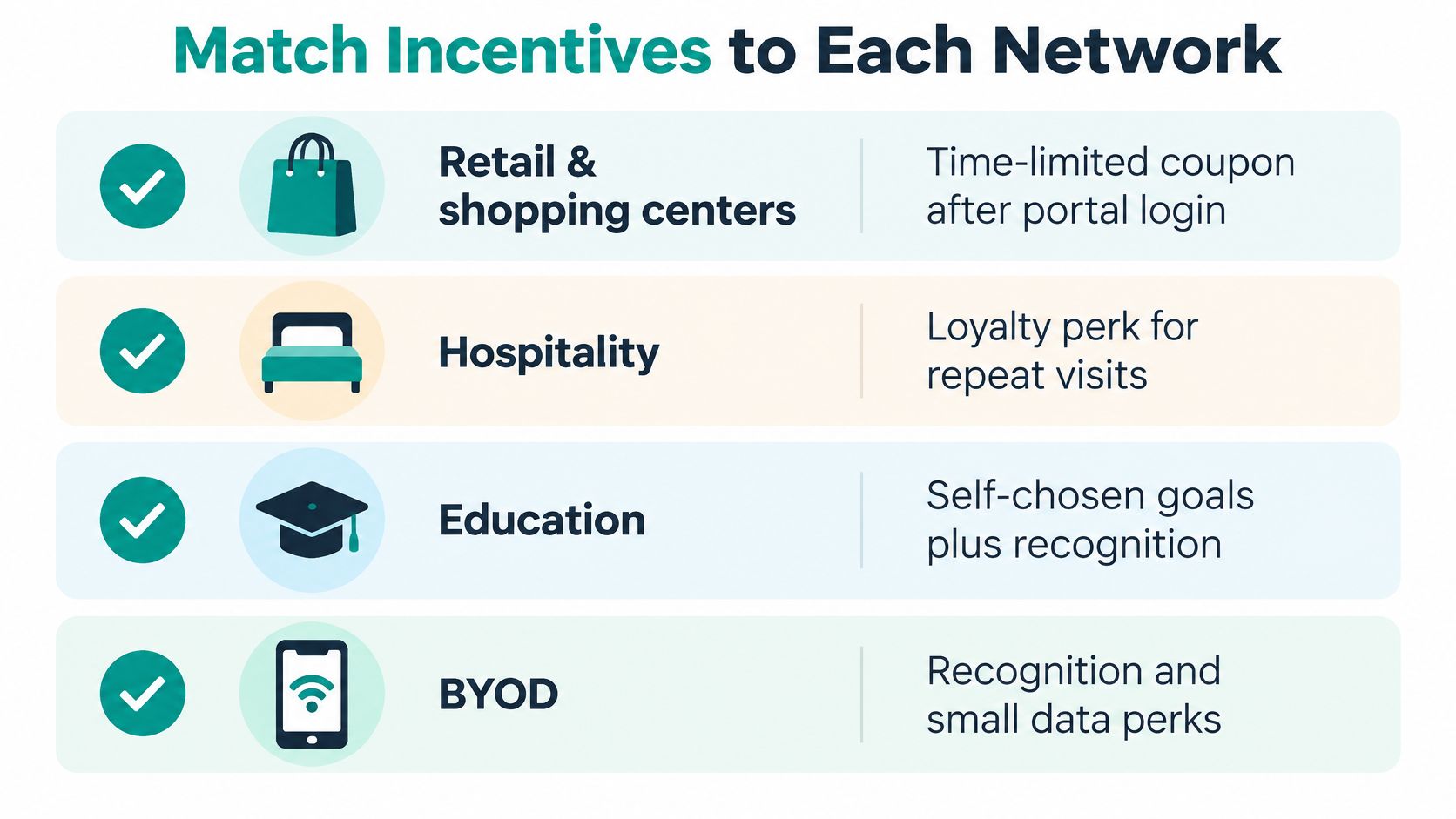
| Sector | Monetary lever | Non-monetary lever | Wi-Fi access approach |
|---|---|---|---|
| Retail and shopping centres | Time-limited coupon or geo-fenced voucher | Early access and personal thanks | Social login on guest network with offer after sign-in |
| Hospitality | Discount on next stay or dining | Priority check-in and recognition | Captive portal with voucher for returning guests |
| Education and campus | Printing or cafeteria credit | Peer recognition and library priority | IPSK per student for controlled, traceable access |
| Corporate BYOD | Performance bonus tied to measurable targets | Flexibility, development and recognition | EasyPSK per employee device, revocable when needed |
Why the access layer carries half the design
BYOD programmes create a measurable security and cost trade-off. One published BYOD summary reports that more than 80% of organisations use BYOD, 68% report improved employee productivity after implementing BYOD policies, and 60% identify security as their top concern, with 95% of business users employing personal devices for multifactor authentication on work accounts, per JumpCloud's BYOD statistics. Those numbers argue for separating guest, student, employee and personal-device access rather than running everyone across one shared wireless network.
In Cisco and Meraki environments, individual pre-shared keys (IPSK) give each person or device its own credential. Revoke one without disrupting the room. Map it to a policy. EasyPSK-style credentials do the same job with simpler onboarding, which matters when hundreds of students arrive in the same week.
A campus example shows how the two halves meet. A student completes a short survey on a per-student key and earns printing credit. Access stays controlled and traceable, the reward is small but real, and nobody's device shares a password with the whole hall. For retail equivalents, the mechanics of retail customer engagement follow the same structure.
Incentives for staff should never weaken the access policy that protects the network. If a reward requires loosening authentication, it isn't a reward. It's a liability.
Choosing Your Incentive Mix for the Next Campaign
You can settle this in one planning session. Four steps, in order.
Name the behaviour. Is it repetitive and measurable, like a guest completing a registration, or creative and service-based, like a frontline team lifting complaint resolution? The first suits money. The second suits recognition, autonomy and development, and cash can actively hurt it.
Pick the mix. Usually one modest monetary reward plus one visible non-monetary one. A coupon plus early access. A small bonus plus a named mention in the team briefing. Two levers, different mechanisms, same behaviour.
Decide the access and identity method. Separate guest, student, employee and personal-device users. Use IPSK or EasyPSK keys for staff and students so rewards never require shared passwords. If the venue needs to charge for access, the Payment Options feature provides a billing gateway, and voucher printing with geo-fencing push notifications handles the offer side.
Pilot for four to six weeks. Check redemption, repeat visits, data quality, satisfaction and fairness across groups. Compare against a baseline period, not against a hunch. If the numbers hold and no group is worse off, expand.

Take your current guest and staff incentives, hold them against the sector table, and pick one pilot to run this quarter. One behaviour, two levers, a defined access method and a four-week measurement window. That's the whole programme.
Splash Access runs the connectivity layer that makes these incentives possible: captive portals for Cisco Meraki networks, social login and social WiFi for guests, and IPSK or EasyPSK authentication so each person and device gets its own revocable key. Whether you're rewarding shoppers in a retail venue, students on campus or staff in a BYOD office, you can deliver the offer right after login and measure what happens next. Visit Splash Access to see how the platform fits your network.