Ever wished you could send the perfect offer to a customer the exact moment they walk near your store? That’s the simple, powerful idea behind geofencing marketing. Think of it as drawing a virtual boundary around a real-world place, which triggers an action whenever someone’s device crosses that line. It’s a super smart way to connect with people right where they are.
Your Guide to Hyper-Local Marketing
At its heart, geofencing is all about delivering the right message to the right person at just the right time and place. Let's imagine it's a digital tripwire for your business.
When someone with a smartphone enters your pre-defined zone—whether it's a retail shop, a university campus, or a corporate office—you can automatically send them a welcome text, a special discount, or a relevant notification. It’s timely, relevant, and incredibly effective.
This technology is a game-changer across different sectors. It’s transforming how businesses manage BYOD corporate environments and boosting engagement in education and retail. A rock-solid network is the backbone of this strategy, which is why solutions from partners like Cisco and Meraki are so often used. They provide the stable Wi-Fi infrastructure needed to make these real-time interactions happen without a hitch.
So, how does it all start? Often, the process kicks off when a user connects to guest Wi-Fi through a captive portal. This is where authentication solutions like IPSK or EasyPSK do more than just secure the connection; they create the perfect, permission-based moment for users to opt into location services.
Geofencing is just one piece of a larger puzzle. To get the full picture, it helps to grasp the broader principles of understanding location targeting in advertising. To see how this technology drives real customer engagement, check out our complete guide to location-based marketing.
How Geofencing Actually Works
So, how does this all happen behind the scenes? Without getting lost in the technical weeds, think of geofencing as setting up an invisible tripwire around a real-world location.
We create this virtual boundary using a mix of GPS, cellular data, and Wi-Fi signals. This fence can be drawn around just about anything—a coffee shop, a specific conference hall, or an entire university campus.
The magic really starts when a user gives their permission, or "opts in." A common way this happens is when they log into a guest Wi-Fi network through a captive portal. You’ve seen these before in retail stores, on education campuses, and in BYOD corporate environments. Once they're connected, their device's location can be noted anonymously.
The moment their device crosses that invisible line—either entering or leaving the area—it triggers a pre-planned action. This could be anything from a push notification with a "Welcome back!" discount to an event reminder or even a security alert.
The Network is the Foundation
For any of this to work smoothly, it all hinges on a solid and accurate network. If the connection is spotty, you'll get delayed triggers or bad location data, which pretty much sinks the whole campaign. This is exactly why having a reliable infrastructure from partners like Cisco and Meraki is so important.
Secure authentication solutions, like IPSK or EasyPSK, are also a big piece of the puzzle. They don't just keep your network safe; they also create a smooth sign-on process that makes it easy for people to opt-in via the captive portal. When the network is strong, that digital tripwire is precise and reliable, every single time.
This flow chart gives you a great visual of how a virtual boundary can set off a real-world marketing action.
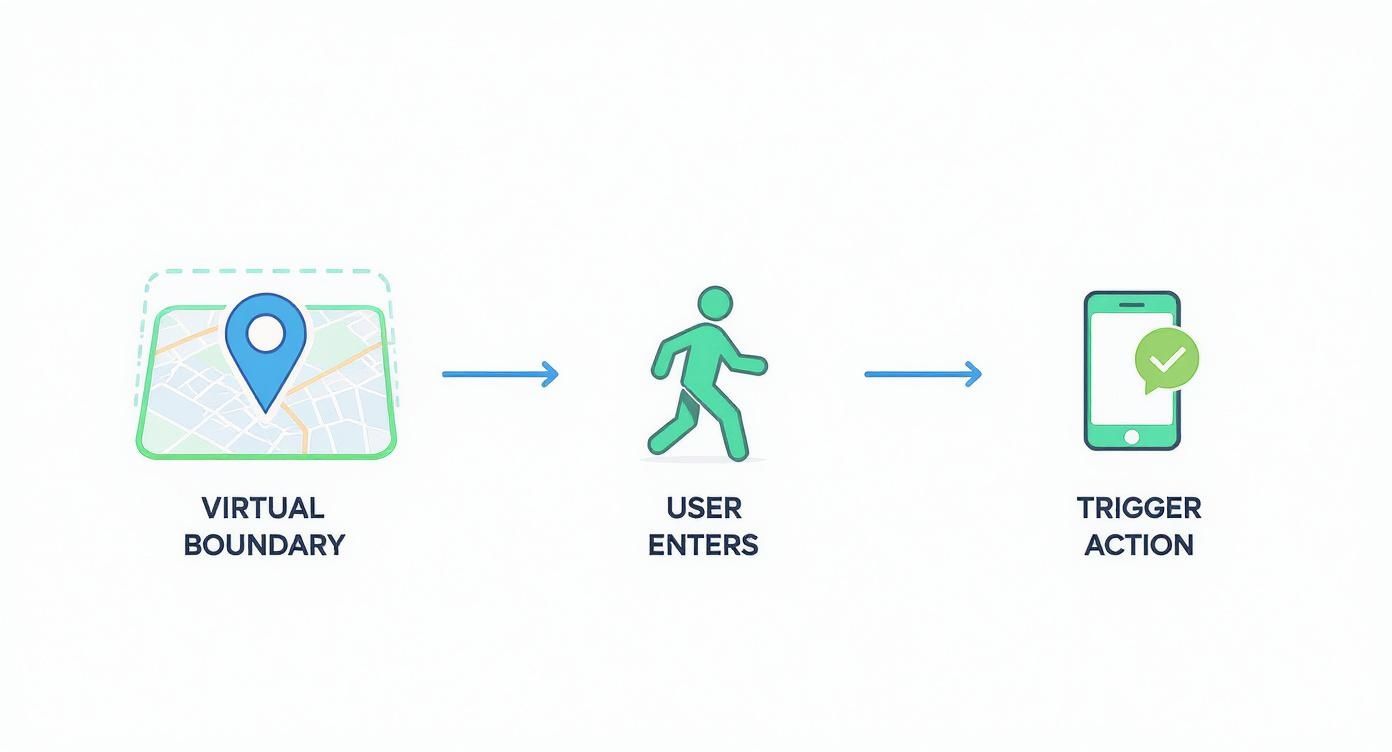
As the graphic shows, it’s a simple but incredibly effective sequence: a person walks into a defined zone and gets a message that’s relevant to that exact time and place. This kind of immediate, contextual interaction is why the industry is booming.
In fact, the market is expected to grow at a compound annual growth rate of 25% between 2025 and 2034, all because it’s so good at grabbing consumer attention. You can read the full research on geofencing market growth to see the data. Understanding this basic interaction is the first step, but you can go much deeper into how to use location analytics to really sharpen your strategy.
Tying Geofencing to Your Wi-Fi Authentication
This is where your existing network infrastructure can really start working for your marketing team. Stop thinking of your guest Wi-Fi as just a freebie. Instead, see it as the front door for your entire geofencing strategy. The secret ingredient here is the captive portal—that login page everyone sees when they first connect.
Imagine a shopper in your retail store, a student on campus, or even an employee in a BYOD corporate office hopping onto the Wi-Fi. That login page is the perfect moment to ask for their permission to send location-based updates. It's a simple, fair trade: they get reliable internet, and you get the chance to send them genuinely useful content.
Securing Access and Gaining Consent
Of course, none of this works if the connection isn't secure or the user experience is clunky. That's where modern authentication solutions make a huge difference. Systems like IPSK (Individual Pre-Shared Key) or EasyPSK give each user their own unique and secure key to the network. This is absolutely essential in crowded environments like education campuses or corporate offices.
When you pair these secure authentication methods with solid hardware from a provider like Cisco Meraki, the Wi-Fi login process becomes something more. It’s no longer just about getting online; it’s a clear, straightforward opt-in for your geofencing campaigns.
A standard network login is transformed into a strategic marketing asset. By linking authentication with location consent, you're building a highly effective, personalized funnel right from your own Wi-Fi.
This whole process feels natural for the user. They connect, they authenticate, and they agree to receive location-based info—all in one go. This creates the foundation you need to send targeted alerts, special offers, and other geofenced messages.
If you want to dive deeper into how this first step works, it’s worth understanding the role a Wi-Fi captive portal plays. Think of it as the digital handshake that kicks everything off.
Geofencing Examples in the Real World
It’s one thing to talk about geofencing in theory, but where does it actually make a difference? Let's look at how this technology is being used right now to turn a person's physical location into a genuine opportunity to connect.
The core idea is simple: use a virtual boundary to trigger a real-world action.

This isn't just a niche tactic anymore. Geofencing is becoming a major force, particularly in North America, which is on track to claim a 35.2% share of the entire global market by 2025. This boom is fueled by strong communication networks and huge adoption in industries like retail, where it's a proven way to get more people through the door. For a deeper dive, you can discover more insights about the geofencing market.
Geofencing Use Cases By Industry
The real magic of geofencing is how flexible it is. Different businesses have different goals, and this technology can adapt to just about any of them, especially when built on a solid foundation like a Cisco Meraki network.
Here's a quick look at how various sectors are putting geofencing to work.
| Industry Sector | Primary Goal | Example Action |
|---|---|---|
| Retail & Malls | Increase foot traffic & sales | Send a 15% off coupon to a shopper's phone when they walk past your store. |
| Education Campuses | Improve student engagement | Automatically mark attendance when students enter a lecture hall with the campus app. |
| Corporate Offices | Streamline operations | Trigger automatic check-in for a meeting when an employee enters the conference room. |
| Healthcare | Enhance patient experience | Send a "your turn is next" notification when a patient enters the clinic's waiting area. |
| Events & Venues | Boost attendee interaction | Push a schedule reminder or a vendor special to attendees as they walk through the event hall. |
As you can see, the applications are all about delivering the right message at the right moment.
Tying It All Together With Wi-Fi Authentication
So, how does this all start? Often, it begins with something as simple as connecting to the guest Wi-Fi.
When a visitor logs into a network through a captive portal, they’re not just getting internet access—they’re opening the door for these kinds of smart, location-based interactions.
When you combine geofencing with secure authentication solutions like IPSK or EasyPSK, you get something really powerful. You can confirm exactly who is on your network and where they are, which unlocks a whole new level of marketing precision.
This combination is a game-changer for personalization. You stop broadcasting generic messages and start delivering truly helpful information at the exact time and place it matters most. It's about turning a simple Wi-Fi login into a dynamic tool for improving customer experience personalization.
What Makes Geofencing So Powerful?
So, what's all the fuss about geofencing? When you pair it with your existing Cisco Meraki Wi-Fi, it's about making every dollar in your marketing budget count.
The biggest win is the ability to deliver hyper-relevant, personalized messages. You stop broadcasting generic ads to everyone and start talking to people based on where they are right now. That context is everything.
Imagine a student stepping into the campus library and instantly getting a notification about open study rooms. Or think about a shopper in a retail mall receiving a special discount just as they walk past your storefront. It's marketing that feels genuinely helpful because it happens at the perfect time and place.
A Smarter Way to Boost Your ROI
Geofencing isn't just about sending clever notifications; it's a goldmine of data. For the first time, you can truly see how people move through your physical space. You get a clear picture of foot traffic patterns, how long people stay in certain areas, and when your busiest times really are.
This kind of insight is invaluable for making smarter business decisions—from optimizing store layouts to scheduling staff.
This all leads to a much stronger return on investment (ROI). You're no longer wasting ad spend on people who are miles away. Instead, you're focusing your budget on a highly relevant audience right on your doorstep, which naturally pushes conversion rates way up.
The proof is in the numbers. Geofencing campaigns see an average click-through rate of 7.5%, blowing typical digital ad benchmarks out of the water. On top of that, 53% of shoppers say they've visited a store after getting a location-based alert.
These stats really highlight the impact of smart, location-aware marketing. You can read the full research about geofencing performance for a deeper dive.
And when you connect this strategy with secure Wi-Fi authentication solutions like IPSK or EasyPSK, you create a frictionless way for people to opt-in, making your geofencing campaigns even more effective.
Getting Started with Your Geofencing Strategy
So, you're ready to put geofencing to work for your business. Where do you begin? The first step, and the most important one, is to figure out what you want to achieve.
Your goals will look different depending on your industry. A retail store might want to increase foot traffic, while a university in the education sector might focus on better on-campus communication. In a BYOD corporate environment, the goal could be as simple as streamlining network access.
Once you’ve nailed down your "why," it's time to define the "where." Pinpoint the physical locations that are most important to your goals and draw your virtual fences around them. This could be as small as a single storefront, as large as an entire college campus, or as specific as one wing of an office building.
With your locations set, you can start thinking about the experience. What message or offer will grab someone's attention when they cross that virtual line? A simple welcome message, a can't-miss discount, or a timely reminder can be incredibly effective.
Ensuring Your Tech is Ready
Of course, none of this works without the right technology in place. A successful geofencing strategy is built on a reliable Wi-Fi network that can deliver accurate location data without a hitch.
Think of a robust network from a trusted provider like Cisco Meraki as your foundation. When you add a captive portal and secure authentication solutions like IPSK or EasyPSK, you create the perfect opportunity for users to opt-in and connect.
This kind of setup turns your Wi-Fi from a basic utility into a powerful marketing tool. To get a better sense of how all these components work together, check out our marketing automation integration to see how you can start delivering real, measurable results.
Geofencing FAQs
Got questions about how geofencing marketing actually plays out in the real world? You're in good company. Let's clear up some of the most common questions businesses have when they start looking into this technology.
How Accurate Is Geofencing Technology?
The accuracy of a geofence is surprisingly good, though it can depend on the setup. Think of it like a spectrum: for wide-open outdoor areas, GPS provides laser-focused precision. For indoor spaces like a retail store or a university campus, Wi-Fi triangulation is the star.
For businesses running on Cisco Meraki networks, this is a huge advantage. The existing Wi-Fi infrastructure can provide rock-solid location data inside a building, making it ideal for the retail or education sectors. It’s what ensures your message hits the customer’s screen at the perfect moment—not a minute too late.
Is Geofencing an Invasion of Privacy?
This is a big one, and the short answer is no, not when it's done right. Ethical geofencing is a permission-based strategy, plain and simple.
Users have to actively opt-in. A common way this happens is when they agree to share their location to access guest Wi-Fi through a captive portal. It's a transparent handshake. They get free internet, and you get a chance to send them a relevant offer. With secure authentication solutions like IPSK or EasyPSK in place, their data is protected, building trust from the first interaction. It’s all about offering value in exchange for permission, not tracking people in the shadows.
Can Geofencing Integrate with Other Tools?
Absolutely. This is where geofencing really shines. Modern geofencing platforms are built to play nicely with the marketing stack you already rely on.
They can plug directly into your CRM, analytics software, and marketing automation systems. Imagine your Cisco Meraki network flagging a customer's visit, which then automatically enriches their profile in your CRM and triggers a follow-up email sequence. This turns a simple location ping into a powerful, automated marketing action, whether you're managing a BYOD corporate network or a busy retail floor.
Ready to turn your guest Wi-Fi into a powerful marketing engine with geofencing? Splash Access works directly with your Cisco Meraki hardware to create personalized, location-aware experiences that get results. Learn more and get started today.