Welcome to the central nervous system of every great restaurant! Let's talk about restaurant operation management—it's the complete system of processes that keeps your establishment running like a well-oiled machine, coordinating everything from front-of-house service to back-of-house workflows. Think of it as your strategic playbook for turning ingredients and service into profit and happy, loyal customers.
Understanding Restaurant Operations
At its core, restaurant operation management is all about orchestrating countless moving parts to deliver a consistent, high-quality experience for both your guests and your staff. It’s the invisible framework that ensures the kitchen has what it needs, the servers know the specials, and the bills are always accurate. When you nail it, everything just works.
This involves a delicate balance of art and science. The "art" is the hospitality—that warm greeting, the perfectly cooked meal, and the inviting atmosphere. The "science" is the smart, data-driven decision-making that fine-tunes every single process, from staffing schedules to inventory orders. Small, clever tweaks in these daily routines can lead to huge wins in efficiency and guest satisfaction. For a deeper dive, this comprehensive guide to restaurant operation management is a fantastic resource.
Core Pillars of Restaurant Operations
To truly get a handle on operations, it helps to break it down into its essential components. Think of these as the foundational pillars that hold up your entire business.
| Operational Area | Key Focus | Example Activities |
|---|---|---|
| Front-of-House (FOH) | Guest Experience & Service | Greeting guests, taking orders, managing reservations, payment processing |
| Back-of-House (BOH) | Food Production & Quality | Menu planning, cooking, plating, kitchen sanitation, dishwashing |
| Inventory Management | Cost Control & Supply Chain | Ordering supplies, tracking stock, performing inventory counts, managing vendors |
| Staffing & HR | Team Performance & Culture | Hiring, training, scheduling, payroll, ensuring compliance with labor laws |
| Finance & Admin | Profitability & Reporting | Budgeting, analyzing sales data, bookkeeping, managing profit and loss |
| Marketing & Customer Relations | Brand Growth & Loyalty | Running promotions, managing social media, responding to reviews |
| Compliance & Safety | Risk Mitigation & Standards | Adhering to health codes, maintaining equipment, ensuring workplace safety |
Each of these areas needs its own strategies and tools, but they all have to work in perfect harmony for the restaurant to really shine.
The Modern Tech-Infused Approach
Today, technology is a key ingredient in successful operations. Smart networking solutions from leaders like Cisco and Meraki are changing how restaurants function, creating a connected environment that supports both staff and customers. For instance, a solid guest Wi-Fi network isn't just a perk anymore; it's a powerful operational tool.
By using Captive Portals, a simple Wi-Fi login becomes a direct line to your guests. Imagine greeting them with a branded splash page offering promotions right after they connect with a quick social wifi login. This is incredibly useful across different sectors:
- Retail: A cafe inside a store can push daily specials to shoppers.
- Education: A campus eatery can offer student-only discounts.
- BYOD Corporate: A restaurant popular for business lunches can provide secure, seamless internet access for professionals.
Advanced authentication solutions like IPSK and EasyPSK take this a step further, offering secure and managed access for every user. You can find more details on improving operational efficiency with these modern tools.
Mastering operations is essential for survival in an industry with famously tight margins. It's about squeezing every bit of value from your resources to protect your bottom line.
This constant pressure on the bottom line has reshaped the industry. Globally, restaurants often work with net profit margins between 3–5% on average, while the top performers might hit around 10%. This reality forces operators to get serious about controlling costs and investing carefully in technology that delivers a clear return.
Harmonizing Front and Back of House Operations
A restaurant’s success is a tale of two worlds, each distinct yet completely dependent on the other. You've got the front-of-house (FOH)—the stage where every guest interaction happens. Then you have the back-of-house (BOH), the engine room where the culinary magic is made. True excellence in restaurant operation management happens when these two halves move in perfect rhythm.
Think about the guest's journey. It begins with booking a table, moves to a warm greeting at the door, continues with easy ordering, and wraps up with a simple, quick payment. That entire flow is the FOH's domain. When it’s all humming along, guests feel welcome and cared for, and they can't wait to come back.
But a flawless guest experience is impossible without an equally sharp BOH. This is where inventory is meticulously managed to cut waste, kitchen workflows are tuned for speed and consistency, and food quality is a non-negotiable standard for every single plate. The real magic happens when a server's promise to a guest is fulfilled by a kitchen that delivers on that promise—on time, every time.
This chart shows how it all fits together, with management, FOH, and BOH all connected under the umbrella of operations.
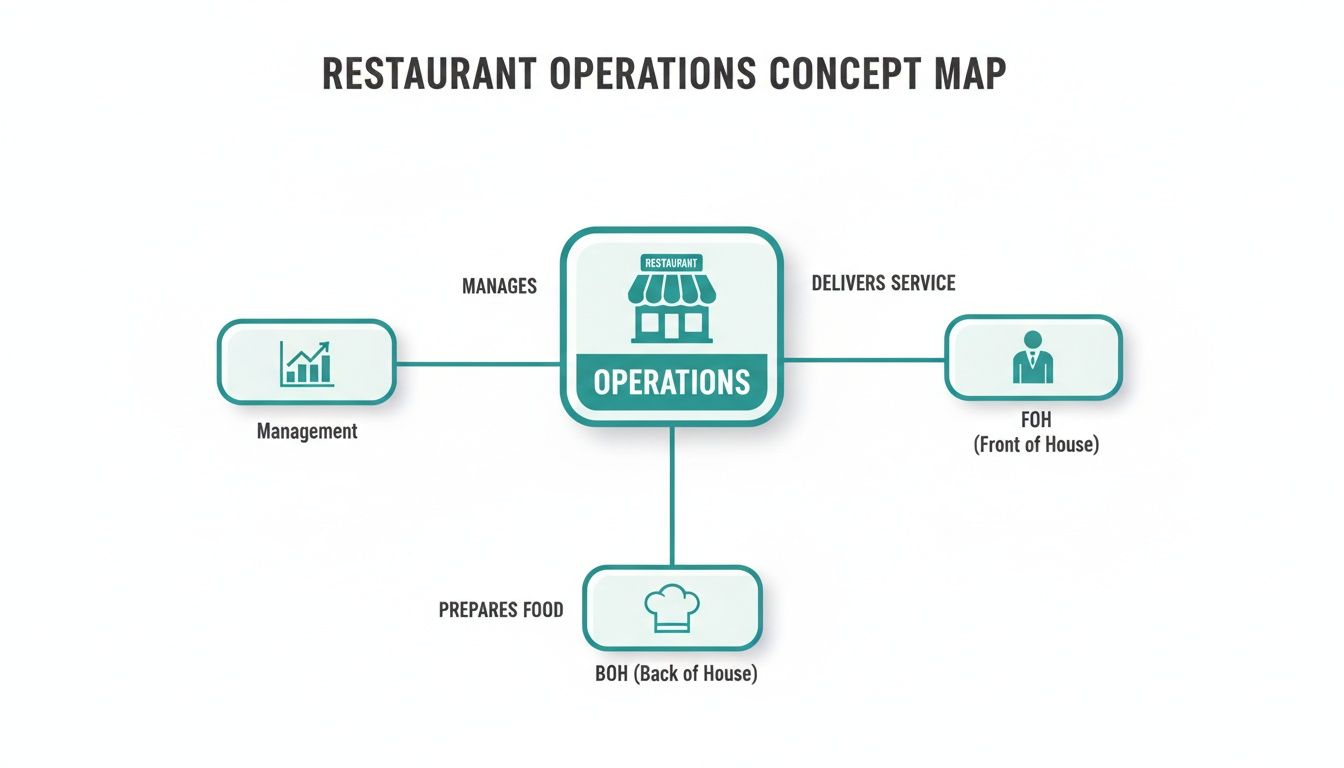
As you can see, no department is an island. Great management means seeing the whole picture and understanding how the guest-facing teams and the production crew rely on one another.
Orchestrating the Front of House Experience
Today’s FOH runs on smart technology. Mobile POS systems let servers take orders and handle payments right at the table, which cuts down on errors and helps turn tables faster. But often, the first tech interaction a guest has is connecting to your guest Wi-Fi.
This is where networking gear from industry mainstays like Cisco and Meraki can be a game-changer. By setting up Captive Portals, you turn a simple Wi-Fi login into a powerful marketing and engagement tool. A guest logs in with a social login, and they’re immediately taken to a branded page showing off the day’s specials or an upcoming event.
This strategy is incredibly versatile and works in all sorts of places:
- Retail cafes: A coffee shop inside a mall could offer a discount to anyone who logs into the Wi-Fi.
- Education campuses: A university cafeteria can use its portal to push student-only meal deals.
- BYOD Corporate settings: A downtown lunch spot can provide secure, fast internet for professionals on their lunch break.
Fine-Tuning the Back of House Engine
While the FOH is all about the guest, the BOH is obsessed with process. A smooth-running BOH is built on clear, repeatable workflows. That means standardized recipes, exact portion controls, and a kitchen layout designed to eliminate wasted steps.
Inventory management is another massive piece of the BOH puzzle. If you order too much, you’re stuck with waste and cash tied up in stock. Order too little, and you're telling customers you're out of their favorite dish. Smart tracking and forecasting make sure you have what you need, right when you need it.
The secret to a synchronized operation is communication. When the FOH can instantly tell the BOH about an allergy or an order change, or when the kitchen can give servers a real-time heads-up on an "86'd" item, the whole system just works.
Even advanced authentication solutions like IPSK (Individual Pre-Shared Key) and EasyPSK have a role to play. They secure the internal network used by staff devices—like kitchen display systems or manager tablets—keeping it separate from the public guest Wi-Fi. This protects important operational data while ensuring your critical BOH tools are always connected.
Finally, getting these processes down on paper is key. You can find some excellent examples of policies and procedures to help you build your own. By getting these two vital areas in sync, you create an operation that isn’t just efficient, but profitable and built to last.
Enhancing the Guest Experience with Smart Wi-Fi
In the restaurant world, offering free guest Wi-Fi has gone from a nice-to-have perk to an absolute must. But what if your Wi-Fi could do more than just get people online? Smart Wi-Fi turns this basic utility into a serious asset for restaurant operation management, opening up a direct line to your guests and giving you a goldmine of business insights.
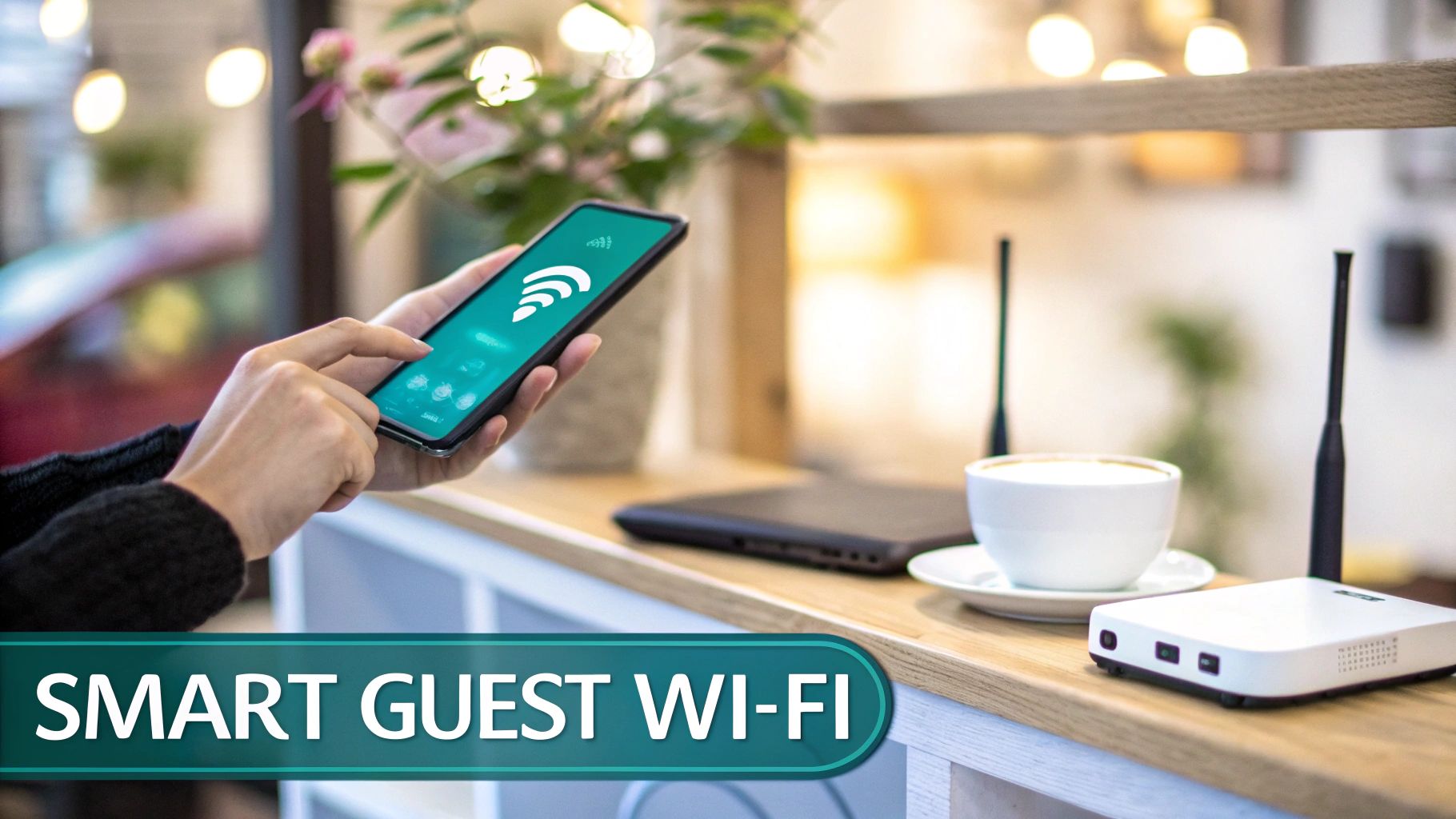
This modern approach all starts with a rock-solid network, usually built on reliable hardware from pros like Cisco or Meraki. From there, you add an intelligent layer that engages customers the second they connect. Instead of fumbling for a generic password, guests see a custom-branded login page, turning a simple connection into a memorable first impression.
Turning Connectivity into an Experience with Captive Portals
The real magic behind this transformation is the Captive Portal. This is the branded splash page that pops up before anyone gets full internet access. Forget just asking for a password. A captive portal can invite guests to connect using their social media accounts, a smooth method known as social wifi or social login.
This one simple step is incredibly powerful. It makes logging in a breeze for your guests while providing your restaurant with valuable, permission-based marketing data. This is where your Wi-Fi stops being a cost and starts becoming an active part of your operations.
- Retail: A café in a shopping mall could show a splash page with a daily special or a coupon for a shop next door, driving sales for both businesses.
- Education: A campus coffee spot can use its portal to promote student events or offer exclusive discounts to anyone who logs in with a university email.
- BYOD Corporate: A restaurant that's popular for business lunches can provide a secure, seamless login that professionals trust, cementing its reputation as a great place to work and dine.
A captive portal isn't just a login screen; it's your restaurant's digital handshake. It’s the first chance you get to engage with guests on their own devices, and it sets the tone for their entire visit.
Digital tools and data are becoming central to running a modern restaurant. Forecasts predict that by 2025, these tools will dramatically reshape both how restaurants make money and how they operate day-to-day. We're already seeing it happen: industry data shows that 57% of full-service restaurants now accept online reservations through their websites. It’s a clear sign of how much customers value speed and convenience.
Securing the Network with Advanced Authentication
Engaging guests is great, but keeping your network secure is non-negotiable. A single, shared password for everyone isn't just a hassle—it's a massive security risk. This is where advanced authentication solutions come in, giving you a way to provide controlled, secure access for different kinds of users.
Solutions like IPSK (Individual Pre-Shared Key) and management platforms like EasyPSK offer a much safer way to handle things. Instead of one password for the entire building, IPSK assigns a unique, private key to each individual user or device.
This approach gives you complete control over who is on your network and what they can do. For corporate BYOD (Bring Your Own Device) environments where employees might be working during lunch, IPSK ensures their connection is totally secure and separate from the public guest network. If a problem ever comes up with a specific user's device, their individual key can be shut down instantly without affecting anyone else.
To see how these capabilities can be put to work, you can explore detailed hospitality Wi-Fi solutions. By combining a fantastic guest experience with ironclad security, your Wi-Fi network becomes a true cornerstone of top-tier restaurant operation management.
Turning Guest Wi-Fi Into Business Intelligence
So, you’ve got guest Wi-Fi. That’s great. But if you’re only thinking of it as a way to give customers internet access, you’re leaving a ton of value on the table. Your Wi-Fi network is sitting on a goldmine of data that can completely sharpen your restaurant operation management. It's time to stop guessing what your customers want and start making decisions based on what they actually do.
The right platform, especially one built to work with powerful hardware from brands like Cisco and Meraki, can turn your network into an incredible analytics engine. Every single time a guest logs on, you get a chance to understand their habits a little better. This is where your guest wifi stops being a simple utility and becomes one of your sharpest strategic tools.
What Your Wi-Fi Analytics Are Really Telling You
At its heart, Wi-Fi analytics is about watching anonymous user behavior to see what trends emerge. Think of it like being able to watch the flow of customers through your dining room, but with way more accuracy and detail. You can track concrete numbers that have a direct impact on how you run your business.
Here are a few of the most important metrics you should be watching:
- Footfall: This isn't an estimate; it's the exact number of people who enter your Wi-Fi zone. You get a precise count of visitor traffic, hour by hour.
- Dwell Time: This tells you how long visitors stick around. Are they grabbing a quick coffee to go, or are they settling in for a long, leisurely meal?
- Visit Frequency: This is where you separate the regulars from the first-timers. It tracks how often individual guests come back, helping you spot your most loyal customers.
This data becomes incredibly useful when you apply it to your specific environment. In a bustling Retail cafe, long dwell times could be your cue to upsell another coffee or a slice of cake. For a quick-service joint near an Education campus, seeing the daily student rush in your data helps you nail down the perfect staffing schedule.
By analyzing these metrics, you move from assumptions to facts. You’re no longer guessing when your busiest times are—you know for certain, down to the minute.
This kind of detail is a true game-changer. Let's say you're in a BYOD Corporate area where professionals stop in for working lunches. Your data might show they stay longer on Tuesdays and Thursdays, which could be the perfect reason to launch a new lunch special aimed directly at them. You can dive deeper into how to capture and make sense of these insights with advanced location analytics.
From Data to Decisions
Just collecting data isn't enough—the real magic happens when you put it to work. When your guest wifi is managed through a smart system using Captive Portals, you can directly link your analytics to your marketing and operations. With secure authentication solutions like IPSK and EasyPSK, you can be confident that every connection is managed properly, giving you reliable data points to work from.
Imagine you notice a group of loyal customers who haven't stopped by in over a month. If your system links a social login or social wifi connection to a customer profile, you can create a laser-focused marketing campaign. You could set up an automated "We Miss You!" email that sends them a special offer to bring them back in.
This is a world away from the old spray-and-pray marketing. It's personal, it's timely, and it's all based on real customer behavior.
Comparing Wi-Fi Authentication Methods for Different Venues
Choosing the right way for guests to log in is a critical piece of the puzzle. The best method depends entirely on your venue and your goals, as the needs of a campus coffee shop are completely different from a high-end corporate lunch spot.
This table breaks down some common authentication solutions to help you find the best fit.
| Authentication Method | Best For | Key Benefit | Example Use Case |
|---|---|---|---|
| Social Login | Retail, Casual Dining | Gathers marketing data with ease and provides a fast, familiar login experience for guests. | A cafe in a mall uses it to build its Facebook audience and send targeted ads. |
| Simple Click-Through | Quick-Service Restaurants | Offers the fastest possible connection, prioritizing convenience for guests in a hurry. | A busy downtown sandwich shop gets customers online with a single tap. |
| IPSK / EasyPSK | BYOD Corporate, Education | Provides the highest level of security by giving each user a unique key to the network. | A restaurant near a corporate park offers secure Wi-Fi for professionals handling sensitive work. |
By tailoring the login experience to your specific environment, you're not just providing a better service; you're gathering the intelligence you need. This is how you transform your Wi-Fi from a simple cost center into a powerful tool that drives loyalty, optimizes schedules, and ultimately, grows your bottom line.
Using Data to Optimize Staffing and Inventory
When it comes to your restaurant's profitability, two levers have the most immediate impact: labor and inventory. In modern restaurant operation management, getting these right is no longer a guessing game. It's about using solid data to make smart, predictive decisions that turn your biggest expenses into well-oiled assets.
Get this right, and you'll see a direct boost to your bottom line.
This data-driven approach is becoming the industry standard. Large enterprise chains have long relied on standardized tech platforms to manage their POS, inventory, and guest data. Now, independent restaurants can tap into similar powerful tools through subscription services. The catch? Adoption can be slow, which often leads to higher waste and labor costs that eat away at already thin margins.
Build Intelligent Schedules with Wi-Fi Analytics
Forget staffing based on last year's sales figures or a manager's gut feeling. Those days are over. Your guest wifi network, especially a robust one built on reliable Cisco and Meraki hardware, is an untapped goldmine of foot traffic data. It gives you a crystal-clear picture of your busiest and slowest periods—down to the specific day and hour.
Think about a café in a busy Retail district. Wi-Fi analytics might show that customer dwell times peak between 2 PM and 4 PM. That's your cue to schedule an extra barista to push those afternoon pastry sales. Or, imagine a diner near a university campus; the data could reveal a sudden traffic spike every Tuesday afternoon, letting you staff up right before the student rush hits.
With this level of precision, you can:
- Eliminate costly overstaffing during predictable lulls, saving a significant chunk on labor.
- Prevent service bottlenecks during peak hours, keeping the guest experience smooth and frustration-free.
- Optimize breaks and shift changes based on actual customer flow, not just the clock on the wall.
The data you collect from Captive Portals and secure authentication solutions like IPSK is what fuels these insights. Every time a guest connects—whether through a quick social login or a secure method for a BYOD Corporate crowd—they help you understand the rhythm of your restaurant.
By turning your Wi-Fi from a simple amenity into a business intelligence tool, you can build staff schedules that perfectly match real customer demand.
Modernize Inventory to Minimize Waste
Just as data sharpens your scheduling, it brings incredible precision to inventory management. Knowing exactly what you’re selling and how fast is the key to slashing waste and strengthening your purchasing power. When you can walk into a meeting with a supplier armed with precise data on your weekly usage, you're in a far better position to negotiate favorable terms.
Modern inventory workflows have moved far beyond the old clipboard and manual count. They involve linking your POS data directly with inventory software, creating a live, real-time view of your stock. This allows you to set up automated alerts for low-stock items and generate purchase orders based on predictive sales forecasts. For more on this, explore these top inventory management best practices to really dial in your process.
Ultimately, using data for staffing and inventory is all about control. It’s about transforming your two largest variable costs from unpredictable headaches into manageable, optimized parts of your operation. That's the edge you need to thrive.
Frequently Asked Questions
When you start digging into modern restaurant operation management, especially the tech side of things, a lot of questions pop up. Let's walk through some of the most common ones with clear, practical answers to help you put these powerful strategies to work in your own restaurant.
Can a Small Independent Restaurant Afford Technology Like Cisco Meraki?
Absolutely. The key is to stop thinking of it as a cost and start seeing it as an investment in efficiency. Technology isn't just for the big chains anymore; subscription-based models have made it incredibly accessible, getting rid of the need for a huge upfront payment. You pay a predictable fee and get powerful tools working for you from day one.
The return on that investment usually shows up faster than you’d expect. For instance, using Wi-Fi analytics to dial in your staff schedules can easily save you thousands in labor costs over a year. Or, think about using a Captive Portal with a social wifi login to build your marketing list—a single targeted promotion can bring in enough new business to cover the service's cost many times over. The trick is to start with a solution that can grow with you and measure its direct impact on your bottom line.
What Are IPSK And EasyPSK?
IPSK stands for Individual Pre-Shared Key, and EasyPSK is just a system that makes managing them, well, easy. Picture your traditional shared Wi-Fi password as one master key to your entire building. If that key gets lost or someone shares it, your whole network is suddenly vulnerable.
IPSK is like giving every trusted user their own secure, unique keycard. In a restaurant, this means you can give guests time-limited access. For BYOD Corporate or Education environments, it means every user gets a personal key, which stops unauthorized devices from hopping on your network and seriously boosts security for everyone.
If one person's device is compromised or they leave the company, you just revoke their specific keycard. Nobody else is affected. It's a massive leap forward in security and control, making it essential for any business that takes its digital safety seriously.
This level of control is a fundamental part of modernizing your restaurant operation management infrastructure, keeping both your public and private networks secure and simple to handle.
How Difficult Is Managing A Captive Portal System?
Not difficult at all. The best modern systems are built for hospitality folks, not IT wizards. Honestly, if you can update your restaurant's Facebook page, you can manage a Captive Portal. Most have user-friendly dashboards with drag-and-drop tools to design your branded login page, simple forms to pick what info you want to collect, and one-click connections to your marketing tools.
Analytics are shown in clean, visual charts, so you can see visitor trends at a glance. The underlying technology, often powered by rock-solid hardware from Cisco and Meraki, does all the heavy lifting in the background. This leaves you free to focus on what you're best at: creating an amazing guest experience and using the insights from your guest wifi to grow your business.
How Does Social Login Benefit My Restaurant?
Adding a social login option to your Captive Portal is a true win-win. For your guests, it's the quickest, most familiar way to get online—no fumbling with long passwords or filling out tedious forms. For your restaurant, it’s an incredible tool for building a direct marketing channel to your customers.
When a guest connects using social wifi, they give you permission to access basic profile details, like their name or email address. This data is pure gold for building a marketing list you can use for targeted promotions, birthday offers, and "we miss you" campaigns to bring regulars back. It’s a simple, seamless way to turn a first-time visitor into a loyal fan. To see how it's done, you can learn more about how to set up guest Wi-Fi that truly works for your business.
Can This Technology Work In Different Sectors?
Yes, and that’s one of its biggest advantages. The core idea of using smart Wi-Fi to improve operations is incredibly flexible.
- Retail: A café inside a department store could use its captive portal to promote a flash sale happening on another floor, directly nudging shopper behavior. Dwell time analytics could reveal which departments are grabbing the most attention.
- Education: A university food court can use IPSK for secure, managed network access for students while using the guest network to send out alerts about campus events or special meal deals.
- BYOD Corporate: A restaurant that attracts a lot of business professionals can offer a premium, secure Wi-Fi experience with EasyPSK, cementing its reputation as the go-to spot for working lunches and client meetings.
The foundational technology from providers like Cisco Meraki provides the stable base, while the authentication solutions and marketing tools are flexible enough to hit the specific goals of just about any environment. It all comes down to tailoring the experience to fit your audience.
Ready to transform your guest Wi-Fi from a simple amenity into a powerful business tool? Splash Access provides an all-in-one platform built on Cisco Meraki to create stunning captive portals, secure networks with IPSK, and unlock the data you need to grow. Learn more about Splash Access and see how our solutions can revolutionize your restaurant's operations.