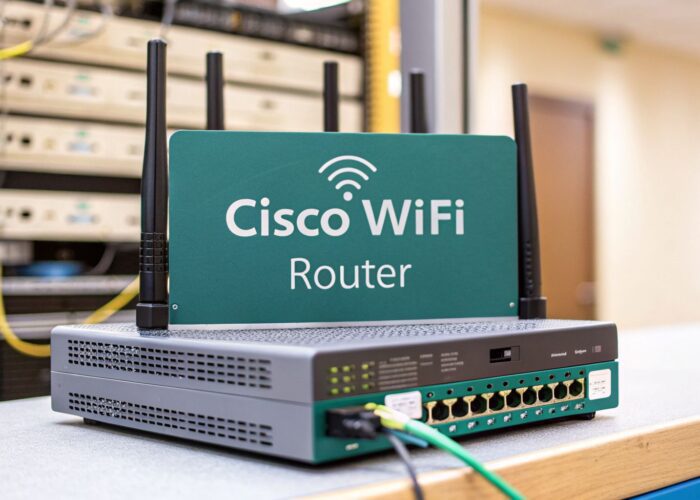
Hey there! Let's talk about setting up your business Wi-Fi. It’s about so much more than just getting a signal. It's about building a secure, high-performance network that serves as a genuine asset for your entire organization. Frankly, in today's super-connected world, a weak or insecure network just isn't an option.
Why Your Router Connection Strategy Matters
Let's be honest: just plugging in a router and calling it a day doesn't cut it anymore. For modern retail stores, education campuses, and corporate offices managing Bring Your Own Device (BYOD) policies, a strategic approach is absolutely essential. This guide is all about using professional-grade solutions, like those from Cisco Meraki, to create a fantastic experience for both your internal team and your guests.
To appreciate just how sophisticated modern networks have become, it helps to look back. The journey of wireless networking is pretty incredible. It all started with an experiment back in 1971 called ALOHAnet, which connected the seven Hawaiian Islands with a wireless packet network. This laid the foundation for the protocols that would eventually become the Wi-Fi we know and depend on.
By 1991, early wireless tech was already popping up in retail cashier systems. Fast forward to 2012, and a quarter of all households worldwide had Wi-Fi. The demands we place on our networks today are worlds away from those early days, which is why our approach has to evolve too.
A properly configured modern router is the key to creating a great guest wifi experience while keeping your internal network completely locked down and secure.

This kind of setup is just the beginning. It's your launchpad for unlocking capabilities that go far beyond simple internet access.
The Strategic Value of Advanced Connectivity
Thinking strategically about your Wi-Fi opens up a world of possibilities for both security and user engagement. It’s no longer just about providing a connection; it's about managing that connection intelligently.
Think about a typical corporate or education environment. Trying to manage hundreds of personal devices (BYOD) with a single, shared password is a security nightmare waiting to happen.
This is where modern authentication solutions really shine.
- Captive Portals: We've all seen these! They're the branded landing pages that pop up when you join a guest network. By offering social wifi login options (like using a Facebook account), businesses in the retail sector can build marketing lists and gain valuable insights into customer behavior. This is often called social login.
- Individual Pre-Shared Keys (IPSK): For more secure environments like corporate offices or education campuses, solutions like EasyPSK are a total game-changer. Each user gets their own unique password. This dramatically boosts security because you can revoke access for a single person instantly without disrupting anyone else.
And as more businesses integrate smart devices, understanding the unique needs of WiFi for IoT becomes critical. These specialized network setups ensure that everything from security cameras to smart thermostats operates reliably and, most importantly, securely.
Laying the Foundation for a Flawless Physical Setup
It’s tempting to jump straight into configuring splash pages and security settings, but let's pump the brakes. The physical setup—where and how you install your hardware—is where a great network is truly made or broken. Get this wrong, and you're signing up for a future of dropped connections and frustrating troubleshooting sessions.
Think about your access points (APs) like light bulbs. You wouldn't put your main light in a closet and expect it to illuminate the whole room. It’s the same with your Cisco Meraki APs. If they’re tucked away behind metal filing cabinets or buried in a storage room, your Wi-Fi signal will be weak and unreliable. Whether you're designing for a busy retail space, a multi-building education campus, or a device-heavy BYOD corporate office, placement is everything.
A professional site survey for your wireless network is always your best bet for mapping out the perfect AP locations. But if you're doing it yourself, you can still get great results by following some fundamental rules. Start by identifying the high-density areas where users will congregate and then look for potential dead zones.
From the Field: We've seen it all. Don't place your APs near elevator shafts, in kitchens next to microwave ovens, or flat against thick concrete walls. These are notorious signal killers. The goal is a clear line of sight from the AP to as much of the user area as possible.
Getting Power and Data to Your APs
With your locations mapped out, it's time to get your access points connected. Every AP needs two things: a data connection and power. Your primary AP, the one acting as the gateway, must be plugged directly into your internet source (your modem or main switch) using a quality Ethernet cable.
For powering the rest of your Cisco Meraki APs, you generally have two options:
- Standard Power Adapter: Simply plug the AP's power brick into a nearby electrical outlet. This is easy, but it means you're limited to placing APs where you have available outlets.
- Power over Ethernet (PoE): This is the method professionals prefer. PoE is a fantastic technology that sends both power and data over a single Ethernet cable. This is a game-changer for clean installations, especially when mounting APs on ceilings or in other spots far from an outlet.
Most business-grade network switches come with PoE ports built-in. You just run one cable from the switch to the AP, and it handles the rest, powering up the device and connecting it to the network instantly.
Don't Neglect the Finishing Touches
One last thing that often gets overlooked is cable management. A "rat's nest" of wires in your IT closet isn't just an eyesore; it's a maintenance hazard. When something goes wrong, the last thing you want is to trace a single cable through a tangled mess.
Take a few extra minutes to organize your wiring. Use velcro straps or zip ties to bundle cables neatly and run them through cable management arms in your rack. It’s a small detail that pays off massively down the road. This solid physical foundation is what makes all the advanced features—like your captive portals with social wifi login or sophisticated authentication solutions like IPSK—run smoothly.
Configuring Your Cisco Meraki Dashboard for Success
Alright, with your hardware all hooked up, it’s time to get to the good stuff: firing up your network inside the Cisco Meraki dashboard. This is where you’ll turn a box of wires and plastic into a living, breathing network. We're going to set up your first wireless networks (SSIDs) and lock them down with some essential security right out of the gate.
Getting the hardware online is pretty universal, and you've already handled the heavy lifting. This quick visual sums up those physical first steps.

That simple "connect, position, power" process is the foundation for any solid Wi-Fi deployment. Now you’re ready for the real configuration work.
The Cisco Meraki dashboard is famous for making complex network tasks feel surprisingly simple. If you want to get a full tour of its power, you can learn more about Meraki cloud networking. For now, let’s jump in and create two separate networks—one for your staff and one for your guests.
Building Your First SSIDs
The first thing you'll do is create two distinct SSIDs. Think of these as different doors into your network: a private one for trusted staff and a public one for visitors.
- Corporate SSID: This is the secure network for your team, employees, or students. We’ll fortify this with strong security from the start, which sets the stage for adding advanced authentication solutions like IPSK or EasyPSK down the road.
- Guest WiFi SSID: This is your public-facing network for customers and clients. It needs to be completely sealed off from your private network. This is the SSID where we'll eventually add a Captive Portal for social login.
Creating separate SSIDs is the foundational step for network segmentation. It’s a non-negotiable security practice for any modern business, whether you're in retail, education, or managing a corporate BYOD environment.
Isolating Traffic with VLANs and DHCP
To truly protect your internal data, you must ensure guest traffic and internal traffic never cross paths. This is a job for Virtual LANs, or VLANs. By assigning your guest wifi SSID to its own dedicated VLAN, you're building a digital wall between your two networks.
At the same time, you’ll configure DHCP (Dynamic Host Configuration Protocol) for each network. This is the service that hands out an IP address to every connecting device. Setting up separate DHCP pools for your corporate and guest networks reinforces that separation and prevents frustrating IP address conflicts.
I’ve seen this countless times: a router's DHCP service glitches and stops assigning IP addresses. Users are connected to the Wi-Fi but have no internet access, and the help desk calls start rolling in. Proper segmentation can contain the fallout from issues like this.
Setting Basic Firewall Rules
The last piece of this initial setup puzzle is laying down some basic firewall rules. The Cisco Meraki dashboard makes this incredibly easy by letting you apply rules directly to an SSID.
For your guest wifi network, the most critical rule you can create is to block all access to your internal corporate IP address ranges.
This single rule is your first line of defense. It acts like a bouncer, ensuring that even a curious user on the guest network can't get a peek into your private data. It's a simple click that delivers a huge security win, protecting your sensitive information from day one.
The need for these security layers has only grown. The wireless revolution began on September 30, 1999, with the launch of 802.11b, which offered a then-blazing 11 Mbit/s. Just a decade later, 802.11n (Wi-Fi 4) boosted speeds to 450 Mbps, a must-have for busy corporate environments. As we see 628 million hotspots predicted by 2026, features like voucher printing and billing gateways have become indispensable tools for modern businesses.
Creating a Branded Guest Experience with Captive Portals
Your guest wifi is so much more than a simple utility—it’s the digital handshake you offer every visitor. Leaving it as a generic, password-free network is a huge missed opportunity. A Captive Portal is what turns that basic connection into a professional, secure, and branded welcome mat for your business.
Think about the first impression. When a customer in your retail shop or a guest at your corporate office connects to your Wi-Fi, what do they see? Instead of a generic password box, they should be greeted by a polished splash page with your logo and brand colors. This is exactly what you get when you pair a powerful platform like Splash Access with your Cisco Meraki hardware. You're moving past just connecting wifi router hardware and starting to build a real experience.

That initial interaction is your chance to set clear terms of use, ethically gather marketing insights, and, most importantly, create a layer of accountability for everyone on your network.
Choosing the Right Authentication Solution
The core of any good captive portal is how you let people on. Your choice of authentication solutions really depends on your goals. Are you a coffee shop looking to grow your mailing list, or are you a school that needs to know exactly who is connected at all times?
For most businesses in retail and hospitality, social Wi-Fi is a fantastic choice. It allows guests to log in using their social media profiles, creating a super-smooth experience. In return, you can ethically build an audience for future promotions, turning your free Wi-Fi into a valuable marketing channel. This social login method is a win-win.
But for environments where control is paramount—think an education campus or a corporate guest network—you need a more locked-down approach.
Choosing the right authentication method depends on your goals, from ease of access to data collection. Here’s a breakdown of common options.
Guest WiFi Authentication Methods Compared
| Authentication Method | Best For | Key Benefit |
|---|---|---|
| Social Login | Retail, Cafes, Hospitality | Effortless for users, great for marketing |
| Voucher/Code | Schools, Corporate, Paid Access | High control over access duration |
| Click-Through | Public Venues, Quick-Service | Fastest access, requires T&Cs agreement |
| Email/Form Fill | B2B Environments, Conferences | Lead generation and direct communication |
Ultimately, the best method is the one that aligns with your security needs and business objectives.
Controlled Access with Vouchers and Codes
In more structured settings, a voucher system offers the perfect blend of security and usability. Instead of a free-for-all, you generate unique access codes that are valid for a specific amount of time. I've found this works incredibly well for:
- Education: Issuing temporary access codes to visiting parents or guest lecturers without giving them full network privileges.
- Corporate BYOD: Handing out codes to contractors or clients that expire the moment their project or visit ends.
- Paid Wi-Fi: Generating access vouchers that align with paid time slots in hotels or event spaces.
This method gives you pinpoint control. You can create a single code for a one-hour meeting or generate a batch of 50 unique codes for a week-long conference. Once the timer runs out, access is cut off automatically. It’s a simple way to keep your network secure and prevent unauthorized lingering.
Think of a captive portal as your digital front door. It ensures no one gets onto your network without first checking in—whether that's through a social login, a paid voucher, or just agreeing to your terms. This single step adds a crucial layer of accountability.
This level of control is fundamental when you're connecting wifi router systems for professional use. You can learn more about crafting a secure and effective landing page by exploring the features of a modern WiFi captive portal.
Streamlining the Connection with QR Codes
Even the most beautiful splash page can be tripped up by a clunky connection process—finding the SSID, opening a browser, waiting for the redirect. This is where QR-code onboarding is a game-changer.
By placing a simple QR code on a table tent, poster, or digital display, you eliminate all those manual steps. A guest points their phone's camera at the code, and their device is instantly directed to your branded splash page. The process becomes immediate and completely intuitive.
This is especially effective in busy spots like cafes, conference halls, and student lounges. It removes friction, gets people online faster, and delivers a polished, modern experience. It’s a small detail that leaves a huge impression, showing you’ve thought through every part of their visit—right down to the Wi-Fi.
Advanced Security for BYOD with IPSK and EasyPSK
Alright, let's talk about delivering serious, enterprise-grade security that’s surprisingly easy to manage. While a Captive Portal with social login is perfect for your guest wifi network, your internal network demands a much tougher line of defense, especially in today's BYOD corporate world.
This is where Individual Pre-Shared Keys (IPSK) and solutions like EasyPSK become absolute game-changers. We've all seen it: the old method of giving one single Wi-Fi password to every employee. It's a huge security hole. What happens when someone leaves the company? You're stuck changing the password for everyone, which is a massive headache and disrupts the entire office.
IPSK completely flips that outdated model on its head. Instead of one password to rule them all, every single user or device gets its own unique key to access your secure WPA2 network.
The Power of Individual Keys
This "one key per user" approach is incredibly powerful because it gives you fine-grained control over who can access your network. It’s not just a theory; I’ve seen it solve real-world problems in all sorts of busy environments.
Think about these common scenarios:
- Education: When a student moves out of campus housing at the end of the semester, you can simply revoke their specific key. Nobody else is affected.
- Corporate: An employee's laptop is lost or stolen. No problem. You can instantly deactivate its unique key, neutralizing the security threat in seconds.
- Retail: For long-term staff, tying network access directly to an individual key means that when their employment ends, their access does too. Clean and simple.
This approach delivers the heavy-duty security of complex 802.1x authentication but completely sidesteps the steep learning curve and management nightmare. It's the perfect middle ground for organizations that need strong security but can't afford to waste time on overly complex systems.
With IPSK, you're no longer just connecting wifi router hardware; you're building an intelligent network where every single connection is known and accounted for. You're shifting from a "trust everyone" model to a "trust, but verify" model, which is absolutely essential for any modern business.
Integrating IPSK with Meraki and Splash Access
Getting this advanced security up and running with your Cisco Meraki gear is incredibly straightforward, especially when you pair it with a platform like Splash Access. From one central dashboard, you can generate, distribute, and manage thousands of unique keys. You can even set keys to automatically expire on a specific date—perfect for temporary contractors or event staff.
This seamless integration is a huge win. Instead of juggling different systems, you have a unified platform for both your guest captive portal and your secure internal network. To see exactly how the backend works, you can dig into the details on IPSK with RADIUS authentication.
It's amazing to think how far Wi-Fi has come. Its roots go back to the 1970s with ALOHAnet, but the 1999 launch of 802.11b at 11 Mbps is what truly brought wireless into our daily lives. Just a decade later, the 2009 introduction of 802.11n pushed speeds to 450 Mbps with MIMO technology, a critical upgrade for handling crowds of devices in co-working spaces. An IDC survey from 2015 even showed 18% of people considered Wi-Fi their most important daily utility—ranking it higher than TV.
Today, this technology enables retail businesses to track footfall with camera analytics and allows education and corporate IT teams to secure thousands of devices with WPA2/IPSK. If you're a history buff, you can check out more on the journey of this amazing technology from Wifirst. It's this ability to securely manage a massive number of devices that makes modern Wi-Fi a cornerstone of business today.
Troubleshooting Common WiFi Connection Hiccups
Alright, you've done the hard work of connecting wifi router hardware and meticulously setting up your SSIDs. But even with the best setup, sometimes things just don't work as expected. The good news is you don’t need to be a network engineer to solve the most common issues.
We've all seen it: a device says it’s connected to the Wi-Fi, but there's no internet. It’s a classic, frustrating problem that often points to a DHCP issue—basically, the router isn't giving your device the IP address it needs to get online. When you run into situations where you have WiFi connected but no internet access, it's a very common hurdle that's usually fixable.
Most of the time, a simple device reboot or restarting the router is all it takes to get them talking again. If you're running a Cisco Meraki system, you have an advantage: you can pop into the dashboard and check the client's health status to see exactly what the network thinks is wrong.
Diagnosing Connection Issues
Another frequent headache, especially in busy places like retail centers or on education campuses, is wireless interference. You might notice the network feels sluggish, or devices keep dropping off. The Cisco Meraki dashboard is your best friend here, offering powerful tools to scan for nearby wireless signals and pinpoint what's causing the disruption to your APs.
Before you dive too deep, run through these quick checks:
- Check the Lights: The status lights on your Cisco Meraki APs are the first place to look. A solid green or blue usually means everything is fine. Amber or blinking lights, however, often point to a connectivity or configuration problem.
- Physical Connections: It sounds almost too simple, but you'd be surprised how often a loose Ethernet cable is the culprit. Double-check that every cable is plugged in securely.
- Reboot in Order: If you need to restart everything, the sequence matters. Power down and restart your modem first. Once it's back online, do the same for your router, and then finally reconnect your client devices.
Sometimes the problem isn't your main network at all. We’ve seen specific router firmware where simply enabling the guest network feature messes with the wireless channel settings, causing interference that kicks devices off the primary network. It's a weird one, but it happens.
When the Captive Portal Fails
What if the guest wifi network is running, but nobody can get through the captive portal? This usually signals an authentication or redirect snag. First, make sure the splash page URL is entered correctly in your Cisco Meraki settings. Then, check that your firewall isn't accidentally blocking access to your authentication solutions provider.
If you're using social login or vouchers with a platform like Splash Access, confirm that your subscription is active and properly linked to your Meraki organization. A quick review of these settings is typically all it takes to solve login problems and keep your BYOD corporate guests and customers connecting without a hitch. For a more comprehensive look at solutions, we have an article dedicated to addressing common WiFi connectivity issues.
Common Questions We Hear About Business WiFi
You've got your router hooked up and the network is broadcasting. That’s a great start! But now comes the real-world management. Let's tackle some of the most frequent questions we get from businesses, schools, and retailers just like you.
Why Do I Really Need a Separate Guest WiFi Network?
This is non-negotiable. Setting up a dedicated guest wifi network using VLANs on your Cisco Meraki gear is the single most important security step you can take. It’s like building a wall between your public-facing lobby and your secure back office.
Your internal network is where the crown jewels are kept—think point-of-sale systems in retail, student records in education, or sensitive corporate files. By shunting all guest traffic onto its own isolated network, you make it impossible for a visitor, whether they're just curious or have bad intentions, to even see your private resources. It also means you can throttle guest bandwidth or filter content without slowing down your own team's critical work.
Captive Portal vs. IPSK: What’s the Difference?
It’s easy to get these confused, but they serve two very different purposes for two very different groups.
A Captive Portal, which you can manage with a platform like Splash Access, is the welcome mat for your temporary visitors. It’s that branded splash page you see at a hotel or coffee shop that asks for a social WiFi login, a voucher code, or just a click to accept your terms. It’s built for transient users in retail, hospitality, and public venues.
IPSK (Individual Pre-Shared Key), on the other hand, is for your trusted insiders in a BYOD environment—employees, long-term contractors, or students in a dorm. Instead of a shared password, each person gets their own unique WPA2 key. You'd typically run a Captive Portal on your "Guest-WiFi" SSID and use an authentication solution like EasyPSK for your secure "Staff-WiFi" SSID.
The core idea is simple: a Captive Portal manages transient guests, while IPSK secures trusted members of your organization. One is for marketing and easy access; the other is for robust, long-term security.
Can I Just Use Social Login for My Corporate BYOD Network?
We hear this one a lot, and the answer is a hard no. Social WiFi login is an amazing tool for public guest wifi networks. It’s low-friction, gets customers online fast, and offers great marketing insights for retail.
But your corporate BYOD network is a different beast entirely. It likely grants access to internal servers, printers, and other sensitive company resources. For that, you need a much higher level of security and accountability. This is exactly what IPSK and other enterprise-grade authentication solutions are designed for. They tie network access to a specific, verified individual, giving you a clear record of who is on your network and what they're doing. A social media account just can't provide that level of security for a sensitive corporate or education network.
At Splash Access, we specialize in making these advanced setups easy to manage. Our platform integrates seamlessly with Cisco Meraki to provide branded captive portals, powerful social logins, and secure IPSK solutions for any environment, from retail and education to corporate BYOD. Learn more at https://www.splashaccess.com.