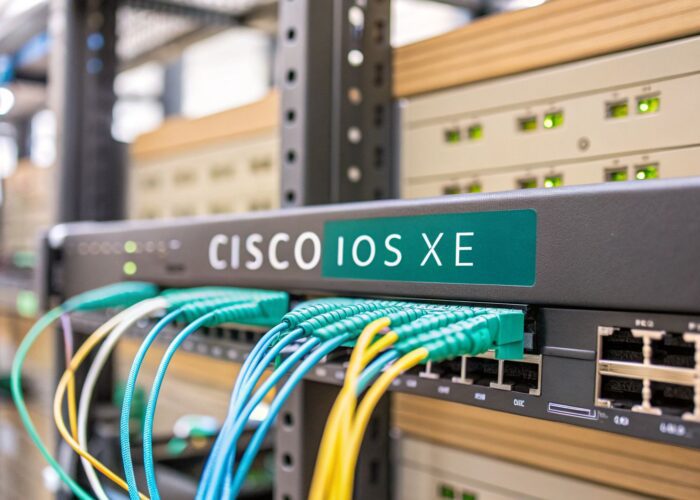
So, what exactly is a cloud based network? Let's chat about it! It's a system where your network's brain—all the management and control functions—lives in the cloud instead of in a server closet down the hall. Imagine swapping out that bulky, expensive on-site hardware for a sleek, intelligent dashboard you can access from literally anywhere.
Welcome to Your Future Cloud Based Network
Let's break down what a cloud based network really means and why it's become such a big deal. The central idea is moving the network controller, the piece of the puzzle that manages all your Wi-Fi access points and settings, from a physical box in your office to a secure, remote data center.
This isn't just a minor technical tweak; it’s a completely different way of thinking about connectivity. For businesses and organizations in Education, Retail, and corporate settings, this shift makes powerful, enterprise-grade networking refreshingly simple and surprisingly affordable. With a great platform like Cisco Meraki, managing a complex network feels easy.
It's no surprise that a staggering 94% of enterprises now use cloud computing in some form. This massive adoption has made cloud-based networks the go-to solution for managing everything from a secure corporate BYOD environment to a busy campus guest Wi-Fi network.
Cloud Networking vs Traditional On-Premises Networking
To truly grasp the change, it helps to compare the new way with the old. The table below breaks down the fundamental differences between managing your network via the cloud versus sticking with traditional on-site hardware. It really highlights the key benefits that modern businesses are looking for.
| Feature | Cloud Based Network (e.g., Cisco Meraki) | Traditional On-Premises Network |
|---|---|---|
| Management & Control | Centralized dashboard, accessible from any web browser | On-site hardware controller, requires physical access |
| Deployment | Zero-touch provisioning; plug-and-play setup | Manual configuration required for each device |
| Scalability | Effortlessly add new sites and devices through the dashboard | Requires purchasing and installing new hardware |
| Maintenance | Automatic firmware and security updates pushed from the cloud | Manual updates and patching by IT staff |
| Multi-Site Management | A single "pane of glass" to view and manage all locations | Separate controllers and management for each site |
| Upfront Cost | Lower initial hardware investment (subscription-based) | High capital expenditure for controllers and servers |
As you can see, the cloud model takes a lot of the hands-on, time-consuming work off your IT team's plate, freeing them up to focus on more strategic projects.
The Old Way vs. The New Cloud Way
With traditional networks, IT staff had to be physically present to make changes, troubleshoot problems, or run updates. If your business had multiple locations, like a chain of retail stores or a school district, this quickly became a logistical nightmare. Every single site needed its own expensive hardware and someone to manage it.
A cloud based network completely flips this model around. Instead of juggling dozens of separate systems, you get a unified dashboard to oversee your entire network. Whether you’re managing Wi-Fi for one coffee shop or a sprawling university, all the control you need is right at your fingertips with a solution like Cisco Meraki.
This approach delivers some powerful, immediate advantages:
- Centralized Management: Control hundreds of sites from one intuitive interface.
- Zero-Touch Deployment: Ship a new access point to a location, have someone plug it in, and it configures itself automatically.
- Scalability on Demand: Adding new devices or entire locations is simple and doesn't require a massive infrastructure overhaul.
- Enhanced Security: Firmware and security updates happen automatically, so your network is always protected from the latest threats without anyone lifting a finger.
Smart Authentication for Modern Needs
One of the most impressive parts of a modern cloud based network is its ability to handle user access intelligently. This is where authentication solutions shine. Forget about that one shared password that’s impossible to manage and a huge security risk.
Technologies like IPSK (Identity Pre-Shared Key) and EasyPSK give each user or device its own unique password. This is a game-changer for student housing or corporate BYOD policies, adding a critical layer of personal accountability and security. On top of that, Captive Portals allow you to create beautiful, branded login pages for guest Wi-Fi, offering simple access through social logins and turning a basic connection into a valuable marketing opportunity. If you're curious about how this works in practice, you can learn more about what Cisco Meraki offers.
The Core Components of a Cloud Wi-Fi Network
Alright, we've covered the high-level idea of a cloud-based network. Now, let’s get into the specifics and look at the key pieces that work together to deliver that smart, seamless Wi-Fi experience. Think of it less like a complex machine and more like a well-coordinated crew, where each member has a distinct and vital job.
At its heart, a cloud-managed Wi-Fi system is built from just a few core parts: the hardware that users connect to, the "brain" that orchestrates everything from the cloud, and the user-facing portal that handles the login experience. It’s this elegant simplicity that makes it so effective for all kinds of places, from a single busy coffee shop to a university campus with thousands of students.
This diagram does a fantastic job of showing the fundamental differences between the old-school, on-premises approach and a modern cloud-managed system.

You can see right away how the cloud model cuts down on the physical hardware you need to maintain on-site, moving all that complexity into a secure, easy-to-use dashboard.
The Access Points: Your Smart Gateways on the Ground
First, you have the Wireless Access Points (APs). These are the physical devices you’ve likely seen mounted on walls or ceilings—the hardware that actually broadcasts the Wi-Fi signal. But in a cloud network, they are far more than just signal boosters.
Modern APs, like the ones from Cisco Meraki, are intelligent endpoints that are in constant communication with the cloud. They are the frontline workers of your network. Because they’re cloud-managed, deployment is incredibly simple. An IT person can just plug one in, and it automatically connects to the cloud, downloads its configuration, and starts working. This is what we call zero-touch provisioning. You can dive deeper into how this works in our guide on cloud-managed wireless access points.
The Cloud Controller: The Brain of the Whole Operation
If the APs are the frontline workers, then the cloud controller is the central command center—the brain of the operation. This isn't a physical server humming away in your IT closet. It’s a powerful software platform, securely hosted in the cloud and accessible through a web browser. This is where the real power of cloud networking comes to life.
From one single dashboard, an administrator can:
- See the entire network at a glance: Check the real-time health of every AP, switch, and connected user across every single location.
- Push out network-wide updates: Need to change a Wi-Fi password or deploy a new security policy? You can do it for all your sites with just a few clicks.
- Access deep analytics: Get valuable reports on how your network is being used, what devices are connecting, and which applications are consuming the most bandwidth.
For anyone running a network, especially across multiple sites, this centralized control is a game-changer. Platforms like Cisco Meraki, with their extensive Cisco Meraki integrations, make managing a network for a national retail chain or a global enterprise feel almost as easy as managing one for a single office.
The Captive Portal: Your Digital Welcome Mat
Last but not least is the Captive Portal. This is the login page that users are directed to when they first connect to your guest Wi-Fi. Think of it as your digital welcome mat—it’s the first impression a visitor has of your brand and your venue.
A well-executed captive portal is much more than just a gateway to the internet; it turns a basic amenity into a powerful business asset. For businesses in Retail, Education, or even corporate offices with BYOD (Bring Your Own Device) policies, the portal is a key point of interaction. You can offer simple login options like social Wi-Fi, allowing guests to connect using their social media profiles. This gives them a quick, painless way to get online and provides you with valuable, permission-based marketing insights.
The widespread shift to cloud infrastructure is what makes these powerful features so accessible. In fact, global spending on public cloud services is expected to surpass $1 trillion by 2026, a clear sign of how vital these tools have become for businesses of all sizes.
Mastering Secure Access with Smart Authentication
Let's be honest, network security can sound like a pretty heavy topic. But when you're working with a cloud-based network, you’ll find it’s actually much simpler and stronger than the old-school methods. It’s all about finding that sweet spot between rock-solid security and a great user experience, whether you're connecting students in a dorm or shoppers in a retail store.

We've all been there—using a single, shared Wi-Fi password for an entire building. That approach just doesn't fly anymore. It’s a huge security risk; the moment one person shares that password, your whole network is wide open. This is exactly where modern, cloud-managed authentication methods really start to shine.
The Power of Individual Keys with IPSK
Instead of one password for everyone, imagine giving each user their very own personal key to the Wi-Fi. That’s the simple but powerful idea behind Identity Pre-Shared Key (IPSK), a fantastic feature you'll find in platforms like Cisco Meraki. Some vendors even offer simpler versions like EasyPSK to make it even more straightforward.
For any place with lots of users and personal devices, this approach is a total game-changer.
- Education Sector: Think about student housing or campus-wide BYOD (Bring Your Own Device) policies. With IPSK, every student gets their own login. When they graduate or leave, you can revoke their access in a click without disrupting anyone else.
- Corporate Offices: In a modern BYOD Corporate environment, IPSK gives employees a secure way to connect their personal phones and laptops. Plus, IT can see exactly which device belongs to which person, adding a crucial layer of accountability.
- Retail and Hospitality: For long-term hotel guests or retail staff, individual keys ensure access stays controlled. No more worrying about unauthorized people jumping on the private network.
The real beauty of IPSK is that it delivers enterprise-level security with consumer-level simplicity. Users get a password that feels familiar, but on the back end, your network is far more segmented and secure.
If you really want to get into the nitty-gritty of different authentication protocols, our guide on RADIUS authentication for Wi-Fi is a great next step. This is where a cloud-based network truly shows its strength, letting you manage complex security rules without the headache.
Welcoming Guests Securely with Captive Portals
Now, what about guest Wi-Fi? The goal is a bit different, but security is just as critical. This is the perfect job for Captive Portals. You know that branded login page you see at a coffee shop or in an airport? That's a captive portal. When managed from the cloud, you can customize these portals to get guests online safely while also showing off your brand.
One of the best ways to do this is with social login or social Wi-Fi. This lets visitors connect using an account they already have, like Facebook, Google, or even their work account through Azure AD.
It’s a genuine win-win:
- For the User: They get online fast without needing to remember another password.
- For the Business: You grant access securely and can gather valuable, permission-based data for your marketing and analytics efforts.
By managing these portals through a Cisco Meraki cloud dashboard, you can be confident that every connection is secure and compliant. This becomes even more important as your network grows. Protecting it often requires rigorous health checks, including thorough cloud based penetration testing to find and patch holes before they can be exploited. This proactive approach ensures your guest Wi-Fi is as safe as it is convenient.
How a Cloud Network Transforms Your Business
It's one thing to talk about the theory, but let's get into what a cloud based network can actually do for your organization. Shifting your network management to the cloud isn't just a technical swap; it's a move that solves real problems and opens up new doors. This is where platforms like Cisco Meraki completely change the game, turning what was once a simple utility into a powerful business tool.
Let's step away from the abstract and look at how this plays out in the real world. Whether you're running a school, a retail shop, or a busy office, a well-managed network makes your job easier and your operations smarter. It's all about making your Wi-Fi work for you.
Solving Real-World Challenges in Education
In the Education sector, Wi-Fi management is a constant balancing act. You've got faculty needing secure access, students who expect seamless connectivity, and guests who need simple onboarding—all while thousands of devices clamor for bandwidth. This is exactly the kind of complex environment where a cloud based network shines.
Think about a university campus with hundreds of student dorm rooms. Giving everyone a single, shared password is a security nightmare waiting to happen. A smarter approach is using Authentication Solutions like IPSK (Identity Pre-Shared Key) or EasyPSK, which give each student their own unique key to the network.
The benefits are immediate and obvious:
- Secure BYOD: Students can connect all their personal gadgets—laptops, phones, even gaming consoles—without creating security holes for everyone else.
- Simple Management: When a student moves out, their access is revoked with one click in the Cisco Meraki dashboard. No need to change the password for the entire building.
- Accountability: Since every key is tied to a user, IT teams can actually see who is on the network and what they're doing, making troubleshooting and security monitoring far easier.
This isn't just for higher education. In K-12 classrooms, a cloud-managed network gives teachers the controls to filter content and keep students on task, all while supporting school-issued tablets and personal devices in a secure BYOD environment.
Powering Modern Retail and Corporate Spaces
Over in the Retail and BYOD Corporate worlds, the goals might be different, but the principles are the same. For a retail store, guest Wi-Fi is no longer just a nice-to-have; it's a direct line to your customers. By setting up a Captive Portal that uses a social login, you offer instant internet access in exchange for a "like" or follow. Your social wifi suddenly becomes a customer acquisition machine.
But it goes deeper. A Cisco Meraki network can deliver incredible location analytics. You can finally see which aisles are the busiest, measure how long shoppers stick around, and track how many are repeat visitors. Imagine pushing a targeted coupon to a customer’s phone just as they linger by a high-margin display—that’s the kind of data-driven marketing that moves the needle on sales.
In the corporate world, the explosion of hybrid work and flexible offices makes smart networking a necessity. People expect flawless connectivity whether they're at home, in a satellite office, or at headquarters. We're seeing this play out in industry-wide trends, where 92% of enterprises now have a multi-cloud strategy and 70% use a hybrid model for greater agility.
This flexible approach is a perfect fit for a BYOD Corporate setting. Blending Cisco Meraki access points with cloud services helps streamline operations, cut down on security risks, and can even lead to cost savings of up to 30% for midsize firms. You can read more about these trends and their impact on modern cloud development.
Cloud Wi-Fi Solutions for Different Sectors
Here’s a quick look at how a cloud-based network with smart authentication can be tailored to meet the unique challenges of various industries.
| Sector | Primary Challenge | Cloud Network Solution (Cisco Meraki) | Key Benefit |
|---|---|---|---|
| Hospitality | Providing seamless, secure Wi-Fi for hundreds of temporary guests with varying needs (e.g., conferences, personal stays). | Tiered bandwidth packages, time-based access, and simple captive portal login for guests. | Monetize Wi-Fi with premium access tiers and gather marketing data without burdening front-desk staff. |
| Retail | Understanding in-store customer behavior and finding new ways to engage them to drive sales. | Guest Wi-Fi with social login and location analytics to track foot traffic and dwell times. | Turns Wi-Fi into a marketing tool, builds customer lists, and provides data to optimize store layout. |
| Education | Managing thousands of devices (school-issued and personal) securely while ensuring a safe online environment for students. | IPSK for secure BYOD, content filtering, and centralized device management from a single dashboard. | Dramatically simplifies device onboarding and enhances network security for students and staff. |
| Healthcare | Securing patient data (HIPAA compliance) while providing reliable access for staff, patients, and visitors on separate networks. | Role-based access control to segment traffic for staff, guests, and medical devices (IoMT). | Ensures compliance and data privacy while improving the patient and visitor experience. |
| Co-working | Offering reliable, secure internet as a core service to multiple distinct businesses under one roof. | Network segmentation (VLANs) and IPSK to create private, secure networks for each member company. | Allows for easy onboarding/offboarding of tenants and provides enterprise-grade security as a service. |
As you can see, the core technology is flexible enough to solve very different problems, turning a standard IT cost center into a strategic asset for almost any type of organization.
Unlocking Value with Smart Authentication
The common thread tying all these examples together is smart authentication. It's the engine that makes a network secure, easy to use, and incredibly valuable. Whether it's an IPSK key securing a student's devices or a social login on a Captive Portal engaging a shopper, the right Authentication Solutions are what elevate your network from a simple utility to a core part of your business strategy.
The beauty of a cloud based network managed through Cisco Meraki is that it puts these powerful tools in your hands without requiring an army of network engineers. It makes enterprise-grade features accessible for organizations of any size. This is how you make your network do more than just provide an internet connection—it starts working for you.
Turning Your Wi-Fi Into a Marketing Powerhouse
For most businesses, guest Wi-Fi is simply an operational cost—a necessary utility. But what if you could flip that script? Your cloud based network can do far more than just provide internet; it can become a powerful engine for marketing and deep business intelligence.
It all starts by rethinking the login process. A great guest Wi-Fi experience should feel seamless and valuable for your visitors, turning a simple connection into a meaningful interaction.

This is where a branded Captive Portal comes into play. It’s the first thing your guests see, and it’s your best chance to make a strong impression. Instead of just a password field, you’re presenting a welcome mat that opens a conversation and turns anonymous foot traffic into real, identifiable contacts.
Building Your Audience with Social Login
One of the most effective ways to make logins effortless is by offering social login. Rather than forcing people to fill out another tedious form, social wifi lets them connect with a single click using a social media account they already use every day. For a shopper in a busy Retail store or a student rushing across campus, that convenience is a game-changer.
The real win, however, is for your business. This simple action grants you permission-based access to valuable demographic data. It’s an incredibly smooth way to build out your marketing lists with zero friction, transforming your network into a lead-generation tool that works 24/7.
Think of your guest Wi-Fi as the digital front door to your business. A well-designed Captive Portal, especially one integrated with a Cisco Meraki network, doesn't just grant access—it creates an opportunity for engagement and data collection that directly fuels your marketing efforts.
Unlocking Business Intelligence with Network Analytics
Beyond lead generation, a modern cloud based network is a goldmine of business intelligence. A platform like Cisco Meraki doesn't just manage your hardware; it gives you a clear window into visitor behavior, arming you with the data to make smarter decisions that directly impact your bottom line.
These analytics can answer critical questions across different industries:
- For Retailers: Which displays are drawing the most attention? How long do shoppers typically spend in-store, and how many are repeat customers?
- For Education Campuses: Which common areas are most popular with students at different times? How does foot traffic shift between classes or during major events?
- For Corporate BYOD Environments: When does network usage peak in the office? Are there specific conference rooms or collaboration zones that consistently demand more bandwidth?
This level of insight used to be either impossible or prohibitively expensive to acquire. Today, it's a standard feature of cloud-managed Wi-Fi, allowing you to understand your physical space with digital precision. You can dive deeper into this topic by reading our guide on how to use Wi-Fi for marketing.
From Anonymous Visitors to Known Contacts
Ultimately, the goal is to close the loop between the anonymous people in your space and the known contacts in your database. By combining a frictionless login like social login on a Captive Portal with the powerful back-end analytics from a Cisco Meraki network, you do exactly that.
This is about making your Wi-Fi work for you. Whether you're in Retail, Education, or managing a BYOD Corporate environment, your cloud based network is the key to unlocking a whole new level of customer insight and engagement. You can finally connect the dots between what’s happening in your physical world and your digital strategy.
Your Implementation Checklist for a Seamless Transition
Ready to make the move to a truly world-class Wi-Fi experience? Jumping into a cloud-based network can seem like a massive undertaking, but it's much more manageable than you might imagine. Don't think of this as a dense technical manual—it's more like a friendly roadmap to guide you to a smooth and successful launch.
The real goal here is to give you the confidence to plan your deployment from the ground up. By thinking through what you actually need before you start, you can ensure you get the best possible return on your investment right from day one.
Start with Your "Why": Define Your Core Objectives
Before you even glance at a piece of hardware, you need to nail down your "why." What, specifically, do you want this new network to accomplish? The clearer your goals are, the easier it will be to build a system that actually hits the mark.
- For an Education Campus: Is your top priority giving students secure BYOD access in the dorms with a smart authentication solution like IPSK? Or is it more about managing device use in the classroom and filtering content effectively?
- For a Retail Store: Are you trying to elevate the guest Wi-Fi experience with a polished captive portal? Do you want to capture customer emails through social login and analyze foot traffic patterns?
- For a BYOD Corporate Office: Is the main challenge simplifying how employees connect their personal devices while keeping the network locked down, perhaps with something like EasyPSK?
Figuring this out first will shape every single decision that follows. For a more detailed look at the hands-on part of the process, you might find our guide on the installation of a wireless network helpful.
Plan Your Hardware and Design Your Digital Welcome Mat
Once you've got your goals sorted, it’s time to talk tools. This starts with picking the right Cisco Meraki hardware to handle your needs for coverage and the number of users. Working with a good partner can be invaluable here; they can help with a site survey to map out the perfect number and placement of your access points.
Think of your captive portal as your digital front door. It needs to look great, reflect your brand, and be incredibly simple for people to use. A confusing login is the quickest way to frustrate a visitor.
Next, shift your focus to designing a captive portal that is both beautiful and effective. This is your chance to bring your brand to life. Decide which authentication methods make the most sense. Will you offer social Wi-Fi for quick, one-click access? Or maybe use a voucher system for controlled access? The portal is your opportunity to turn a basic connection into a memorable brand interaction.
Configure, Integrate, and Go Live
This is where the rubber meets the road. The final step is all about configuration—setting up your chosen authentication solutions, like IPSK for your internal team or social login for your guest Wi-Fi. A platform like Cisco Meraki simplifies this whole process with its intuitive cloud dashboard, letting you get things running without a ton of technical overhead.
And don't forget the integrations! One of the biggest wins with a modern cloud-based network is how it can talk to your other business systems. You can link your captive portal directly to your marketing software to automatically build your contact lists, or connect to payment gateways if you plan to offer tiered, premium Wi-Fi. Taking the time to properly integrate everything creates a powerful, automated engine for your business's growth.
Frequently Asked Questions About Cloud-Based Networks
Thinking about making the switch to a cloud-based network? It's a fantastic move for most businesses, but it's completely normal to have some questions. Let's walk through the most common ones we hear so you can feel confident moving forward with a platform like Cisco Meraki.
What Happens if My Internet Connection Goes Down?
This is easily the first question everyone asks, and it's a great one. The good news is, your network keeps on humming. Think of the cloud dashboard as the command center for configuration, not the highway for your data. Your actual local traffic—people connecting to printers or servers—never leaves your building.
If the connection to the Cisco Meraki cloud drops, your Wi-Fi access points simply carry on with their last known instructions. People can still get online, authenticate, and use local resources just as they did before. The only thing you can't do is make new configuration changes from the dashboard until your internet is back up.
How Scalable Is a Cloud-Based Network?
Scalability is where cloud networking really flexes its muscles. For any organization that’s growing, the benefits are huge. Whether you’re adding a couple of new access points to your main office or launching a brand new location across the country, the process is almost laughably simple.
You just ship the new hardware to the site and plug it in. That's it. The device phones home to the cloud and automatically downloads its configuration. This “zero-touch provisioning” means you can scale from a single office to hundreds of sites without the usual IT deployment nightmares. It’s a game-changer for:
- Retail Chains: Manage the Wi-Fi for every single store from one central dashboard.
- Education Campuses: Roll out network coverage to new dorms or academic buildings as your campus expands.
- Corporate Offices: Quickly set up new branch locations or handle the influx of BYOD devices without a hiccup.
How Are Security Updates Handled?
Let's talk about security, because this is another area where cloud networks truly shine. With a platform like Cisco Meraki, firmware patches and critical security updates are handled automatically. Your network is constantly being updated behind the scenes to defend against the latest threats.
This automated-first approach takes a huge burden off your IT team, who no longer have to manually touch every device. It ensures your environment is always secure, which is especially important when you’re running a Captive Portal for guest wifi or using authentication solutions like IPSK or EasyPSK. You get top-tier, enterprise-grade security that’s always current, all managed from the cloud.
Ready to see how a cloud-managed network can transform your business? Splash Access specializes in deploying powerful guest Wi-Fi solutions on Cisco Meraki hardware. Visit us today to learn more.