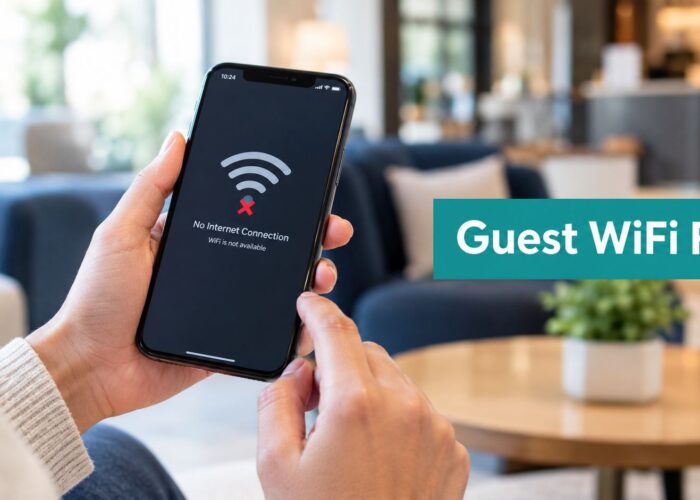
A guest is standing at the front desk. Their phone shows full WiFi bars. Your Cisco Meraki SSID says connected. But the login page never appears, social login never opens, and your guest WiFi is dead in the one moment it needs to feel effortless.
That's the version of captive portal not working that frustrates people most. It looks like internet access should work, but the authentication step never starts. In retail, that means a shopper gives up. In education, a student misses class resources. In a BYOD corporate office, a visitor assumes your network is broken. If you run Meraki with social WiFi, IPSK, or EasyPSK, this usually isn't one big mystery. It's a chain problem, and one link is failing.
That Familiar Frustration When the Guest WiFi Just Wont Load
A hotel guest checks in late, joins the guest SSID, and waits for the splash page. Nothing. A student on campus connects outside a lecture hall and gets the same result. In both cases, the device says connected, but there's no browser prompt, no sign-on window, and no path to internet access.
That pattern is getting more common as captive portals collide with modern web security. The global captive portal market was valued at USD 1.95 billion in 2024 and is projected to reach USD 6.20 billion by 2033, but that growth depends on moving away from older interception methods that break more often as HTTPS becomes the default, according to Grand View Research's captive portal market analysis.
For network teams, the important takeaway is simple. The old habit of assuming the AP or firewall is always the problem wastes time. Many portal failures now start on the client side, where browsers, private addressing, VPN apps, and OS detection logic can stop the login flow before Meraki ever gets a fair shot.
A connected device without a login prompt usually means the portal trigger failed, not that the WiFi signal failed.
If you need a quick refresher on the login flow itself, Splash Access explains what captive portal login is in plain terms. That helps when you're training store staff, front desk teams, or campus helpdesk workers who see the symptom first.
The fastest fixes come from working in order. Start with the device and browser. Then verify DHCP and DNS. After that, check firewall behavior, routing, and the exact Meraki splash settings tied to your authentication method.
Start With the Source Client and Browser First Aid
When the captive portal doesn't appear, the first move isn't the dashboard. It's the phone, tablet, or laptop in front of you.

Use the quick trigger checks first
Start with the actions that take less than a minute:
Turn WiFi off and back on.
That forces the device to re-evaluate the SSID and retry captive portal detection.Forget the SSID, then reconnect.
This clears stale association data and often fixes sessions that got stuck after a partial auth attempt.Open a private or incognito browser window and visit an HTTP-only site.
A reliable test isneverssl.com. Modern browsers enforcing HTTPS-by-default and OS features like MAC address randomization on iOS 14+ and Android 10+ are major culprits, and visiting an HTTP-only site like neverssl.com in an incognito window can force the portal to appear, as noted in Google Chromebook community guidance on captive portal behavior.Disable VPN or proxy apps temporarily.
If the device tries to tunnel traffic before auth completes, the splash page often never loads.
A lot of support teams skip step three. They shouldn't. If Safari or Chrome tries to jump straight to HTTPS, there may be no plain HTTP request for the portal to intercept.
Watch for privacy features that break repeat logins
This matters a lot in education, retail, and BYOD corporate environments where people reconnect constantly.
On iPhone and iPad, look for Private Wi-Fi Address. On Android, check MAC randomization or similar private address settings. These features are useful for privacy, but they can confuse guest WiFi systems that expect the same device identity on return visits. That's especially relevant when you're using IPSK or EasyPSK, where policy handling may rely on consistent client identity.
If the portal worked yesterday but not today for the same user, this is one of the first things I'd suspect.
Practical rule: If the SSID connects but the splash page never appears, force a plain HTTP request before touching Meraki.
Check for app interference, not just browser behavior
Some devices never seem idle enough to trigger the portal cleanly. Background apps, sync clients, and privacy tools may generate traffic that changes how the OS decides internet connectivity. The user sees “connected, no internet,” but no sign-in prompt appears.
For helpdesk staff, keep the script simple:
- Close active VPN apps: Corporate VPN, privacy VPN, and secure DNS apps can hijack the first unauthenticated traffic.
- Pause sync-heavy apps: Cloud storage or calling apps sometimes create noise before the portal flow completes.
- Retry with one clean browser tab: Don't test from a tab loaded with saved HTTPS redirects.
If you need a simple explainer for staff who aren't network specialists, this Splash Access article on captive portal detection is useful because it frames what the device is trying to do before the login page appears.
What usually works and what usually doesn't
| Situation | Usually works | Usually doesn't |
|---|---|---|
| Browser never opens portal | Private window plus HTTP-only site | Repeatedly refreshing a cached HTTPS tab |
| Returning guest fails to reconnect | Disable private Wi-Fi address temporarily and rejoin | Rebooting the AP first |
| Social WiFi page won't load | Turn off VPN and retry clean browser session | Testing inside an app webview |
| EasyPSK or IPSK confusion on revisit | Forget network and reconnect with stable client identity | Assuming RADIUS is broken immediately |
If the device still won't trigger the portal after those checks, then it's time to move to the network foundations.
Verify the Foundation DHCP and DNS Health
A Meraki captive portal can't authenticate a device that never got a usable network identity in the first place. That's why DHCP and DNS are the first infrastructure checks I make.

DHCP is the seating chart
Think of DHCP like the host stand in a busy restaurant. If there are no open tables, new guests wait at the door no matter how good the kitchen is.
In high-density environments, the most frequent cause of portal failure is DHCP pool exhaustion when utilization exceeds 85%, and reducing lease times to 15 to 30 minutes can recycle addresses faster and reduce captive portal failure rates by up to 60%, according to Purple's captive portal login troubleshooting explainer.
That's a real issue in retail centers, student housing, event spaces, and large guest WiFi deployments on Meraki.
Check these first:
- Lease utilization: If the pool is crowded, new clients may connect to WiFi radio but never complete normal onboarding.
- Lease duration: Long leases make sense in stable office VLANs. They're often wrong for guest networks.
- Correct VLAN delivery: A client on the wrong VLAN can look like a portal failure when it's really an address assignment problem.
If you're troubleshooting intermittent failures at busy times of day, DHCP exhaustion moves near the top of the list fast. For a deeper primer on one of the core symptoms, Splash Access has a useful breakdown of DHCP server not responding issues.
DNS is what tells the device where to test
A device doesn't just “know” to open your guest login page. It usually runs a connectivity check first. If DNS can't resolve the expected destination, the portal workflow can fail in strange ways.
For non-network staff who need a plain-English explanation, Finchum Fixes IT explains DNS in a way that's easy to hand to someone on an operations team.
Here's the practical version for troubleshooting:
- The client must receive valid DNS servers.
- The client must be able to resolve standard connectivity check destinations.
- Your guest policy must not break those checks in inconsistent ways.
A simple field checklist
When I'm standing in a retail site or campus building, I don't overcomplicate this layer. I verify:
| Check | What I want to see | What failure looks like |
|---|---|---|
| Client IP lease | Valid guest subnet assignment | Self-assigned or missing address |
| Gateway reachability | Basic local path is alive | Device connected but isolated |
| DNS resolution | Standard lookups complete | Portal never triggers consistently |
| Lease turnover | Pool recovers during busy periods | New guests stall during peak use |
If a guest device has no clean IP lease or no working DNS path, portal troubleshooting above that layer is guesswork.
Meraki admins sometimes jump straight into splash settings because that's the visible symptom. Resist that urge. If DHCP and DNS are unstable, social login, SAML, guest WiFi onboarding, and external authentication all become unpredictable.
Navigate the Network Maze Firewall and Routing Rules
A lot of captive portal problems come from security rules doing exactly what they were told to do. The issue is that pre-auth traffic needs a small amount of freedom before the user is allowed full access.
The portal needs a controlled walled garden
Before authentication, the device still needs to reach a few places:
- The splash page or captive portal endpoint
- The authentication path used by your design
- The operating system's portal detection destinations
- Any required upstream dependency for the login experience
When those paths are blocked, the login page either never appears or it appears and then fails mid-flow.
One of the most common root causes is blocking the operating system connectivity checks. Apple devices test http://captive.apple.com/hotspot-detect.html, Google tests http://connectivitycheck.gstatic.com/generate_204, and Windows tests http://www.msftconnecttest.com/connecttest.txt. If those requests aren't handled correctly, the device often won't trigger the login page, as documented in Wikipedia's overview of captive portal detection behavior.
What to verify on a Cisco Meraki guest network
In a Meraki environment, I'd validate policy in this order:
SSID access policy
Confirm the guest SSID is intended to enforce splash or sign-on behavior. Open access with partial restrictions can look like a broken portal.Pre-auth firewall handling
Make sure unauthenticated users can reach what the portal requires before login. If social WiFi is involved, your policy has to allow the sign-in experience to load cleanly.Routing between AP, gateway, and auth path
The splash page may be fine, but the route to the next dependency may not be.RADIUS reachability where applicable
If you're using external authentication, the traffic path has to be open end to end.
If your team manages multiple customer sites and wants a broader operational view, this guide for MSPs on managed firewalls is a helpful resource for thinking through layered firewall ownership and rule hygiene.
Meraki-specific gotchas that waste time
The biggest mistake I see is allowing general web access tests but forgetting the exact pre-auth path the device needs. That creates inconsistent behavior across Apple, Android, Windows, and ChromeOS devices. One user gets the portal. The next user just sees a dead browser tab.
Another common issue is assuming “the internet is up” means “the captive portal path is up.” Those are not the same thing.
A guest can have working local association and still fail every useful authentication step if the pre-auth route is blocked.
If you're seeing users report that the portal worked on one device but not another, don't blame the devices first. Compare what each device attempted before the login page should have appeared. Apple, Android, and Windows don't all probe the network the same way.
A practical allowlist mindset
Don't think in terms of “open everything until login.” Think in terms of “allow the exact minimum the portal needs.”
Use this approach:
- Allow detection traffic: The OS has to decide there's a captive network present.
- Allow the splash destination: The login page itself must be reachable.
- Allow the auth handoff: If credentials, social login, SAML, or guest acceptance happens elsewhere, that path must be reachable too.
- Deny unnecessary browsing before auth: Keep the guest network controlled without breaking the onboarding path.
If you need a plain-language reference for one common symptom, Splash Access has a focused explanation of traffic being blocked by firewall policy.
Once these rules are correct, the rest of the troubleshooting gets much cleaner. If they're wrong, every higher-layer fix becomes unreliable.
Configure Meraki and Splash Access Settings Correctly
If the device checks are clean and the network path is clean, I go straight to the Meraki dashboard. Here, small configuration misses cause big confusion.

Start in the Access Control page
For Meraki, the key path is Wireless > Configure > Access Control.
That's where you verify the splash behavior is enabled and tied to the right authentication method. According to Meraki's splash page configuration overview, an administrator must access Wireless > Configure > Access Control, enable the splash page feature, and then choose the correct authentication type such as Social WiFi or SAML. If that two-step process isn't completed, the portal won't render.
That sounds obvious, but in practice it's a frequent miss. Admins enable the SSID, assume sign-on is implied, and then wonder why guests browse or stall without ever seeing a login page.
For IPSK and EasyPSK, the block setting matters
When you're working with IPSK or EasyPSK on Meraki, don't stop at the splash page selection.
You also need to confirm:
- Sign-on with my RADIUS server is selected where your design requires it
- The RADIUS details match the intended authentication flow
- Block all access until sign-on is complete is enabled when you need the portal to trigger before access is granted
Without that block setting, Meraki may pass traffic in a way that makes the portal appear inconsistent or absent. The result is a classic “captive portal not working” complaint even though the issue is policy bypass, not portal failure.
A click-by-click validation routine
When I audit a Meraki guest SSID, I look for these items in order:
| Dashboard area | What to confirm | Why it matters |
|---|---|---|
| Access Control | Splash page is enabled | No splash enabled means no portal render |
| Auth type | Correct choice such as Social WiFi, SAML, or RADIUS-backed flow | Wrong method breaks the expected journey |
| Sign-on behavior | Block all access until sign-on is complete, when required | Prevents bypass that hides the issue |
| External dependency path | Cloud and auth services are reachable | Portal can't complete if upstream auth path is broken |
If you're building a branded guest WiFi login page, keep the workflow simple during testing. Strip out extras first. Confirm base auth. Then add social login, SAML, QR flows, or custom experiences one by one.
Don't ignore Meraki cloud dependencies
There's one more Meraki-specific point that matters in the field. If your external RADIUS flow depends on Meraki cloud communication and that link is blocked, the portal may fail before users ever see a usable sign-on sequence. In those cases, the AP and SSID can look healthy while authentication breaks upstream unnoticed.
That's why I separate radio health, policy health, and authentication path health. Teams often verify only the first one.
Clean SSID association doesn't prove your Meraki authentication solution is healthy. It only proves the client joined the network.
For education, retail, and BYOD corporate deployments, disciplined templates help. One known-good SSID profile for social WiFi, another for SAML, another for IPSK or EasyPSK. That reduces drift and makes failures easier to isolate.
The only product point worth making here is factual. Splash Access supports Meraki guest WiFi workflows including splash pages, social WiFi, and authentication integrations. In a Meraki deployment, that means the portal settings in dashboard and the external login experience have to agree exactly, or users get stuck in the gap.
Your Pre-Support Checklist and Prevention Plan
When the portal still won't load, don't open a support ticket with “guest WiFi broken.” Gather evidence once, and the resolution gets faster.

What to record before escalation
Write down the details that help:
- Client details: Device type, OS, browser, and whether private addressing or VPN was enabled
- Connection details: SSID name, approximate time, and location or AP area
- Observed behavior: No portal popup, blank browser, looping login, or post-auth failure
- Foundation checks: Whether DHCP lease and DNS resolution looked normal
- Meraki checks: Splash enabled, auth type correct, block-until-sign-on setting reviewed
A front desk team in hospitality or a campus support desk can gather most of that with a short checklist. They don't need deep network access to be useful.
Prevention is mostly about consistency
The best long-term fix isn't one magic setting. It's reducing avoidable edge cases:
- Keep guest DHCP leases short in dense environments
- Standardize Meraki templates by use case
- Train staff to test with a clean browser and HTTP-only page first
- Review pre-auth firewall behavior whenever login methods change
- Test repeat connections on iPhone, Android, Windows, and Mac devices
That last point matters because guest WiFi problems often show up first on the second or third reconnect, especially when private addressing and browser security features get involved.
Good captive portal support starts with a repeatable checklist, not with guesswork.
If you run through the client checks, the DHCP and DNS basics, the firewall path, and the exact Meraki access control settings, you'll solve most captive portal failures before they turn into a long outage.
If your team uses Cisco Meraki and needs a cleaner way to manage guest WiFi, social login, IPSK, EasyPSK, and branded captive portal workflows across retail, education, hospitality, or BYOD corporate environments, Splash Access is worth evaluating. It's built around Meraki deployments, and it helps standardize the login experience so you spend less time chasing avoidable portal failures.