When you hear "Wi-Fi," you probably think of the little router humming away in the corner of your living room. It’s perfect for streaming movies and connecting a few phones and laptops. But what happens when you try to use that same technology in a bustling retail store, a sprawling education campus, or a corporate office with a Bring-Your-Own-Device (BYOD) policy?
That’s when you hit a wall. A home router in a business environment is like trying to direct rush hour traffic with a single stop sign. It simply wasn't built for the job.
So, What Exactly Are Business Wi‑Fi Solutions?
This is where professional, business Wi‑Fi solutions step in. They are complete, managed wireless ecosystems designed from the ground up for high-density use, ironclad security, and centralized control. Think of them less as a utility and more as a strategic asset for your organization.
A professional Wi-Fi network is like a modern highway system, while a home router is a single-lane country road. The highway has multiple lanes, controlled on-ramps, and sophisticated traffic management to keep thousands of vehicles moving smoothly and safely, preventing gridlock.
Engineered for Crowds and Performance
Solutions from industry leaders like Cisco and its cloud-managed Meraki platform are purpose-built for environments packed with people and devices. They ensure that whether you have 50 customers in a coffee shop or 500 students in a lecture hall, everyone gets a fast, reliable connection. This magic happens through intelligent access points and cloud-based management that automatically balances the network load.
The need for these powerful systems is exploding. The global managed Wi-Fi market, valued at USD 7.75 billion in 2023, is projected to surge to USD 20.48 billion by 2030, a clear sign that businesses everywhere are demanding better connectivity. You can dig into the market growth data on Business Research Insights.
It’s About More Than a Password
A key difference is how users get onto the network. Instead of a single, shared password that quickly becomes a security nightmare, modern business networks use sophisticated Authentication Solutions to manage exactly who gets access, and how.
This is a game-changer for different environments:
- Education: Easily separate student and faculty devices onto different networks and apply content filters.
- Retail: Offer seamless guest wifi with easy social login options that customers actually want to use.
- BYOD Corporate: Use technologies like IPSK (Identity Pre-Shared Key) or EasyPSK to give each employee a unique, private key for their personal devices, drastically improving security.
Ultimately, these systems provide the foundation for a reliable, secure, and intelligent wireless environment. They transform Wi-Fi from a simple background utility into a powerful tool that protects data, elevates the user experience, and helps your organization thrive.
The Building Blocks of a Powerful Wireless Network
To really get what sets a professional Wi-Fi network apart from your home setup, you have to look under the hood. It’s not about getting lost in technical jargon, but about understanding the key pieces that work in harmony to create a secure, reliable, and user-friendly wireless experience for everyone. These are the building blocks behind a network that just works, no matter how many people are trying to connect.
This framework shows how a solid business Wi-Fi strategy rests on three core pillars: robust security, simplified management, and the ability to grow without skipping a beat.
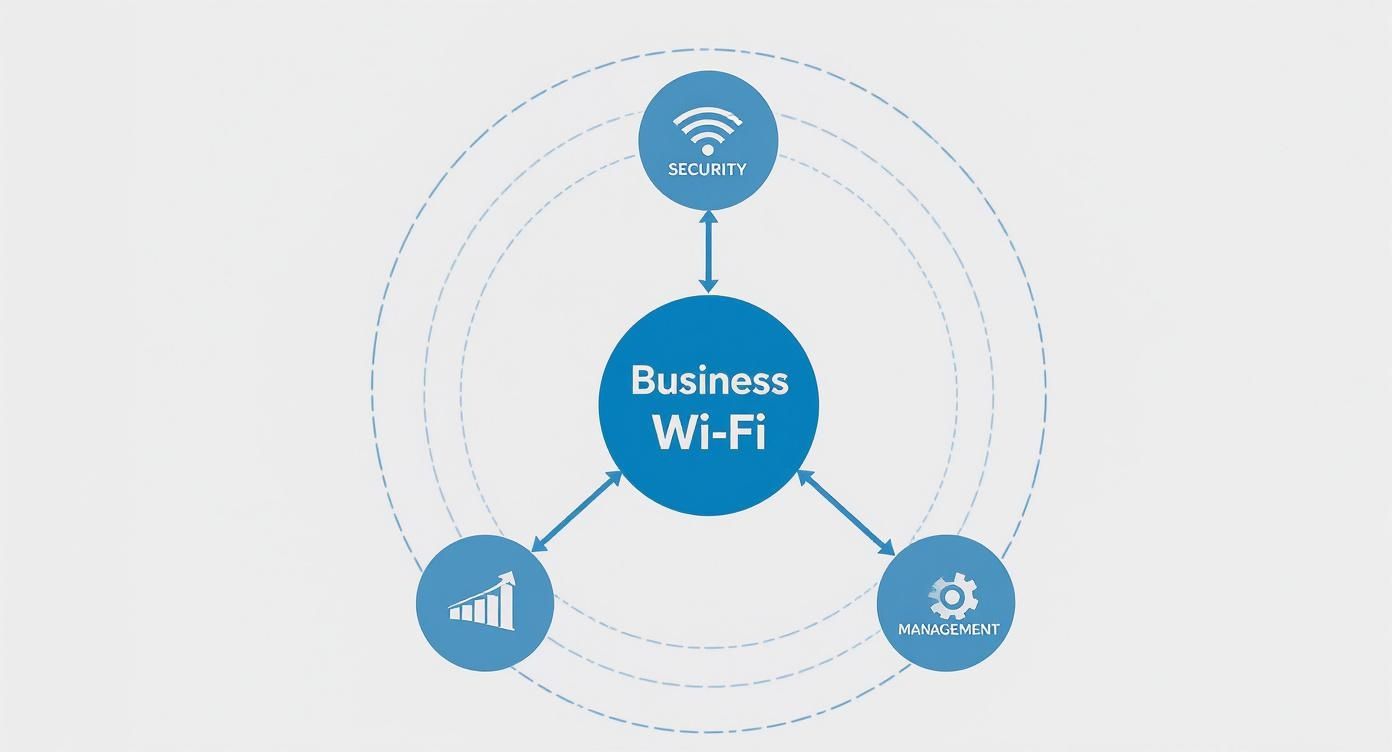
The key takeaway is that these elements are deeply connected. Strong security gives you the confidence to expand, and centralized management makes it all possible without burning out your IT team.
Your Network's Front Door: The Captive Portal
Think of a Captive Portal as the friendly front door to your network. It's the branded login page that guests see right after they select your Wi-Fi, and it’s your first chance to make a great impression while controlling who gets online.
A Captive Portal transforms guest Wi-Fi from a simple utility into a strategic tool. It's the difference between leaving a key under the mat and having a concierge greet your visitors, verify their identity, and offer them a welcome drink.
For instance, a Retail store can use its portal to flash a daily deal, while an Education campus can post important announcements. Modern portals, especially when running on powerful hardware from providers like Cisco Meraki, also open the door to slick social login options. This lets guests connect with their social media credentials, which is incredibly convenient for them and gives you valuable (and anonymous) demographic data. This social wifi approach is a true win-win.
Below is a quick comparison showing just how different the feature set is when you move from a basic router to a professional solution.
Key Features of Business Wi Fi Solutions
| Feature | Consumer Wi-Fi | Business Wi-Fi Solution |
|---|---|---|
| Security | Basic WPA2/WPA3 password | Advanced encryption, IPSK, firewalls, threat detection |
| Authentication | Single shared password | Captive portals, social login, Azure AD, SAML, EasyPSK |
| Guest Access | Simple "guest network" option | Controlled, branded, and time-limited access |
| Scalability | Limited to 1-2 access points | Supports hundreds of APs and thousands of users |
| Management | Individual device web interface | Centralized cloud-based dashboard |
| Analytics | Basic device list | Detailed user demographics, footfall, and usage data |
As you can see, the gap is significant. Business solutions are built from the ground up for control, security, and insight.
Smart Authentication for a Modern Workplace
The days of a single Wi-Fi password scribbled on a whiteboard are long gone. Modern Authentication Solutions are far more intelligent, especially in today's world of Bring Your Own Device (BYOD). This is where technologies like IPSK and EasyPSK truly shine.
IPSK, or Identity Pre-Shared Key, is a brilliantly simple concept. Instead of one password for the whole network, each user or device gets its own unique key. This move alone massively boosts your security posture.
- Individual Control: When an employee leaves, you just revoke their key. No one else is affected.
- Device Security: If a student’s laptop goes missing or a corporate tablet is stolen, you can cut off its access in seconds.
- Simplified Management: IT teams in BYOD Corporate offices no longer have to wrestle with complex certificate systems to secure personal devices.
This method gives you incredibly granular control, ensuring only the right people and the right devices can get on your network. It’s a foundational piece for building a secure network that reflects the reality of a modern workplace.
Of course, all these features rely on hardware that is strategically placed throughout your space. You can learn more about what are access points in our detailed guide. These devices are the physical foundation broadcasting the signal that keeps your business running smoothly.
Creating Great Guest Experiences with Captive Portals
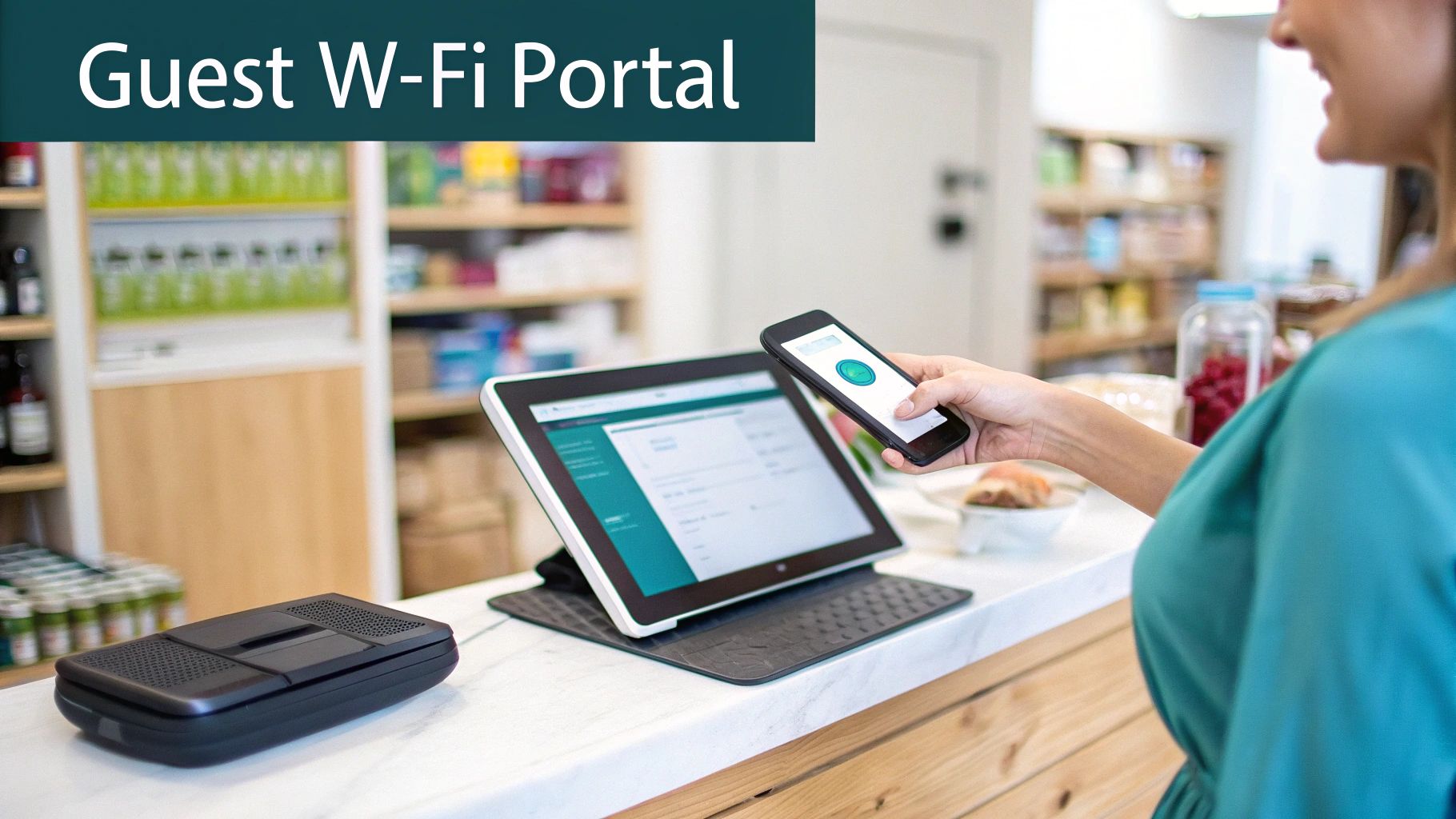
Offering free guest Wi-Fi isn't a perk anymore; it's an absolute expectation. But what if that simple connection could do more than just get people online? This is where a Captive Portal comes in, turning a basic utility into a powerful tool for engagement, marketing, and security.
Think of it as the digital doorman for your network. It’s that branded login page that greets your visitors, and it's your first—and best—chance to make a great digital impression. Instead of an anonymous connection, the portal welcomes every user, lays out the terms, and can even offer them something valuable right from the start.
More Than Just a Login Page
A modern captive portal, especially one built on a robust platform like Cisco Meraki, is far more than a simple login screen. It’s a flexible canvas you can design to hit your specific business goals. This is where business wi fi solutions really start to show their value beyond just providing internet.
For instance, a Retail shop’s portal can flash a QR code for an instant 10% discount, driving a sale the moment a shopper connects. In an Education setting, the portal could remind students about an upcoming campus event or new library hours. It's essentially an owned marketing channel that you have complete control over.
A well-designed captive portal is the bridge between your physical space and your digital presence. It initiates a conversation with your guests, turning a simple Wi-Fi connection into a meaningful interaction that can drive loyalty and gather insights.
Unlocking the Power of Social WiFi
One of the slickest features of a modern captive portal is social login. This lets visitors hop onto your guest wifi using credentials they already have, like a Facebook or Google account. For them, it’s a huge win—no more fumbling with tiny keyboards to type out long email addresses or invent yet another password.
But the real magic is what it does for your business. Social wifi can provide valuable, anonymized demographic data that helps you get a much clearer picture of who your customers are. This simple, frictionless login is a huge piece of the customer experience puzzle and fits right into broader customer experience management strategies that focus on guest satisfaction.
Secure and Simple Authentication Solutions
Beyond the marketing glitz, captive portals are workhorses for security and network management. They act as gatekeepers, ensuring everyone who connects has agreed to your terms of service—a critical first line of defense for your business and other users on the network.
This is also where more advanced Authentication Solutions step in. For places like corporate offices with a steady stream of visitors or schools with unique access requirements, the portal can integrate with systems like IPSK or EasyPSK.
Here’s how that might look in the real world:
- BYOD Corporate: A visiting contractor gets a time-limited voucher code to enter on the portal, giving them secure, temporary access.
- Education: Students log in with their existing school credentials, which automatically puts them on the right network with the right content filters applied.
- Retail: A loyalty program member could just punch in their phone number to unlock special members-only offers.
By blending a user-friendly front end with powerful authentication on the back end, you create a system that’s both welcoming and incredibly secure. If you’re looking to put these features to work, understanding the fundamentals of a WiFi captive portal is the perfect place to start. This approach transforms your guest network from a potential headache into a managed, secure, and insightful business asset.
How Different Industries Win with Tailored Wi-Fi
A one-size-fits-all approach to Wi-Fi just doesn’t work in the professional world. The needs of a sprawling university campus are worlds away from a trendy retail boutique or a high-security corporate office. Smart business Wi-Fi solutions aren't just about providing an internet connection; they’re about building a wireless environment that solves specific, real-world problems for each industry.
Let's look at some practical examples to see how different sectors adapt their networks to win. We'll see how platforms from industry leaders like Cisco and its Meraki cloud platform provide the flexible foundation needed to turn Wi-Fi into a true business partner.
The Connected Campus in Education
For the Education sector, managing a Wi-Fi network is a truly unique challenge. It’s a constant balancing act between the academic demands of hundreds (or thousands) of students and the absolute necessity of a safe, secure online environment. This is where a generic solution would fail almost immediately.
Picture a university lecture hall where every student is streaming a video lecture, or a high school library where everyone is researching online at the same time. The network has to handle that kind of density without breaking a sweat. But it’s about more than just speed; it’s about control.
- Content Filtering: Schools need to guarantee students are accessing appropriate academic material. A managed Wi-Fi solution lets administrators easily block specific websites or entire categories of content across the student network.
- BYOD Management: The Bring-Your-Own-Device (BYOD) trend is massive in schools. Authentication solutions like IPSK are perfect for this, assigning each student a unique key for their devices. If a laptop is lost or a student misuses their access, IT can instantly revoke that single key without disrupting anyone else.
In a school, the Wi-Fi network is really an extension of the classroom. It has to be reliable enough for learning, secure enough for safety, and smart enough to manage a flood of personal devices.
Driving Sales and Insights in Retail
In the Retail world, the focus shifts completely. Here, guest Wi-Fi is a powerful tool for elevating the customer experience and gathering priceless business intelligence. The moment a shopper walks in and connects to your network is a golden opportunity to engage with them.
This is where a slick Captive Portal really shines. By offering social login options, retailers make getting online incredibly easy for shoppers. This social Wi-Fi approach not only gives the customer a better experience but also provides the business with anonymized demographic data, helping them understand who their customers are. These same principles are critical for specialized venues like hotels, and you can dive deeper in our guide on WiFi solutions for hotels.
On top of that, Wi-Fi analytics can map out customer foot traffic, showing which aisles are most popular and how long people linger in certain areas. That kind of information is invaluable for optimizing store layouts and product placement.
Securing the Modern Corporate Office
For BYOD Corporate environments, the number one priority is security. You have employees, contractors, and guests all needing to get online, so the network must be segmented and locked down. The rise of BYOD policies adds another layer of complexity, with personal smartphones and laptops constantly connecting to company resources.
This is where advanced Authentication Solutions like EasyPSK are indispensable. Instead of a single, shared password that could easily be compromised, each employee gets their own private key for their devices.
- Simplified Onboarding: New hires can be issued their unique key, making it simple to get their personal devices securely connected from day one.
- Granular Control: When an employee leaves the company, their access is revoked with a single click, instantly securing the network without affecting anyone else.
- Guest Management: Visitors can be sent to a separate guest network via a Captive Portal, giving them time-limited access that keeps them completely walled off from the internal corporate network.
The demand for these robust indoor wireless systems highlights just how critical they've become. In fact, the market for in-building wireless solutions was USD 7.38 billion in 2023 and is projected to hit USD 15.85 billion by 2030, driven by the need for constant, high-speed connectivity in offices, malls, and other venues.
At the end of the day, each of these industries uses the same core building blocks—access points, captive portals, and authentication—but they assemble them in unique ways to achieve very different goals.
The Smart Shift to Cloud-Managed Networks
Not too long ago, managing a business network meant having a server closet humming away on-site and needing an IT expert physically there to troubleshoot every hiccup. This old-school approach was like having a dedicated maintenance crew for each of your locations—expensive, clunky, and painfully slow to change. Thankfully, there's a much smarter way to do things now.
The move to cloud-managed Wi-Fi has completely changed the game. Instead of juggling hardware at every single site, imagine having one powerful dashboard to see and control your entire network from anywhere with an internet connection. This model, often called Wi-Fi as a Service (WaaS), puts enterprise-level wireless within reach for just about everyone.

This isn't just a niche trend; it's a massive shift. The WaaS market, valued at USD 8.1 billion in 2025, is expected to explode to USD 43.1 billion by 2035. This incredible growth is driven by businesses eager to ditch hardware headaches and centralize control. You can see the WaaS market growth projections for yourself to grasp how fast this is moving.
The Cisco Meraki Advantage
Leading this charge are platforms like Cisco Meraki. Their cloud dashboard has become the gold standard for centralized management, giving you a bird's-eye view of every access point, user, and bit of network traffic in real-time. For any business with more than one location, this is nothing short of revolutionary.
Picture a retail chain rolling out a new holiday promotion on its Captive Portal to all 100 stores with just a few clicks. Or think about a school district's IT team fixing a connectivity problem in a single classroom from their central office miles away. This level of control used to be a fantasy without a huge budget and a small army of IT staff.
Cloud management transforms your Wi-Fi from a scattered collection of high-maintenance boxes into a single, intelligent system. It's the difference between managing a fleet of cars one by one versus having a single dashboard that instantly shows the health, location, and performance of every vehicle.
Practical Benefits You Can Count On
This modern approach brings real, tangible benefits that go way beyond simple convenience. Whether you're a BYOD Corporate office or a sprawling school campus, the advantages hit your bottom line and make day-to-day operations smoother.
Here are some of the key wins:
- Zero-Touch Deployment: Ship a new access point directly to a site, plug it in, and watch it automatically download its configuration from the cloud. Expanding your network has never been easier.
- Automatic Security Updates: The cloud platform handles all the firmware updates and security patches for you, protecting your network from the latest threats without you lifting a finger.
- Simplified Troubleshooting: The dashboard offers deep insights into network health, letting IT teams find and fix issues remotely—often before users even know there's a problem.
- Effortless Scalability: Need to add a new branch office or boost your guest wifi capacity? Just add new devices to the dashboard. Your network grows with your business, instantly.
At the end of the day, cloud-managed networks are simply a smarter investment. They cut down the need for expensive on-site hardware and specialized staff, all while delivering better security, scalability, and control. If you want to dive deeper into the technology that makes all this possible, you can learn what is Cisco Meraki in our detailed explainer.
Choosing the Right Partner for Your Wi-Fi Project
Putting a powerful wireless network in place is a big move, and the entire project's success often comes down to the partner you choose to lead the way. This isn't just about ordering some hardware. It's about finding an expert who genuinely understands how a well-designed network can actually help you hit your business goals. The right team makes sure your business wi fi solutions are a strategic investment, not just another line item on the expense report.
A huge piece of the puzzle is expertise with top-tier platforms. You'll want to look for partners who have a deep, practical knowledge of industry-leading systems like Cisco and Meraki. Their hands-on experience is what allows them to design a network that can truly handle the unique demands of your world—whether that's a high-density Education campus, a bustling Retail store, or a security-conscious BYOD Corporate environment.
Beyond the Hardware
The best partners bring much more to the table than just installation. They deliver a complete solution, one that includes advanced features for keeping your network secure and managing the guest experience. As you talk to potential partners, make sure to ask about their experience with sophisticated Authentication Solutions.
The right technology partner doesn't just sell you equipment. They build a secure, scalable, and intelligent wireless foundation that grows with your business, ensuring your investment pays dividends for years to come.
Do they know how to properly implement IPSK or EasyPSK to make managing employee devices a breeze? Can they design genuinely engaging Captive Portals that actually improve the guest experience instead of frustrating people? These are the features that transform a basic network into a powerful business asset.
What to Look for in a Wi-Fi Partner
When building your checklist, think long-term value, not just upfront cost. A great partner will be obsessed with security, scalability, and what happens after the installation is complete.
Here’s what to zero in on:
- Custom Captive Portals: Can they build a branded guest wifi portal that feels like a part of your business? Think features like social login or promotional offers that actually connect with your visitors.
- A Security-First Mindset: Do they have a proven history of locking down networks in places just like yours? This is especially critical if you have a BYOD policy.
- Integration Know-How: A top-tier partner can help you pipe social wifi data into your marketing platforms or connect authentication systems to your existing IT stack.
- Ongoing Support: What’s the plan for day two and beyond? Make sure they offer reliable support to help you manage, troubleshoot, and get the most out of your network down the road.
In the end, choosing a partner is about finding a team that gets your vision. They should be able to take your needs and turn them into a rock-solid, secure, and easy-to-use wireless network that helps your operations, makes users happy, and delivers a real return on your investment.
Got Questions About Business Wi-Fi? We Have Answers.
Thinking about stepping up your wireless network game? It's a big move, and it's totally normal to have a few questions swirling around. We've been in the trenches with businesses of all sizes, so we've put together some straight-to-the-point answers to the questions we hear most often.
What Really Separates Business Wi-Fi from My Home Setup?
At its core, it boils down to three things: density, security, and management.
Your home router is designed for a handful of devices. A professional network, especially one running on hardware like Cisco Meraki, is engineered to handle hundreds of people connecting at the same time without grinding to a halt.
Beyond that, you get serious security features and a single dashboard to control everything. It's the difference between a bicycle and a commercial delivery truck—both will get you down the road, but only one is built for heavy-duty, reliable work.
How Does a Captive Portal Actually Help My Business?
A Captive Portal is the login screen your guests see, but it’s so much more than a password field. It's a powerful tool for engagement.
You can ask users to agree to your terms of service, show them a quick ad for your latest special, or let them log in using their social media accounts. This social Wi-Fi approach makes connecting a breeze for them while giving you a golden opportunity to gather marketing insights.
Think of a Captive Portal as your digital front desk. It greets every visitor, establishes the rules of engagement, and turns a simple connection into a valuable business interaction.
This gateway isn't just for marketing; it's also a fundamental part of keeping your network safe. To really get into the weeds on this, check out our guide on how to secure a WiFi network.
Why Is Something Like IPSK Important for BYOD?
IPSK, which stands for Individual Pre-Shared Key, is a lifesaver in any environment where people bring their own devices, like a BYOD Corporate office or a school campus.
Instead of one password for everyone, IPSK technology lets you assign a unique, personal Wi-Fi key to every single person or device.
Why does this matter? Imagine an employee leaves the company or a student loses their laptop. You just disable their specific key. No more changing the password for the entire organization and dealing with the chaos that follows. It makes your Authentication Solutions incredibly secure and surprisingly simple to manage, especially with tools like EasyPSK that streamline the whole process.
Can I Manage Wi-Fi for All My Locations from One Place?
You bet. That's one of the biggest selling points of a cloud-managed system like Meraki.
From a single web browser, you can see how the network is performing, make changes to your Captive Portals, and fix problems across all your locations. It doesn't matter if you have two offices or two hundred—you get a bird's-eye view and total control from anywhere with an internet connection.
Ready to turn your Wi-Fi from a simple utility into a smart, secure business asset? Splash Access offers instantly deployable captive portals and advanced authentication solutions built specifically for the Cisco Meraki platform.