Have you ever looked at your free guest WiFi and thought, "This could be working a lot harder for my business"? If so, you're not alone! A PayLink is the answer, transforming your standard login page (your Captive Portal) into a secure, digital pay station.
Instead of just giving away access for free, a PayLink lets you sell timed WiFi passes—maybe for an hour, a full day, or even a whole week. It’s a super smart way to create a better experience for everyone.
Your Guide to PayLink
At its heart, PayLink is a feature that turns your existing guest WiFi network into a direct revenue stream. Think of it as adding a premium, paid fast lane to your free WiFi highway. It's not about getting rid of free access entirely, but about giving users more choices. This is especially handy in high-traffic spots like Retail shopping centres, university campuses in the Education sector, or large BYOD Corporate offices with lots of visitors.
This system plugs right into powerful network hardware from brands like Cisco and Meraki, making the whole experience feel smooth and professional. When a guest connects, they land on your custom-branded portal where they can pick the access level that works best for them.
How It Works With Other Authentication Solutions
The beauty of PayLink is that it doesn't have to be an all-or-nothing solution. It's designed to play nicely with other common guest wifi login methods and Authentication Solutions, giving you a flexible, multi-layered approach to getting people online.
You can easily combine it with:
- Social Login: Offer a basic, free tier where users log in with their social media accounts. This is a fantastic marketing tool, and you can still upsell them to a paid plan for faster speeds or longer sessions. This is a key feature of social wifi.
- Vouchers: Hand out pre-generated codes for specific groups, like conference attendees or VIP guests, giving them controlled access alongside the self-service paid options.
- IPSK and EasyPSK: In BYOD Corporate environments, you can run more secure Authentication Solutions like IPSK and EasyPSK in parallel for employee and trusted BYOD devices, keeping them completely separate from your public guest traffic.
To get started, it helps to have a basic understanding of what a loyalty program is, because offering tiered services creates a similar value exchange. You can see how this all comes together by exploring specific Splash Access payment solutions.
Let's break down how a PayLink system really stacks up against the standard "free for all" approach.
PayLink WiFi vs Traditional Free WiFi
This table shows the key differences between a network powered by PayLink and a standard, free guest WiFi setup.
| Feature | PayLink System | Traditional Free WiFi |
|---|---|---|
| Monetization | Direct revenue from selling WiFi passes | No direct revenue generation |
| User Tiers | Offers multiple tiers (e.g., free, premium, VIP) | Typically one-size-fits-all access |
| Bandwidth Control | Prioritizes bandwidth for paying users | Bandwidth is shared equally, often leading to slow speeds |
| User Experience | Empowers users with choice and premium options | Can be frustrating due to congestion and slow speeds |
| Data Collection | Gathers rich marketing data from both free & paid tiers | Limited to basic login data (if any) |
| Business Model | Turns WiFi from a cost center into a profit center | WiFi is purely an operational expense |
As you can see, the PayLink model introduces a layer of strategy that goes far beyond simply providing a connection. It turns a basic amenity into a dynamic business tool that can generate income and improve the overall visitor experience.
How PayLink Transforms Your Captive Portal Experience
So, how does this actually work in the real world? Let's walk through a typical scenario.
Picture a guest—maybe a student on a campus in the Education sector or a shopper in a Retail mall—connecting to your Cisco Meraki WiFi for the first time. The very first thing they’ll see is your branded splash page, which is essentially your digital welcome mat. This is your Captive Portal, and it's where you get to set the terms.
Instead of a simple "connect" button, you can present a full menu of access options. Maybe you offer a free, slower tier for someone just checking their email. You could also have a social wifi login to capture useful marketing data. And right alongside those, you can feature a premium, high-speed option powered by PayLink for anyone needing to stream video or jump on a conference call.
When a guest chooses a paid plan, PayLink seamlessly takes over, handling the entire payment process securely on their own device. It’s all built-in, creating a smooth and trustworthy experience from start to finish.
This whole process boils down to three simple steps: a user connects, they see the portal, and you generate revenue.
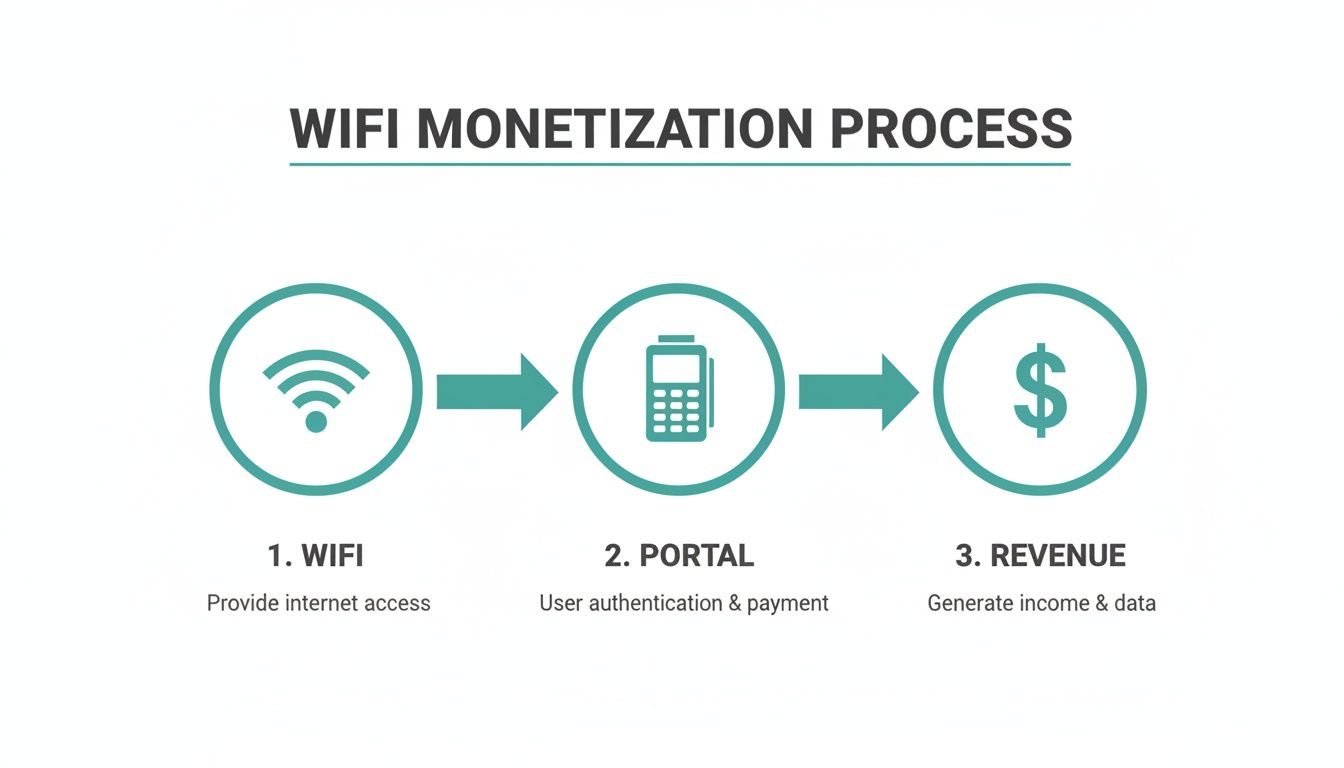
The journey from connecting to paying is direct and incredibly simple, both for your guests and for you. And because it's all running on a solid Cisco Meraki foundation, the entire interaction is stable, secure, and reliable.
Seamless Integration Across Different Environments
This kind of flexibility is crucial because a student in a dorm has very different needs than a shopper or a temporary contractor in a BYOD Corporate setting.
- Education: A university could provide a standard free network for all students but use PayLink to sell premium, high-speed access perfect for gaming, 4K streaming, or even for conference attendees visiting over the summer.
- Retail: Imagine a shopping center offering 30 minutes of free access via a social login. After that, serious shoppers or remote workers can buy a day-pass to stay connected without interruption.
- BYOD Corporate: In an office, you can offer basic guest wifi for quick meetings. For contractors or long-term visitors, you can sell weekly or monthly plans for the high-performance connection they need to get their work done.
This adaptability is what makes the system so powerful. You’re not just offering WiFi; you’re building a tiered access model that caters to every type of user.
By blending free and paid tiers, you create a guest WiFi experience that feels generous yet offers the high-performance connectivity that power users demand. It turns a standard amenity into a versatile and valuable asset.
And the best part? This approach doesn't interfere with your other Authentication Solutions. You can still run secure access methods like IPSK or EasyPSK for employees and corporate devices on the very same Cisco network infrastructure. Your internal traffic remains completely separate and secure from public access. Once you truly understand the role of your WiFi captive portal, you can design a user journey that's both intuitive and profitable.
The Strategic Benefits of Integrating PayLink
Adding PayLink to your guest wifi isn't just another feature—it's a strategic upgrade that makes your network work for you. By building a payment system directly into your Cisco Meraki powered Captive Portals, you unlock some powerful advantages that go way beyond simply offering an internet connection.
Right away, this approach turns a necessary expense into a new revenue stream. You can finally monetize your existing hardware, creating a network that pays for itself or even becomes a new profit center for your venue.
A Better Experience for Everyone
One of the biggest wins here is just how much better the user experience becomes. A tiered access model means you can cater to everyone, from the casual browser to the serious power user.
- Casual Guests: They can still connect for free using a quick social login or a time-limited pass. This is perfect for someone doing a quick check-in at a Retail store.
- Power Users: Guests who need a solid, high-speed connection for business meetings or streaming content are usually more than happy to pay a small fee for a premium experience. This is especially true in Education or BYOD Corporate settings.
This flexibility gets rid of the old "one-size-fits-all" problem of traditional free guest wifi, where everyone gets stuck with slow speeds during busy times. It simply gives users a choice, which leads to much happier guests.
Smarter Network and Bandwidth Management
Segmenting users into paid and free tiers is also a huge help for network management. By dedicating more bandwidth to your premium users, you can cut down on congestion and keep your network resources free for critical business operations on your Cisco network.
This is particularly important for corporate networks that need to keep secure Authentication Solutions like IPSK and EasyPSK running without a hitch for employees.
With PayLink, you can guarantee a quality experience for those who need it most, without sacrificing the free access that many visitors have come to expect. It strikes the perfect balance between hospitality and performance.
This level of control doesn't just improve performance; it also gives you incredibly valuable data. There's a reason the Wi-Fi analytics market is booming. Valued at USD 7.32 billion in 2026, it's projected to hit USD 17.98 billion by 2031, growing at a blistering 19.65% CAGR. Cloud deployments are leading the charge, holding over 62% of the market share, making scalable solutions ideal for campuses and hotels.
Understanding this data is a core part of any modern WiFi marketing platform. To dig deeper into the broader world of payment solutions and their strategic impact, you can find some great insights from payment experts. Putting a system like PayLink in place helps you tap into these trends, turning simple connectivity into a measurable business asset.
How Different Industries Use PayLink
The real magic of a PayLink system isn't just the tech itself—it's seeing how it solves real-world problems in different settings. While the underlying function is the same, the way it's applied on Cisco Meraki networks can look wildly different from one industry to the next.
This isn't some cookie-cutter solution. Think of it as a versatile tool that adapts to the specific demands of a busy university campus, a high-end shopping mall, or a secure corporate office. Let's dig into how these places are putting payment links to work.
Education Campuses and Dormitories
In any Education setting, reliable internet is simply non-negotiable. Universities are cleverly using PayLink to build tiered Wi-Fi systems that serve everyone on campus. They might offer a basic, free connection in common areas for light browsing, but in student dorms, a premium paid tier delivers the high-speed, low-latency connection essential for streaming, online gaming, and demanding academic research.
This model is incredibly flexible and extends to other campus events too:
- Summer Conferences: When the campus hosts visiting academics or guests, they can buy short-term, high-performance Wi-Fi passes directly from the Captive Portals. This turns the network into a revenue generator during what are typically quieter months.
- Sporting Events: Stadiums and arenas can offer fans a paid premium Wi-Fi option, ensuring they can stream highlights and post to social media without battling a slow, congested network.
This strategy gives students the robust connectivity they expect while creating a network model that can actually pay for itself.
Retail and Shopping Centers
For the Retail world, PayLink is all about elevating the shopper experience and capturing useful data. A popular approach is to offer a limited window of free guest wifi—maybe 30 minutes—in exchange for a social login. This social wifi connection is a goldmine, giving the shopping center valuable marketing insights from the get-go.
When that free time runs out, shoppers who need to stay online longer—perhaps while grabbing lunch or working from a coffee shop—can easily purchase an unlimited day pass. This hybrid model keeps casual visitors happy while monetizing the connection for those who see real value in it. It's a smart play in a growing market; the global guest Wi-Fi provider space, recently valued at USD 2.5 billion, is expected to skyrocket to USD 12.9 billion. For retailers, this translates into using analytics to understand foot traffic and boost return rates by up to 20% with well-timed campaigns. You can discover more insights about these connectivity platforms and their growth.
Corporate and BYOD Environments
In a BYOD Corporate environment, everything comes down to network security and segmentation. PayLink is a perfect fit here, allowing businesses to provide a basic, time-limited internet connection for guests in for quick meetings. Crucially, this keeps all public traffic completely isolated from the secure internal network.
By layering access tiers, a corporate network can safely accommodate visitors without compromising the performance or security of employee connections managed through robust Authentication Solutions.
For visitors staying longer, like contractors or consultants, companies can sell weekly or monthly access passes. This gives them the reliable, high-speed connection they need to be productive, but without the headache of complex IT onboarding. This setup slots in perfectly alongside more permanent Authentication Solutions like IPSK and EasyPSK, which are reserved for trusted employees and company devices. For some businesses, especially in hospitality, this model can make a huge difference to the bottom line. You can check out our guide on how to increase hotel revenue for more ideas.
Choosing the Right WiFi Authentication Mix
A PayLink system is a fantastic tool for getting a return on your guest WiFi, but it rarely stands alone. The most successful networks, especially those built on platforms like Cisco Meraki, blend several Authentication Solutions to create a flexible and welcoming experience for every visitor. Think of it less as picking one tool for the job and more like building the perfect toolkit for your specific venue.
By combining different methods, you can cater to every type of guest, from a one-time visitor grabbing coffee to a long-term contractor on-site for a month. This layered approach ensures you’re not leaving money on the table while still providing the right level of access for everyone who walks through your door.
PayLink and Vouchers
Vouchers are just pre-generated codes that grant network access for a set amount of time. They’re perfect for controlled environments like conferences or hotel meeting rooms, where you want to give a specific group guaranteed access without making them pull out a credit card. The big drawback? They require someone to physically or digitally hand them out, which isn’t very scalable.
- Vouchers: Best for events, VIP guests, or short-term controlled access. Think of it as a pre-paid ticket to your WiFi.
- PayLink: Ideal for self-service payment in public spaces like Retail centers or university Education campuses where handing out vouchers one by one just isn’t feasible.
These two can work together seamlessly. A hotel could use vouchers for its conference attendees while offering PayLink in the lobby for the general public, all running on the same Cisco Meraki hardware.
PayLink and Secure Protocols like IPSK
When you're dealing with a corporate environment, security is everything. This is where protocols like IPSK (Individual Pre-Shared Key) and our own EasyPSK come into play. These methods aren't for monetizing casual guests; they’re designed for securely onboarding trusted devices in a BYOD Corporate setting. Each user or device gets a unique key, which is worlds more secure than a single shared password plastered on the wall.
PayLink handles your public-facing guest traffic, creating a clean separation from your secure internal network. This lets you welcome visitors and generate revenue without ever compromising the integrity of your corporate data managed by IPSK or other advanced Authentication Solutions.
This segmentation is crucial. PayLink takes care of the transient, public traffic, while IPSK secures the long-term, trusted devices. They serve completely different masters but work in perfect harmony on the same physical network.
PayLink and Social WiFi Login
For marketing-focused venues like restaurants, bars, and Retail shops, this is easily the most powerful combination. A social wifi login lets guests connect for free simply by authenticating with a social media account. In return, you get valuable, opt-in marketing data and a direct channel to engage with your customers.
Pairing a social login with PayLink creates a fantastic tiered model that gives users a choice:
- Free Tier (Social WiFi): Offer a basic, speed-limited connection for a short period—maybe 30 minutes. This is your "freemium" option that builds your marketing list and gets people online fast.
- Premium Tier (PayLink): Once the free time is up, or if a user needs faster speeds right away, you can prompt them to upgrade to a high-speed, unlimited connection via PayLink.
This approach puts the user in control, massively improves the guest wifi experience, and turns your network into a powerful engine for both marketing and direct revenue.
Comparing WiFi Authentication Methods
So, how do all these methods stack up against each other? It's not about one being "better" but about which one is right for a specific job. This table gives you a side-by-side look at PayLink versus other common guest wifi Authentication methods to help you choose the right mix for your venue.
| Method | Best For | Key Advantage | Key Limitation |
|---|---|---|---|
| PayLink | Public venues (airports, hotels), self-service premium access. | Fully automated revenue generation, no staff needed. | Requires users to have a payment method. |
| Vouchers | Conferences, events, VIP guests, managed access. | High control over who gets access and for how long. | Requires manual distribution and management. |
| IPSK/EasyPSK | Corporate BYOD, long-term contractors, secure devices. | High security with unique keys per user/device. | Not suitable for short-term, public guest access. |
| Social Login | Retail, hospitality, marketing-focused venues. | Gathers valuable, opt-in marketing data. | Privacy concerns for some users; limited revenue. |
| Payment Terminal | Venues with a reception desk (hotels, campsites). | Familiar, in-person transaction for less tech-savvy users. | Creates queues and requires staff involvement. |
Ultimately, the goal is to build a flexible system. By combining two or more of these methods, you create a guest wifi network that serves every user's needs while helping you achieve your business objectives, whether that's revenue, security, or marketing.
Getting Started with PayLink on Your Meraki Network
So, you're ready to launch a paid Wi-Fi service on your Cisco Meraki network? The great news is that getting started with PayLink through Splash Access is surprisingly simple. You definitely don’t need to be a network engineer to transform your guest wifi from a necessary expense into a new source of revenue.
Everything is handled through an intuitive, cloud-based dashboard. This is your mission control for bringing your paid Wi-Fi vision to life—from designing custom Captive Portals to securely linking your payment gateway. We designed the process to make network monetization an easy and rewarding project, whether you're running a campus in Education, a shop in Retail, or managing a BYOD Corporate environment.
Building Your Tiered Access Model
The first step is simply deciding what you want to offer your guests. Inside the Splash Access dashboard, you can create different access tiers with just a few clicks. This flexibility is what makes the system so powerful.
- Configure Free Access: Want to offer a taste for free? You can set up a basic tier using social login or a simple form to capture marketing data, easily limiting it by time or speed.
- Set Up Paid Plans: This is where PayLink shines. You can create multiple paid options—think hourly, daily, or weekly passes—at different price points to give users choices that fit their needs.
- Integrate Other Methods: The system plays nicely with other Authentication Solutions. You can still run secure access methods like IPSK and EasyPSK for staff or trusted devices without any conflict.
The beauty of the platform is its "build-your-own" approach. You can mix and match free, paid, and secure access options on the same Cisco Meraki network to create the perfect user journey for your specific venue.
From there, you just need to connect your preferred payment provider. If you're looking for more information on that part of the setup, our guide to payment gateway integration walks you through the whole process.
Once you go live, the dashboard becomes your command center for real-time monitoring. You can track revenue, see which plans are the most popular, and adjust your offerings on the fly to maximize both guest satisfaction and your return on investment. It’s a complete solution for launching and managing a professional paid Wi-Fi service.
PayLink FAQ: Your Questions Answered
When you're thinking about adding a paid Wi-Fi option, a lot of questions come up. Let's walk through some of the most common ones we hear, from payment security to the actual guest experience.
How Do I Know My Guests' Payment Info is Safe?
This is a big one, and rightly so. We've built PayLink to integrate directly with trusted, PCI-compliant payment giants like Stripe and PayPal. Every bit of transaction data is fully encrypted.
Crucially, Splash Access never sees or stores any credit card details on our servers. The entire transaction happens securely within the payment gateway, giving your guests—and you—complete peace of mind right from the Captive Portal.
Can I Still Have a Free Wi-Fi Option?
Not only can you, but we absolutely recommend it. A tiered approach is often the most successful strategy.
You can set up your Captive Portal to give guests choices. For instance, you could offer a free, speed-limited session for 30 minutes, an option to log in with a social wifi account, and then the premium paid tier via PayLink for anyone needing faster speeds or longer access.
This kind of flexibility is a game-changer. We see it used all the time in Education, Retail, and BYOD Corporate environments to perfectly balance guest expectations with the organization's goals.
What Extra Hardware Do I Need to Buy?
None. That’s the beauty of it.
PayLink is designed from the ground up to work with the Cisco Meraki hardware you already have. There’s no extra box to install. Everything is managed in the cloud through the Splash Access dashboard, which talks directly to your Meraki access points to handle the custom portal and user access. It works hand-in-hand with other secure Authentication Solutions like IPSK and EasyPSK.
Ready to see how your guest Wi-Fi can become a real asset? Find out how Splash Access can help you monetize and manage your Cisco Meraki network. Learn more at Splash Access.