Let's get straight to it and talk about something we all rely on every day: Wi-Fi. What if you could manage the wireless network for an entire company, a sprawling university campus, or a chain of retail stores with the same ease as controlling your smart home devices from an app? Hey, that’s the simple, powerful idea behind a cloud-managed wireless access point.
Why Cloud-Managed Wi-Fi Is a Game Changer
Think about being a hotel manager and having to walk into hundreds of rooms to manually adjust each thermostat. Now, imagine controlling all of them from a single, intelligent dashboard on your tablet. That massive leap from manual chaos to streamlined control is exactly what cloud-managed Wi-Fi does for network administration. It moves the "brains" of the network out of a dusty server closet and into an intuitive online interface you can access from anywhere.
This approach has become essential for modern organizations, particularly in sectors like Education, Retail, and corporate environments that embrace BYOD (Bring Your Own Device). These places are absolutely packed with devices, from student laptops and guest smartphones to employee tablets. Trying to manage them all the old-fashioned way is a recipe for headaches.
Simplifying Complex Network Demands
The real genius of a cloud-first system, like the one from Cisco Meraki, is how it makes complexity simple. An IT manager can sit at one dashboard and get a complete picture of the Wi-Fi network across a university campus, a dozen retail stores, or a corporate headquarters. This centralized command center is what makes handling today’s wireless demands possible.
Here’s what that looks like in practice:
- Effortless Scalability: Need to add a new access point to a store on the other side of the country? Just plug it in. The device automatically finds the cloud, downloads its configuration, and starts working. It's that easy.
- Advanced Guest Wi-Fi: You can quickly set up secure guest Wi-Fi with professional-looking Captive Portals. These can offer simple one-click access or even engaging options like social login, turning your free Wi-Fi into a valuable marketing asset, sometimes called social wifi.
- Robust Security: Implementing strong Authentication Solutions is no longer a major project. Technologies like IPSK or EasyPSK can provide a unique password for every single user or device, which is a massive security upgrade for any BYOD environment.
A cloud-managed wireless access point isn't just about getting people online. It's about delivering a secure, reliable, and intelligent connection that’s incredibly easy to manage, no matter how large or spread out your organization is.
This shift toward smarter, centralized management is more than a fleeting trend. As we've covered before in our look at why cloud-managed IT is the wave of the future, this model saves a ton of time, cuts down on costs, and frees up organizations to focus on what really matters.
Understanding The Cloud Managed Wi-Fi Architecture
So, what exactly makes a cloud managed wireless access point different from the Wi-Fi systems most of us are used to? Let's break it down. The best way to think about it is by comparing an old DVD collection to a modern streaming service like Netflix.
With a traditional on-premise Wi-Fi setup, every business location needs a physical, on-site hardware controller. This is usually a bulky box humming away in a server closet, acting as the "brain" for all the local access points. It’s a lot like owning a separate DVD player for every single TV in your house. It works, sure, but it's expensive, demands constant manual updates, and quickly becomes a huge headache to manage if you have more than one site.
The cloud-managed architecture flips this model on its head.
Instead of a physical controller at each site, the "brain" of the entire network lives securely in the cloud. This means a single IT person can manage, monitor, and update thousands of access points across countless locations—from a sprawling university campus to a national retail chain—all from a single web browser. This fundamental shift is what makes systems from providers like Cisco Meraki so powerful.
The Power Of Centralized Control
This architectural shift is about more than just convenience; it unlocks a whole new level of efficiency and control. This is especially true for multi-site organizations in Education, Retail, and corporate environments with heavy BYOD (Bring Your Own Device) usage.
From one dashboard, you can push out a new security policy, update firmware across the board, or configure a guest Wi-Fi network simultaneously across all your locations. Imagine the time and resources that saves.
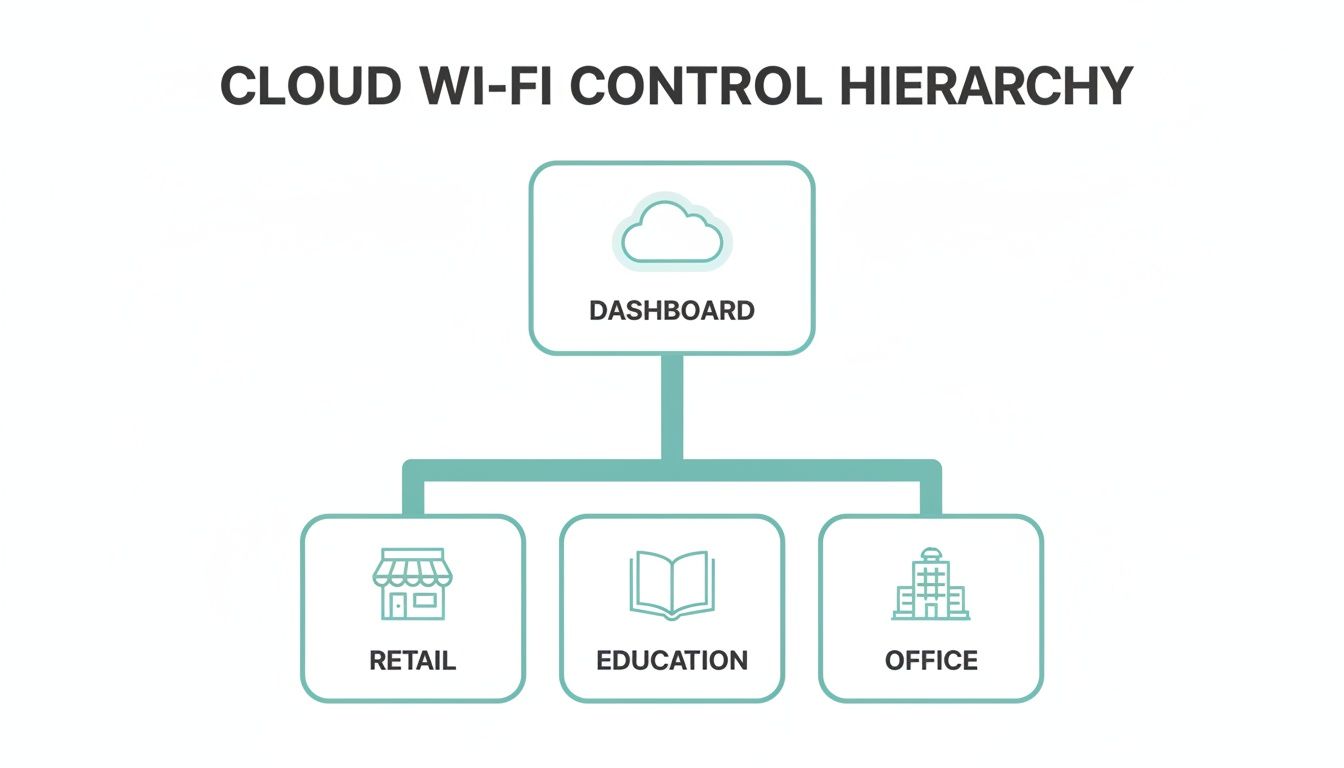
The image above perfectly illustrates this simple yet powerful hierarchy. Whether it's a bustling retail store, a busy corporate office, or a dynamic school campus, every location's Wi-Fi is managed from one unified point of control in the cloud.
To really see the difference, let's compare the two approaches side-by-side.
Cloud Managed Wi-Fi vs Traditional On-Premise Controllers
| Feature | Cloud Managed Wi-Fi (e.g., Cisco Meraki) | Traditional On-Premise Controller |
|---|---|---|
| Management Interface | Centralized web-based dashboard, accessible anywhere | Localized hardware appliance, managed on-site or via VPN |
| Initial Cost | Lower upfront hardware cost (no controller purchase) | High upfront cost for hardware controller and licenses |
| Scalability | Extremely simple; add APs and they auto-configure | Complex and costly; requires controller upgrades or new hardware |
| Multi-Site Management | Seamless management of all sites from a single pane of glass | Requires complex VPNs or a separate controller at each site |
| Firmware & Updates | Automated, scheduled updates pushed from the cloud | Manual updates required for each controller, often causing downtime |
| Feature Deployment | New features deployed instantly via cloud software updates | Requires firmware upgrades, and sometimes hardware replacement |
| On-site IT Needs | Minimal; "zero-touch" deployment is standard | Requires skilled IT staff on-site for setup and maintenance |
The table makes it clear: cloud management drastically simplifies nearly every aspect of running a wireless network, from initial setup to day-to-day operations. For a deeper dive, you can explore our detailed comparison of cloud versus server setups.
Seamless Guest Experiences And Security
This centralized architecture is also the foundation for creating sophisticated and secure user experiences. It allows for the easy deployment of advanced features like Captive Portals and powerful Authentication Solutions.
Imagine a retail chain wanting to offer social Wi-Fi login to customers. With a cloud-managed system like Cisco Meraki, their marketing team can design and deploy a branded social login page to every single store in just a few minutes.
Key benefits of this approach include:
- Uniform Policies: Ensure every guest, student, or employee receives the same high-quality, secure connection, no matter their location.
- Advanced Authentication: Easily implement robust security protocols like IPSK or EasyPSK. This gives each user or device its own unique key—a critical feature for securing a corporate BYOD environment.
- Effortless Scalability: Adding a new office or store to the network is as simple as plugging in a new access point. It automatically connects to the cloud, downloads the correct settings, and is ready to go.
By moving the network intelligence to the cloud, organizations gain unparalleled visibility and control. This architecture simplifies complex tasks, making it possible to deliver enterprise-grade security and user experiences with a fraction of the traditional effort.
Advanced Security and Authentication Solutions
Beyond just making management easier, a cloud-managed wireless access point brings some serious muscle to network security. Think of it as upgrading from a single deadbolt on your front door to a sophisticated security system where every person has their own unique keycard. This is where platforms like Cisco Meraki really prove their worth, turning security from a constant, hands-on chore into an intelligent, automated defense.
It all starts with the basics, like automated firmware updates that ensure your network is always patched against the latest threats without anyone having to lift a finger. Centralized policies let you decide who can access what, and from where, across your entire network with just a few clicks. It’s a much more proactive way to stay ahead of trouble.
Moving Beyond the Single Shared Password
For decades, Wi-Fi security often meant one password for everyone. This old method is not just a pain—imagine the headache of changing the password for an entire company—it's a massive security hole. If one person leaves or a single device is compromised, the whole network is at risk until that shared password is changed on every single device.
Thankfully, modern Authentication Solutions have completely changed the game. Technologies like IPSK (Individual Pre-Shared Key) and EasyPSK give your network a much stronger defensive posture by assigning a unique password to every user or device.
This approach is a huge upgrade, especially for places with lots of different devices coming and going:
- Corporate BYOD: Each employee's phone and laptop gets its own key. When someone leaves the company, you can revoke their access instantly without affecting anyone else.
- Education Sector: Every student in a university dorm can have their own personal network key. No more password sharing, and each student's devices are kept secure and isolated from their neighbors.
- Retail Environments: Staff devices can be given unique credentials, keeping them separate from the public guest wifi network and securing internal systems.
By giving every user and device its own unique key, you create a network where access is personal and controllable. This dramatically reduces the risk associated with shared credentials and simplifies the process of managing who is on your network at all times.
The Power of Granular Control and Identity
The real magic of these advanced authentication methods is their ability to tie a connection directly to an identity. It's no longer just an anonymous device on the network; it's Sarah's laptop or the tablet from the marketing department. This level of detail allows for much smarter policy enforcement. For those who need even tougher security, it's worth seeing how these systems stack up against traditional enterprise methods in our guide to 802.1X authentication.
This shift is driving major market growth. According to Strategic Market Research, the Gigabit Wi-Fi Access Point market was valued at USD 7.1 billion and is projected to hit USD 12.5 billion by 2030. Cloud-managed APs already account for 58% of enterprise setups, and that number is only expected to grow. You can explore the full market analysis on their website.
Seamless and Secure Guest Access
All this focus on security doesn't mean you have to sacrifice the user experience, especially for guests. A modern cloud-managed wireless access point makes it incredibly simple to create a completely separate and secure network just for visitors.
Using Captive Portals, you can offer login options that are both easy for guests and safe for your network:
- Social Login: Letting guests connect with their social media accounts is a popular choice that can also provide useful marketing data. This is often called social wifi.
- Simple Click-Through: For places where getting online fast is the priority, a simple acceptance of your terms and conditions is all it takes.
- Sponsored Access: In a corporate office, an employee can "sponsor" a guest's access, tying that visitor's connection to a responsible person on your team.
Ultimately, these security and authentication features do more than just protect your data. They take a huge load off of IT teams, create a safer experience for everyone, and turn your Wi-Fi from a simple utility into a smart, secure, and manageable asset.
Creating Powerful Guest Experiences with Captive Portals
This is where your Wi-Fi really begins to work for you, shifting from a simple utility to a powerful business asset. A cloud-managed wireless access point is about more than just delivering an internet connection; it’s your chance to create a branded, secure, and valuable front door for every visitor. The secret ingredient? Captive Portals.
Think of a captive portal as a digital welcome mat. It’s the branded login page that pops up before anyone can access your free guest Wi-Fi. Instead of hunting for a generic network name and typing in a cryptic password, they’re greeted by your logo, your brand colors, and a clear path to get online. It’s your first opportunity to make a great impression and guide their experience.
Platforms like Cisco Meraki are brilliant at this, letting you design and roll out a consistent, user-friendly login experience across all your sites right from one central dashboard.
Authentication Solutions That Work for You
One size rarely fits all, and the same goes for guest access. A major advantage of cloud-managed systems is their flexibility, offering a variety of Authentication Solutions you can match to your specific goals.
You can shape the connection process for different scenarios, whether you're in Education, Retail, or managing a corporate BYOD environment. For a closer look at how these login pages work behind the scenes, our guide on what a captive portal login is breaks it down perfectly.
Here are a few of the most popular options:
- Simple Click-Through Access: Ideal for places like coffee shops where getting online fast is the priority. Users just agree to your terms and are connected in seconds.
- Social Login: This is a marketer's dream. By letting users log in with their social media profiles, you can gather valuable (and permission-based) demographic data. This approach, often called social Wi-Fi, can also boost your online presence.
- Email or Form Fill: An excellent tool for growing your marketing lists. Simply ask for an email address or a few other details in exchange for free Wi-Fi.
The right captive portal doesn't just grant access; it starts a conversation. It turns an anonymous visitor into a known contact, providing insights that can fuel marketing efforts and improve the overall customer experience.
Turning Connectivity Into a Business Tool
When you get it right, especially with specialized solutions layered on top, a captive portal becomes much more than a login page. It evolves into a dynamic tool for engagement and even revenue.
For businesses in the Retail sector, this is incredibly powerful. Imagine a customer connects to your Wi-Fi and the login page immediately offers a digital coupon for an item they're standing right next to. That’s a direct marketing opportunity that can drive sales on the spot.
In hospitality or at large venues, you can create tiered access. Maybe you offer a basic free connection for checking emails, but a premium, high-speed option for guests who need to stream video or join a conference call. Suddenly, your network infrastructure is a new revenue stream.
Security Is a Top Priority
Of course, a great guest experience can't come at the expense of security. A core benefit of using a captive portal on a cloud-managed wireless access point is the ability to completely wall off guest traffic from your secure internal network.
This means you can confidently welcome visitors, students, and customers onto your Wi-Fi without ever putting your sensitive internal systems at risk. Adding technologies like IPSK or EasyPSK provides another layer of security, ensuring individual devices can be managed and secured even on a shared network. It’s this combination of easy access and ironclad security that makes it the go-to solution for any modern organization.
Different Industries, Different Wi-Fi Needs
When it comes to rolling out Wi-Fi, there’s no such thing as a one-size-fits-all solution. What works for a sprawling university campus will be completely wrong for a boutique retail shop or a high-security corporate office. The real power of a cloud-managed wireless access point is its flexibility; it can be molded to solve the very specific problems each industry runs into.
This is about much more than just getting people online. It’s about building a smart, secure, and easy-to-manage network that actually helps your business, school, or venue succeed. For instance, a system from a major player like Cisco Meraki can be configured to handle wildly different challenges across various sectors, all from a single, intuitive cloud dashboard.
Elevating the Education Experience
The modern Education environment is one of the toughest tests for any Wi-Fi network. Picture a lecture hall packed with hundreds of students, all trying to stream video at the same time. Or think about a dorm where every resident has a laptop, a phone, and a gaming console. That kind of device density can absolutely cripple an ordinary network.
This is where sophisticated Authentication Solutions are no longer a luxury—they're a necessity. Using technologies like IPSK (Individual Pre-Shared Key) or EasyPSK, you can give every single student their own unique, secure password that works across all their devices.
For schools, this approach solves several major headaches:
- Better Security: It stops password sharing in its tracks and keeps each student's devices walled off from others on the network.
- Painless Onboarding: Getting new students connected is a breeze, and when they leave, revoking their access is just as simple, all done from one central place.
- Fair Play: You can set network policies to make sure a few heavy users don't hog all the bandwidth and slow things down for everyone else.
Driving Insights in the Retail Sector
For Retail businesses, guest Wi-Fi has evolved from a simple courtesy to a serious business intelligence tool. The moment a customer connects to your network through a Captive Portal, you have a golden opportunity to learn about them and start a conversation.
By offering a social login or a quick email signup on the captive portal, retailers can transform an anonymous browser into a known customer. This data is pure gold for fueling marketing campaigns, loyalty programs, and personalized offers that bring people back.
Beyond that, a Cisco Meraki cloud-managed wireless access point can deliver amazing analytics on foot traffic. You can actually see how many people walk through your doors, how long they stick around, and how often they return. This kind of information is priceless when you're making decisions about store layout, staffing levels, or marketing promotions.
Securing the Modern Corporate Environment
In the corporate world, the BYOD (Bring Your Own Device) trend has thrown a major wrench into network security. Employees want—and expect—to connect their personal phones, tablets, and laptops to the company Wi-Fi. The challenge for IT is letting them do that without opening the door to security threats.
A cloud-managed solution is built for this exact scenario. It makes it easy to create separate, segmented networks for different kinds of users and devices:
- Corporate Network: A fortress for company-owned devices, with strict access rules and high-level security.
- BYOD Network: A separate lane for employee-owned devices, often using IPSK to assign each person a unique key for their personal tech.
- Guest Network: A completely isolated bubble for visitors, managed with a Captive Portal that ensures guest traffic never comes close to sensitive company data.
This knack for securely segmenting traffic isn't just a feature; it's a cornerstone of modern corporate security. It gives employees the convenience they want while providing the robust protection the business absolutely needs.
The growing demand for these smart, secure, and adaptable networks is what's behind the market's explosive growth. According to Verified Market Research, the cloud-managed Wi-Fi market is expected to hit USD 20.04 billion by 2032, climbing at an impressive CAGR of 18.20%. This surge is directly tied to the need for better, more intelligent connectivity in just about every service-focused industry. You can learn more about these market growth insights from Verified Market Research.
Tying Your Wi-Fi into Your Business Systems
Your Wi-Fi network shouldn't just be an isolated utility sitting in the corner. When you're using a cloud-managed wireless access point, it can become a powerful hub that connects directly to your most important business tools, turning what was once a simple internet connection into a wellspring of business intelligence.
This is where platforms like Cisco Meraki really come into their own. Their knack for integration means you can bridge your Wi-Fi with other systems, creating automated processes that save serious time and unlock new possibilities. It’s all about getting your tech to talk to each other.
Hooking Wi-Fi into Your Marketing and Sales Engine
One of the smartest moves you can make is linking your Captive Portals directly to your marketing and CRM platforms. When a guest logs onto your Wi-Fi, the information they share doesn't have to just sit there—it can be put to work immediately.
Think about it in real-world terms:
- Automated Marketing Lists: A customer walks into your shop and uses a social login to get on the guest wifi. Just like that, their email is automatically funneled into your mailing list for the next big sale.
- Richer Customer Profiles: That same login data syncs right up with your CRM, adding another layer of detail to their profile. Now you know they visited a specific store on a particular day, which is gold for personalizing future offers.
In a corporate setting, the advantages are just as compelling. Enterprise-level integrations with identity providers enable secure, frictionless single sign-on (SSO). This means when an employee logs into their laptop, they’re instantly and securely authenticated on the corporate Wi-Fi. It massively simplifies access while keeping the network locked down, even for BYOD devices.
A truly smart network doesn't just provide a connection; it connects systems. By integrating your cloud-managed Wi-Fi with other business tools, you create a seamless flow of information that drives efficiency and uncovers valuable insights.
This kind of deep connectivity is driving massive industry growth. Wireless access points are being adopted at a blistering pace, fueled by bandwidth-hungry cloud apps in offices, healthcare facilities, and senior living communities. In fact, Technavio projects the market will surge by USD 8.14 billion between 2024 and 2029 as more organizations demand top-tier connectivity. You can learn more about these market growth drivers at Technavio. To get a better handle on how different systems can work together, it's worth reviewing some foundational system integration concepts.
Unlocking New Revenue and Operational Efficiencies
Beyond marketing, these integrations can open up entirely new revenue streams and smooth out your day-to-day operations. For instance, in a hotel or co-working space, you can tie your Wi-Fi directly to a billing system. This lets you offer premium, high-speed access tiers for guests who need that extra bandwidth for video calls or large file transfers. Our guide on payment gateway integration walks through how this can turn your network into a direct revenue source.
When you get right down to it, integrations transform your cloud managed wireless access point from a simple cost center into a genuine strategic asset. Whether you’re building better customer profiles, securing corporate access, or creating new paid services, a connected network is always a smarter, more valuable network.
Frequently Asked Questions About Cloud Managed Wi-Fi
Switching up your network tech always comes with a few questions. Let's tackle some of the most common ones we hear about moving to a cloud managed wireless access point.
Is Cloud Managed Wi-Fi Secure Enough for My Business?
It’s a fair question, and the answer is a resounding yes. Security isn't an afterthought with platforms like Cisco Meraki; it’s built into their very foundation.
Think of the link between your access points and the cloud as a heavily armored, encrypted tunnel. All the management data travels through it, completely secure. But here's the key part: your actual user traffic—the sensitive files, customer data, and internal communications—never leaves your local network. It stays right where it should be.
On top of that, these systems are loaded with serious, enterprise-grade security tools:
- Advanced Authentication: Forget simple, shared passwords. Features like IPSK and EasyPSK let you issue a unique key for every single device. This is a game-changer for managing corporate BYOD policies, especially in busy Retail and Education environments.
- Built-in Defenses: You get integrated firewalls and intrusion prevention systems that are always on, actively protecting your network from threats.
- Effortless Updates: The cloud automatically pushes security patches and firmware updates to every access point. This means you're always protected from the latest vulnerabilities, and your IT team doesn't have to lift a finger.
What Happens If My Internet Connection Goes Down?
This is probably the biggest "what if" people have, and the answer is reassuring. If the connection between your access points and the cloud dashboard drops, your local Wi-Fi network keeps humming along without a single hiccup.
Your employees, guests, or students can still connect to Wi-Fi, access local servers and printers, and get online just as they normally would. The access points are smart enough to operate on their last known configuration.
The only thing you lose temporarily is the ability to manage the network from the cloud dashboard or view real-time data. The moment the internet connection is back, everything syncs up automatically.
How Hard Is It to Set Up a New Access Point?
Honestly, this is where cloud-managed Wi-Fi really shines. The process, often called "zero-touch provisioning," is incredibly simple. You can log into your Cisco Meraki dashboard and configure new access points before they've even been shipped to your office.
Once the hardware arrives on-site, anyone—not just a network engineer—can plug it into an internet-connected port. The AP then phones home to the cloud, downloads its configuration, and is fully up and running in minutes.
This makes deploying Wi-Fi across dozens of retail branches or an entire school district ridiculously efficient. You eliminate the need to send a skilled technician to every single location, which also makes it easy to create powerful guest wifi experiences with Captive Portals and social login options right from the start.
Ready to transform your network management and create powerful user experiences? Splash Access integrates directly with Cisco Meraki to deliver all these capabilities and more. Explore how Splash Access can benefit your business.