Hey there! Ever found yourself typing "walled garden tm" into a search engine, trying to figure out what it actually means? It might sound like some complex tech jargon, but the idea is actually super straightforward and incredibly powerful. Think of it as a controlled digital space, like a VIP lounge where you, the host, decide who gets in and what they experience first.
What Is a Walled Garden in Guest Wi-Fi?
Honestly, the name itself is the perfect analogy. Picture a beautiful, classic walled garden—it’s an exclusive area, intentionally walled off from the world outside. Inside, the owner has hand-picked everything, from the flowers to the fountains.
A digital walled garden works the same way, creating a controlled online environment for users before they get full-blown internet access. This is a total game-changer for any business offering guest Wi-Fi.
When someone connects to your network, they don't just jump straight onto the web. They first land in your custom-designed space. This is where a Captive Portal steps in, acting as the friendly digital gatekeeper to your garden.
A Quick Comparison
Just to clear things up, the term "walled garden" gets used in both marketing and networking. While the core idea of a controlled environment is the same, how it's used is quite different.
Walled Garden Concepts at a Glance
| Concept | Marketing Walled Garden | Networking Walled Garden (Captive Portal) |
|---|---|---|
| Who Controls It? | Large tech platforms | The business providing the Wi-Fi network |
| What's Controlled? | User data and access to advertising ecosystems | Initial internet access and user journey |
| User Experience | Seamless within the ecosystem, but data is not portable | An initial login/interaction step to gain access |
| Primary Goal | Monetize user data and keep users on-platform | Enhance security, brand engagement, and data capture |
So, when we're talking about guest Wi-Fi, we're focusing on the networking definition—using a captive portal to create that initial, branded experience.
The Role of Cisco Meraki and Captive Portals
The foundation for these digital spaces is built on robust networking hardware from leaders like Cisco Meraki. The captive portal is the front door—that branded splash page a user sees right after connecting. It requires them to take an action before they can surf the web, and that moment is your golden opportunity.
Instead of just handing out free Wi-Fi, you create a meaningful touchpoint. This approach is incredibly effective across all sorts of industries:
- Education: Schools can keep their main networks secure for students and staff using Authentication Solutions like IPSK or EasyPSK, while visitors are directed to a simple guest login.
- Retail: A store can offer social Wi-Fi login options, gathering valuable marketing insights in exchange for a connection. Suddenly, a basic amenity becomes a powerful tool for understanding customers.
- BYOD Corporate: In the office, managing guest access and personal devices (BYOD) is a huge security concern. A walled garden ensures guests are authenticated safely, without ever touching the sensitive internal network.
This controlled entry point is far more than a login screen; it’s a strategic asset. By having users pass through this gate, you control their initial experience. You can show them a promotion, ask for feedback, or just reinforce your brand. For a deeper dive into the technical setup, you can learn more about configuring walled garden IP ranges.
At its heart, a walled garden on your guest Wi-Fi network transforms a cost center into a strategic tool. It's about shifting from passively providing internet to actively engaging with every person who connects in your space.
Ultimately, the search for "walled garden tm" shows that people are trying to grasp this strategy. The "TM" suggests they're looking for some official, trademarked definition, but the real value is in how it's used. It’s all about creating a secure, branded, and insightful experience for anyone using your guest wifi.
The Two Types of Walled Gardens: Marketing vs. Networking
When people talk about a "walled garden," they could mean one of two very different things. On one hand, you have the massive, closed ecosystems run by Big Tech. On the other, you have the private, controlled network environment you can create for your own business. It's easy to mix them up, but understanding the difference is the first step toward owning your customer relationships.
Let’s start with the giants—the marketing walled gardens. Think about the big platforms that dominate the online world. They've built enormous, self-contained digital worlds where they control absolutely everything: the user data, the content, and the rules for advertising.
Picture a huge, exclusive shopping mall. The mall owner knows every single thing about the shoppers—which stores they visit, how long they linger, what they browse, and what they ultimately buy. But the individual shops inside that mall? They get almost none of that incredibly rich insight. That's a marketing walled garden in a nutshell. They hold a monopoly on user data, which makes it extremely difficult for businesses like yours to build a direct line to your audience.
The Rise of Marketing Walled Gardens
The concept of a digital "walled garden" isn't new; it dates back to early internet service providers in the 1990s. But it really took off with the explosion of global, ad-funded platforms in the 2010s. By 2017, certain companies were already dominating digital ad revenue worldwide. In fact, recent data shows that in 2023, the open internet only saw about 22% of global digital ad spending. The other 78% was swallowed up by these walled garden ecosystems.
This is where the second type of walled garden comes into play—the one you can build. This diagram shows how a networking walled garden gives you control across different environments.

As you can see, a well-managed guest Wi-Fi network becomes the central hub for engaging directly with users and gathering valuable insights, whether you're in retail, education, or a corporate setting.
Your Personal Networking Walled Garden
Now, let's switch gears and talk about the walled garden you can build yourself. A networking walled garden is simply a localized, controlled digital environment that you create using your guest Wi-Fi. By pairing powerful hardware from providers like Cisco Meraki with a smart Captive Portal, you transform your free Wi-Fi from a simple utility into a strategic gateway.
This is your garden. When a visitor connects, they aren't just getting free internet. They first land on your branded splash page. This is a crucial moment—a direct point of contact that happens before they head out to the wider web. It’s your chance to interact with them on your own terms.
This strategy is incredibly powerful in all sorts of places:
- Retail: A clothing boutique can use its captive portal to offer an instant discount code in exchange for an email, turning a casual browser into a known contact.
- Education: A university can give students secure access using IPSK or EasyPSK while guiding parents and visitors to a simple social Wi-Fi login, keeping the network tidy and secure.
- BYOD Corporate: A modern office can manage guest access for contractors and visitors seamlessly, all without compromising the security of the main corporate network.
By creating your own networking walled garden, you’re not just providing a service. You are building a direct channel to your visitors, reclaiming the valuable first-party data that marketing walled gardens typically monopolize.
This approach puts you in the driver's seat of the user journey from the very first connection. Instead of paying to reach people inside someone else’s ecosystem, you can build your own database of engaged users. It's the foundation for effective Wi-Fi marketing strategies that build loyalty and drive real growth, all from an amenity you're likely already offering.
Building Your Garden with Cisco Meraki Captive Portals
Alright, let's get practical. You've seen the potential of a walled garden tm, and now it's time to build one. This isn't about putting up digital fences; it's about creating a smart, controlled entry point through your guest wifi. The real trick is pairing top-notch hardware with an intelligent software layer to manage the experience.
A reliable guest Wi-Fi network starts with a solid foundation, and that's where proven hardware from companies like Cisco Meraki comes in. Their access points give you the stable, secure backbone needed for anything from a small coffee shop to a massive university campus. But the hardware is just the starting line. The real magic begins when you add a smart Captive Portal on top of it all.
Think of a captive portal as your digital doorman. The moment a guest connects to your Wi-Fi, they aren't thrown straight onto the open internet. Instead, they're guided to a branded splash page you control—the gate to your garden. This is your chance to make a first impression and engage with them directly.
Choosing the Right Authentication Solution
That splash page is far more than a simple "welcome" sign; it's a powerful tool for authentication. Depending on your business and what you want to achieve, you can offer different ways for people to log in. Picking the right Authentication Solutions is the key to making this process feel effortless for your users.
For instance, in a Retail environment, speed and convenience are everything. Offering social login or social wifi lets a customer connect with a single click using their existing social media profile. Not only does this get them online fast, but it can also provide you with valuable, anonymous demographic data to better understand who your customers are.
In an Education setting, the priorities shift to security and network segmentation. You absolutely cannot have campus visitors on the same network as students and staff.
A well-designed captive portal lets you create distinct access levels. Students and faculty might use secure credentials for full network access, while a visitor gets a simple guest login that keeps them safely firewalled from sensitive internal systems.
This is where more advanced authentication methods become non-negotiable, especially with so many personal devices on campus or in the office.
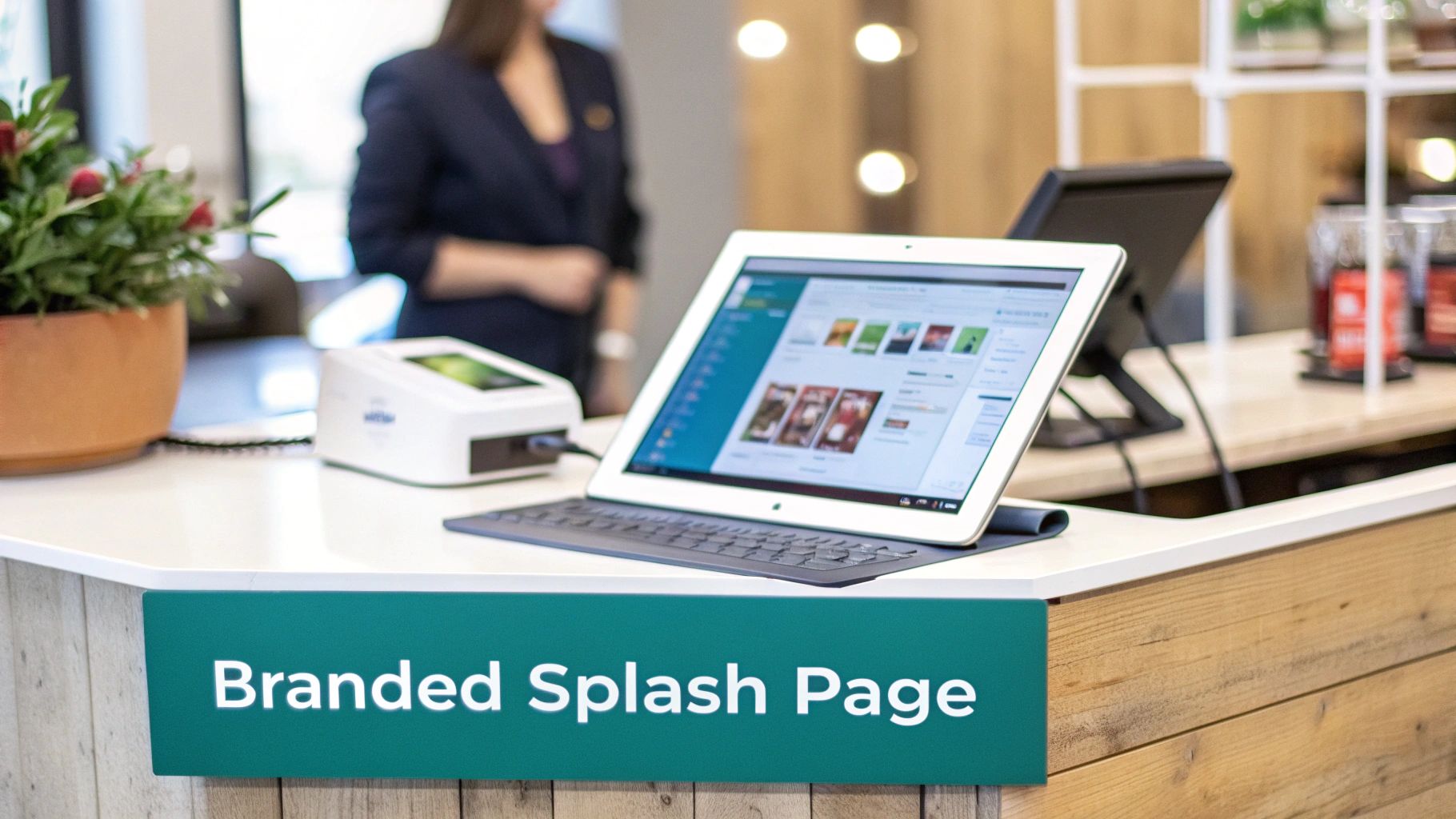
Solutions like Splash Access integrate directly into the Cisco Meraki dashboard, making it surprisingly simple to manage all these different login requirements from a single control panel. This tight integration turns what could be a complex security headache into a straightforward, manageable task.
Securing the BYOD Corporate Environment
In any modern workplace, "Bring Your Own Device" (BYOD) is just how things are done. But every personal laptop, tablet, and smartphone that connects to your network opens a potential security hole if you don't manage it properly. A single, shared Wi-Fi password for everyone simply won't cut it anymore.
This is exactly the problem that IPSK (Individual Pre-Shared Key) and EasyPSK were designed to solve. Instead of one password for the entire company, these systems generate a unique, private key for every single user or device.
- IPSK: Assigns a unique password to a specific device, giving you pinpoint control over network access.
- EasyPSK: Makes it simple to manage thousands of these unique keys, so the system can scale from a small office to a massive enterprise.
If an employee leaves the company or a device is lost, you can revoke its specific key instantly without disrupting anyone else. This brings enterprise-grade security to your BYOD Corporate network and guarantees only authorized people and devices can get online. You can dive deeper into how all these pieces come together in this complete guide on what is a captive portal for Wi-Fi.
Ultimately, building your own walled garden is about creating a secure, valuable, and seamless experience for everyone. Whether it’s a simple social login at a cafe or a high-security IPSK system at a corporate headquarters, the goal is the same: to turn a simple internet connection into a powerful strategic asset.
How a Walled Garden Strategy Drives Business Growth
This is where the rubber meets the road—connecting a technical setup like a walled garden tm to tangible business growth. It’s about so much more than just a secure login screen. You're essentially turning your physical space into a hub for real-time engagement and valuable data collection, building direct relationships with every person who walks through your door.
Boosting Loyalty in Retail and Hospitality
For any business in the Retail sector, a walled garden built on reliable hardware like Cisco Meraki is a game-changer for customer loyalty. Imagine a shopper connecting to your guest wifi. Instead of just getting online, they’re met with a branded portal—your chance to make a great first impression. You can offer an instant discount for an email signup, invite them to your rewards program, or highlight a new product line before they even take another step.
Making this process easy is key. Using simple Authentication Solutions like a one-click social login removes all the friction for the customer. In return, you get valuable, aggregated demographic data. This is first-party data at its finest, helping you understand who your customers are and what they're interested in, without paying a dime to big ad platforms.
Securing Modern Educational and Corporate Environments
In the Education world, you're constantly balancing two needs: giving guests easy access while keeping the core network locked down for students and staff. A walled garden strategy handles this perfectly. Visitors, parents, or prospective students can be routed to a simple captive portal for temporary access, keeping them safely firewalled off from sensitive internal systems.
At the same time, students and faculty can connect their own devices using more advanced and secure methods like IPSK or EasyPSK. This gives every user a unique key to the network, which is a massive win for both security and network management. This same segmented approach is absolutely essential in BYOD Corporate environments, too.
A networking walled garden gives you precise control over who accesses which parts of your network. It allows you to welcome guests and manage personal devices (BYOD) without ever compromising the security of your internal corporate data.
That level of control is non-negotiable for protecting sensitive company information while still offering the seamless connectivity that modern teams expect.
Reclaiming Your Data and Building Relationships
Ultimately, the biggest win here is taking back control of your own audience data. Tech giants built their empires by walling off user data and then charging businesses to reach their own customers. Your captive portal completely flips that script. Every social login or email signup on your guest wifi feeds directly into your own first-party database.
Having that direct line of communication is priceless. The numbers don't lie: marketing walled gardens controlled an estimated 78% of global digital ad revenue in 2022. But here's the interesting part—a 2023 report showed that U.S. consumers spent about 61% of their online time on the open internet, outside those closed ecosystems. By using captive portals, IPSK, and smart splash pages, you can capture that on-site, open-internet attention and turn it into direct, lasting relationships.
When you collect data this way, you can fuel smarter marketing and build real loyalty. Send a follow-up promotion to a recent shopper, let campus visitors know about an upcoming open house, or share a relevant whitepaper with corporate guests. For businesses ready to take the next step, exploring marketing automation integration shows just how easily this Wi-Fi data can flow into your CRM, turning a one-time connection into a long-term customer.
Best Practices for User Experience and Data Privacy
A successful walled garden tm is one people actually want to enter. The tech might be powerful, but the real magic happens when you create an experience that feels more like a welcoming handshake than a frustrating roadblock. It’s all about striking that perfect balance between a smooth user journey and a deep respect for data privacy.
The first impression is everything, and that's your captive portal's splash page. It has to be clean, mobile-friendly, and dead simple to navigate. If someone has to pinch and zoom just to find the "connect" button, you've already lost them. The goal is to get people online with zero friction.
Making the Login Effortless and Secure
The login itself needs to feel invisible. For public spaces like a café in Retail or a hotel lobby, offering social login or social wifi is a brilliant move. People can connect with a single click, which is a huge win for user experience and gives you valuable, anonymized demographic data in return.
But in Education or BYOD Corporate settings, security is the name of the game. This is where advanced Authentication Solutions like IPSK or EasyPSK become non-negotiable. These systems give each user their own unique key to the network, locking things down tight without making them jump through hoops every time they connect.
The best guest Wi-Fi feels invisible after the first connection. A user logs in once, and their device is remembered on future visits, creating a seamless and secure experience that builds trust.
Remember, a beautiful splash page doesn't mean much if the internet connection crawls afterward. The entire experience, from the moment they connect to the speed of their browsing, reflects directly on your brand.
Prioritizing Transparency and Data Privacy
Collecting user data is a big responsibility. Being upfront about why you need it isn't just good manners—it's a legal requirement under regulations like GDPR. Your splash page should clearly and simply explain what information you're collecting and what you'll do with it.
This kind of transparency is what builds trust, and trust is the bedrock of any good customer relationship. When people understand the value exchange—say, their email address for great Wi-Fi—they're far more willing to play along. It's vital to know your obligations; you can find great resources on how platforms like Cisco Meraki handle compliance, such as guides on Meraki and the GDPR.
To maintain that trust and protect the data within your walled garden, it's a smart move to regularly prevent data breaches with a website security audit. Taking this proactive step shows you're serious about protecting the information people have shared with you.
By focusing on a clean design, easy login options, and transparent data policies, your walled garden becomes a huge asset. It turns your guest wifi from a simple utility into a powerful tool for building real relationships based on trust and a great user experience.
Your Digital Front Door: Building Your Own Garden
We've talked about the massive walled gardens built by tech giants—the big names who control so much of our online experience. But what about the time people spend on the open internet while they're physically inside your space? That’s a massive, often overlooked opportunity to build your own garden.
By pairing powerful Cisco Meraki hardware with a smart Captive Portal, you’re not just offering Wi-Fi; you're building a digital front door. This gives you a direct connection to your visitors at the most important moment: when they are right there with you, completely outside the influence of those larger ecosystems.
The Real Story of the Open Internet
It’s easy to get fixated on the ad revenue commanded by the big platforms. Some forecasts even predict the open internet's slice of the global digital ad revenue pie will shrink from 22% in 2023 to just 17% by 2027.
But that’s only half the picture. Look at how people actually spend their time. The average time spent daily on the open internet has skyrocketed from less than two hours in 2014 to over five hours in 2023. Tools built for Cisco Meraki give you a way to tap into those five hours, turning a simple Wi-Fi connection into a valuable, first-party relationship. You can see the data on these digital advertising trends for yourself.
This is where your strategy clicks into place. A shopper in a Retail store using social login, a student on an Education campus signing in with EasyPSK, or a guest in a BYOD Corporate office connecting to the network—they are all stepping through your door first.
More Than Just Free Wi-Fi
The takeaway here is simple: stop thinking of Wi-Fi as just a free utility. It's time to start building a smart, secure digital entryway for your business. This is how you create your own walled garden tm and carve out your own space in a world of giants.
Your guest Wi-Fi is more than an amenity; it's a strategic tool for engagement and data ownership. By creating a controlled, branded experience, you turn a cost center into a powerful asset that builds direct customer relationships.
It doesn’t matter if you’re using a straightforward social wifi login or more advanced Authentication Solutions like IPSK. The goal is the same: create a controlled, valuable experience that benefits both you and your visitors. It’s about owning that first handshake, gathering insights, and building a community, one connection at a time. This is your digital front door, and you hold the key.
Frequently Asked Questions
When you start digging into guest Wi-Fi, a few common questions always seem to pop up. Let's clear the air on some of the big ones so you can see how a walled garden tm strategy fits into your own setup.
Is a Captive Portal the Same as a Walled Garden?
They're not the same thing, but they're definitely a team. A "walled garden" is the bigger idea—it's the controlled, curated digital space you create for your visitors. The Captive Portal is the tool that makes it happen.
Think of it like this: the walled garden is an exclusive party, and the captive portal is the friendly bouncer at the door. It's the splash page that pops up on your guest wifi, acting as the gateway to that controlled environment.
Will a Captive Portal Slow Down My Guest Wi-Fi?
This is a worry I hear all the time, but a well-built system won't cause any lag. When you use solid, enterprise-grade hardware from companies like Cisco Meraki and pair it with an efficient platform, the whole login process is practically instant. That quick moment a guest spends on your splash page is nothing compared to their entire time online.
The trick is making sure your network can handle the traffic and the captive portal software is built for speed. Get that right, and your guests will get a smooth, fast connection without any frustration.
What Is the Difference Between WPA2 and an IPSK Solution?
This question really gets to the core of network security. Your standard WPA2 guest network usually relies on one password for everyone—something like 'GuestPassword123' taped to the counter. It’s easy, but it’s not secure. If one person shares it, everyone has access, and kicking someone off means changing the password for the entire building.
An Individual Pre-Shared Key (IPSK) or a dynamic approach like EasyPSK is a game-changer. It creates a unique, private password for every single user or device. This is a much smarter, more secure way to manage access, especially in Education or BYOD Corporate settings.
With IPSK or EasyPSK, you can finally get a handle on who's on your network.
- Grant individual access: No more shared passwords. Everyone gets their own key.
- Track usage: See exactly who is connected and when.
- Revoke access instantly: When an employee leaves or a device goes missing, you can disable their specific key in a second without disrupting anyone else.
This isn't just basic guest access; it's one of the most robust Authentication Solutions out there. It transforms your Wi-Fi from a potential liability into a securely managed asset.
Ready to build a digital front door for your own network? With Splash Access, you can create a secure, branded, and insightful guest Wi-Fi experience on your Cisco Meraki hardware. See what's possible and get started today.